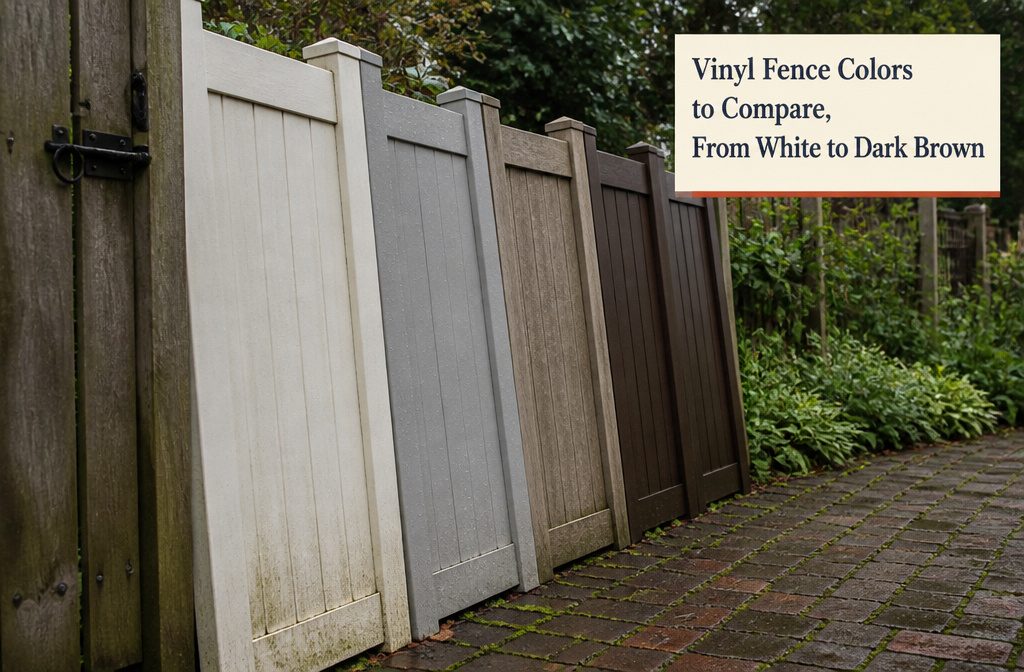
If you hate cleaning, choose gray over white, since white shows dirt, pollen, and algae right away.
Gray costs slightly more than white, about $53–80 per foot installed for a privacy fence, and fewer suppliers stock it. Get a sample before committing, because vinyl can’t be painted later.
1. White Vinyl Fence
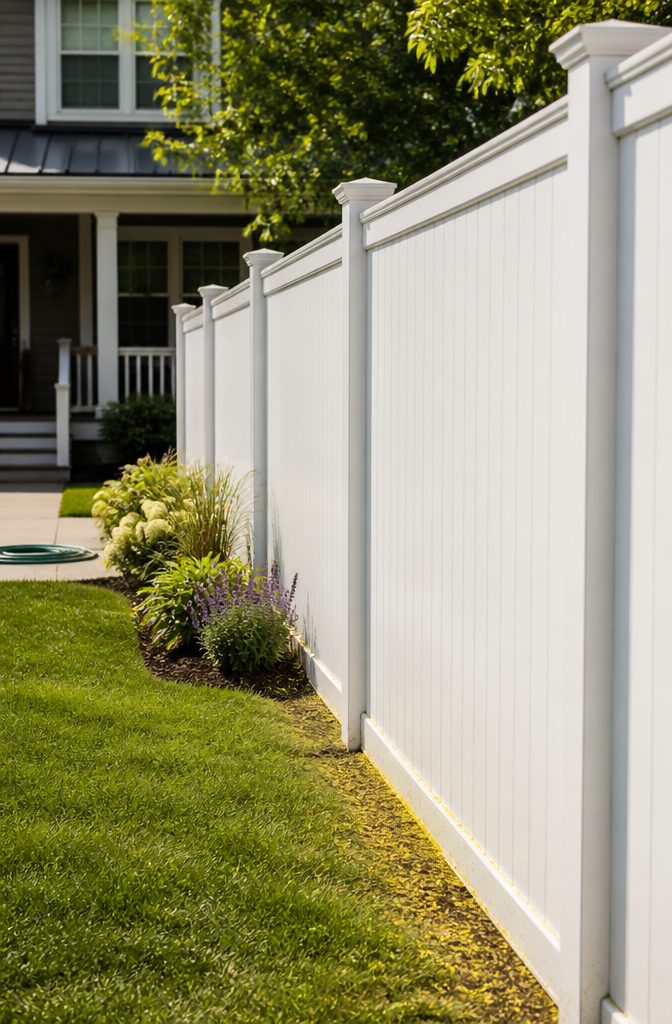
White is the timeless choice, and it suits modern and traditional houses equally well. It also fades slowest and stays coolest in direct sun, since UV stabilizers and titanium dioxide protect light tones from chalking.
The price is upkeep: white shows dirt, pollen, and algae right away, so it only looks crisp while it’s clean.
I’d pick white for a front yard, a traditional neighborhood, or a hot, sunny lot. I’d skip it if you don’t want to hose panels down regularly.
Tall solid white panels can also feel like a wall in a small yard. Vinyl can’t be repainted well later, so settle on white before install.
Recommended Products

Backyard Privacy Enclosure: Our vinyl fence panel set includes 3 panels measuring 50 x 50 in, ideal for concealing outdoor items like trash bins, pool equipment, and air conditioners, keeping your backyard neat and attractive while meeting HOA guidelines

EASY ORDERING: Everything you need for your fence project is in the box except for the final post. Only ONE additional post, BL19112, is required for the end of your project. A gate is available by searching BL19111.
2. Tan, Beige, and Clay
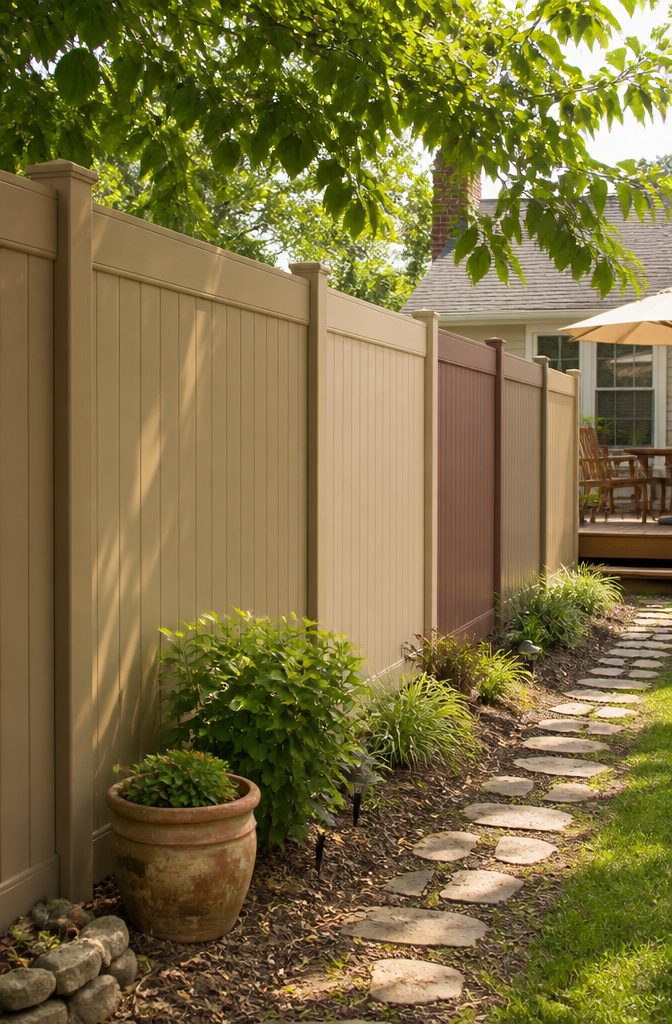
Tan and beige read warmer than white and sit comfortably beside wood decks, mulch beds and other natural plantings, which is why they suit traditional homes.
Dirt, pollen and mildew show less than on white, so the fence goes longer between washings. Expect to pay slightly more than for white, about $53–80 per foot installed for a solid privacy style, and expect fewer suppliers to stock it.
Because the color is baked into the vinyl, it won’t chip, but cheap tan vinyl can look builder-grade, so I’d spend on the panel quality before the color.
Clay is rarer and costs more still. Some manufacturers list it next to Tan in a standard solid line, but many installers don’t carry it.
Recommended Products

Fast, Effective Repair Of Vinyl Fence Holes, Cracks, and Damage.
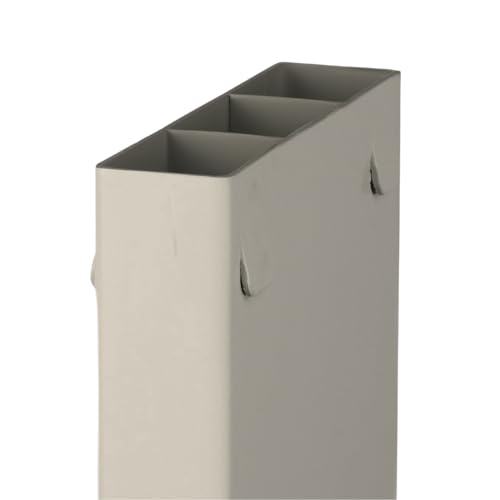
REPLACEMENT RAIL: Made to replace damaged 1.5” x 5.5” rails for vinyl fencing panels. The Weatherables Ribbed Top Rail is the perfect replacement for your outdoor fence. Available in 6ft and 8ft lengths.
3. Gray Vinyl Fence
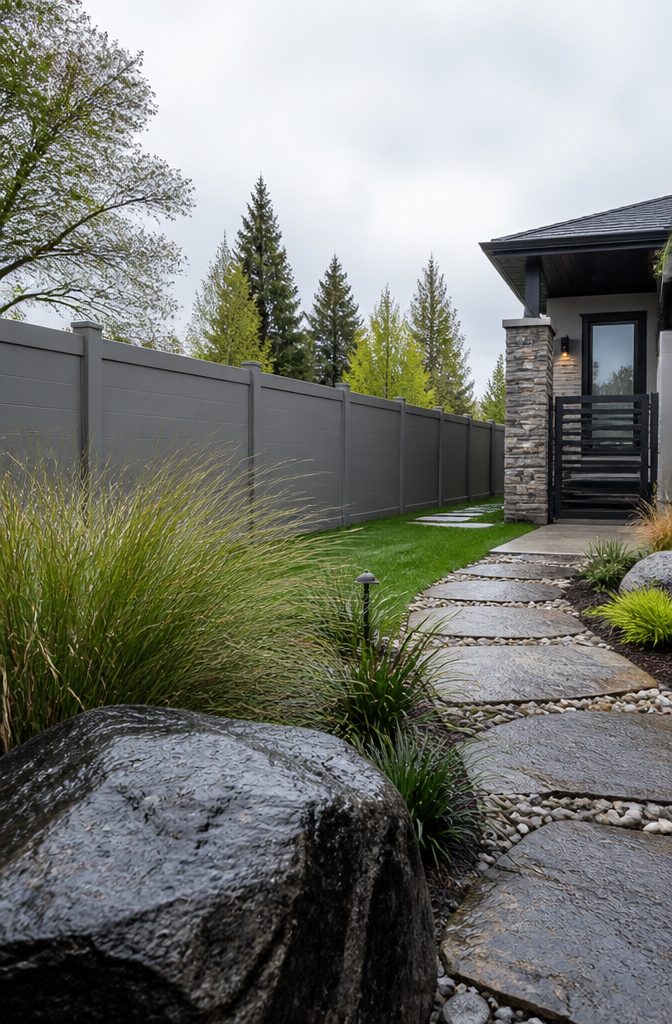
Gray hides dirt, pollen and mildew far better than white, so if you hate cleaning, skip white and go gray.
It leans modern and looks right beside stone or metal accents on a newer house. The color is baked into the vinyl rather than painted on, so a scratch won’t show a different shade underneath.
Expect to pay slightly more than white.
A gray privacy fence runs roughly $53–80 per foot installed. Fewer suppliers stock gray than white, so confirm availability and get a sample before you settle on a shade.
One installer offers plain Gray in its Standard Solid line and Slate Gray, one of its darkest tones, in a smooth wood-grain finish. If you want something darker than standard gray, that’s where I’d look.
Recommended Products

Premium construction: The vinyl construction of these privacy panels ensures that they will maintain their structure and appearance in the harshest of weather conditions. 3” x 3” support posts provide much greater stability than the smaller posts commonly found on competing brands. It is a beautifying addition to your home’s aesthetic that provides long-lasting protection.

Privacy Solution: Most economical way for privacy over chain link fence, porous decorative concealment, existing cyclone wire fence, wood retaining wall, welded wire fence, chain link fence, privacy barrier around swimming pool, block nose neighbor see through, add privacy to acre back yard backdrop, front yard, patio, garden and porch; hide street, road, construction site, pet kennel pen, block surrounding noise and street view, stops dogs from barking at neighbors.

Gray Fence Slat - Designed for a 6' high fence, slats are approximately 68.5" in length to accommodate the bottom locking channel and to prevent the slats from being above the top of the fence. (Available Colors: Beige, Black, Brown, Gray, Green, Redwood, Royal Blue, Sky Blue, White)
4. Dark Browns and Black
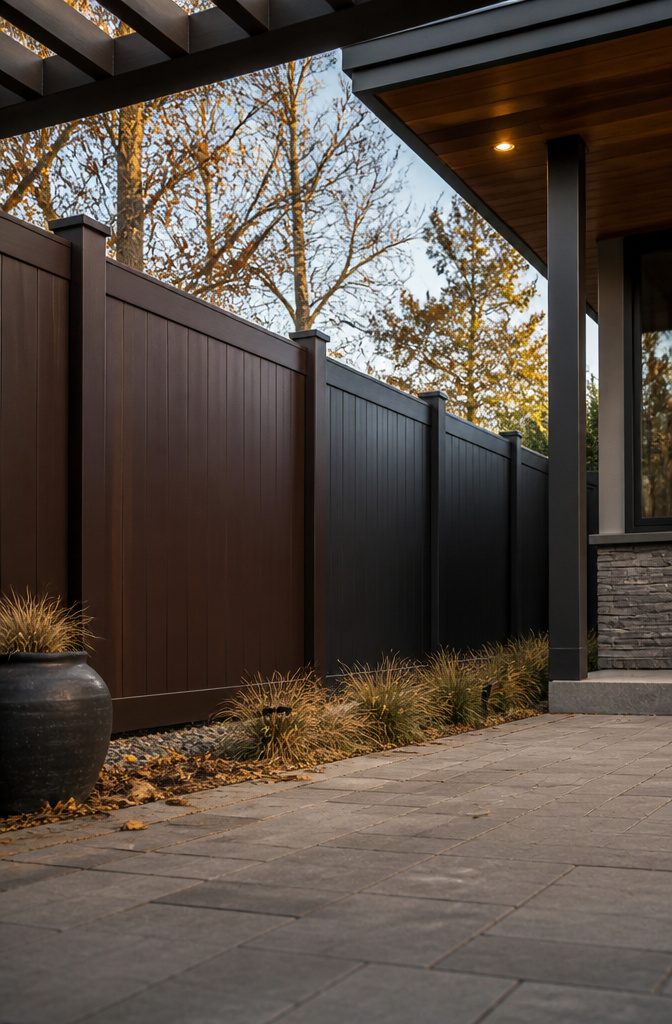
Deep browns, blacks and grays make a bold statement, and the vinyl market treats them that way. Brown is the rarer choice and usually costs more than white, so expect fewer suppliers to quote it.
Black is the one to confirm before you fall for it. Not every maker builds a black vinyl fence.
One manufacturer’s darkest tones stop at Dark Walnut, Dark Sequoia and Slate Gray. If black is what you want, ask for it by name before collecting quotes.
If it isn’t offered, I’d look at Slate Gray first for a cool, modern look, or Dark Walnut for something warmer, and request a sample of each to hold against your house.
Recommended Products

Flexible Usage - 50' long x 5'8" tall - Made to fits on 6 ft tall fence,4"-8" may shorter on width to prevent lay over the fence,great for both construction and residential areas. Customizable sizing is also available to meet your needs.

Brown Fence Slat - Designed for a 6' high fence, slats are approximately 68.5" in length to accommodate the bottom locking channel and to prevent the slats from being above the top of the fence. (Available Colors: Beige, Black, Brown, Gray, Green, Redwood, Royal Blue, Sky Blue, White)

Neighbor Privacy, Not Blackout: Blocks direct line-of-sight while allowing airflow — designed for comfortable backyard privacy, not a solid wall or tarp.
5. Pastel Blue and Green
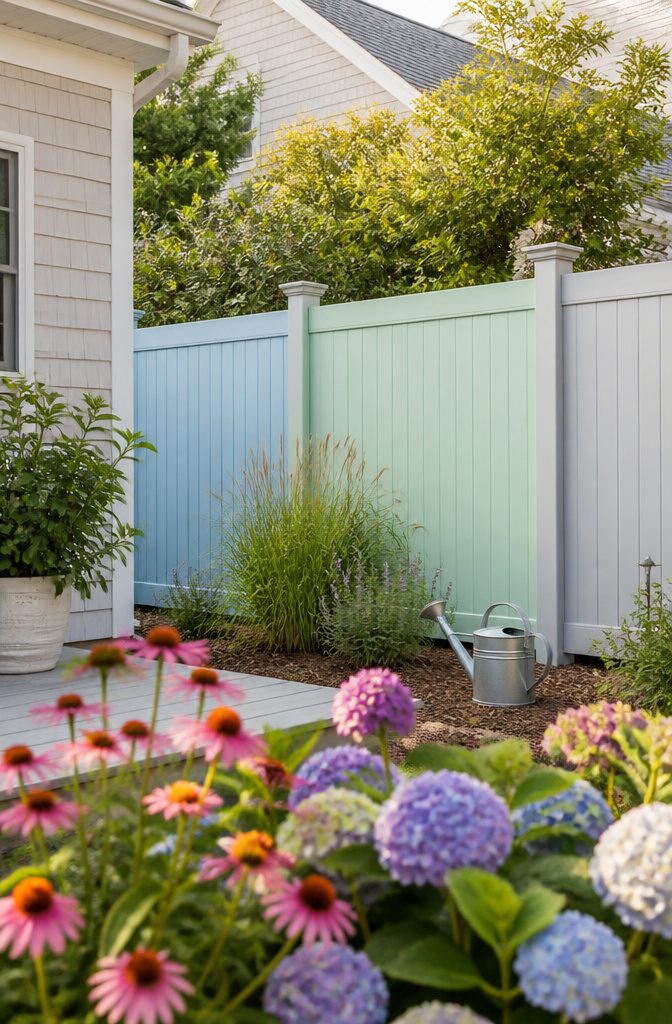
Soft blue, pale green and light gray are calm, quiet colors that suit casual or beachy homes. They also work well around colorful plantings, because flowers and foliage stand out against a muted fence instead of competing with it.
I would choose a pastel only if the house style supports it. Pale green on a formal brick colonial can look like a mistake, and a fence is expensive to repaint or replace.
Availability varies by manufacturer, so check each catalog before you settle on a shade. Request a physical sample and hold it outdoors against your siding, since pastels look different in daylight than under showroom lights.
Recommended Products

Upgrade iCover Privacy Screen For Fence: Our privacy screen is made of heavy-duty knitted net, measuring 6 ft high by 50 ft long. It is suitable for fences with a height of 6 ft or slightly higher. Please accurately measure your fence before purchase
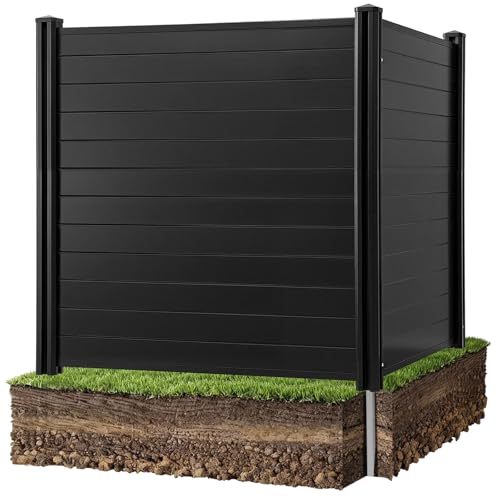
Backyard Privacy Enclosure: Our vinyl fence panel set includes 2 panels measuring 48 x 48 in, ideal for concealing outdoor items like trash bins, pool equipment, and air conditioners, keeping your backyard neat and attractive while meeting HOA guidelines

Backyard Privacy Enclosure: Our vinyl fence panel set includes 3 panels measuring 50 x 48 in, ideal for concealing outdoor items like trash bins, pool equipment, and air conditioners, keeping your backyard neat and attractive while meeting HOA guidelines
6. Wood-Grain Finishes
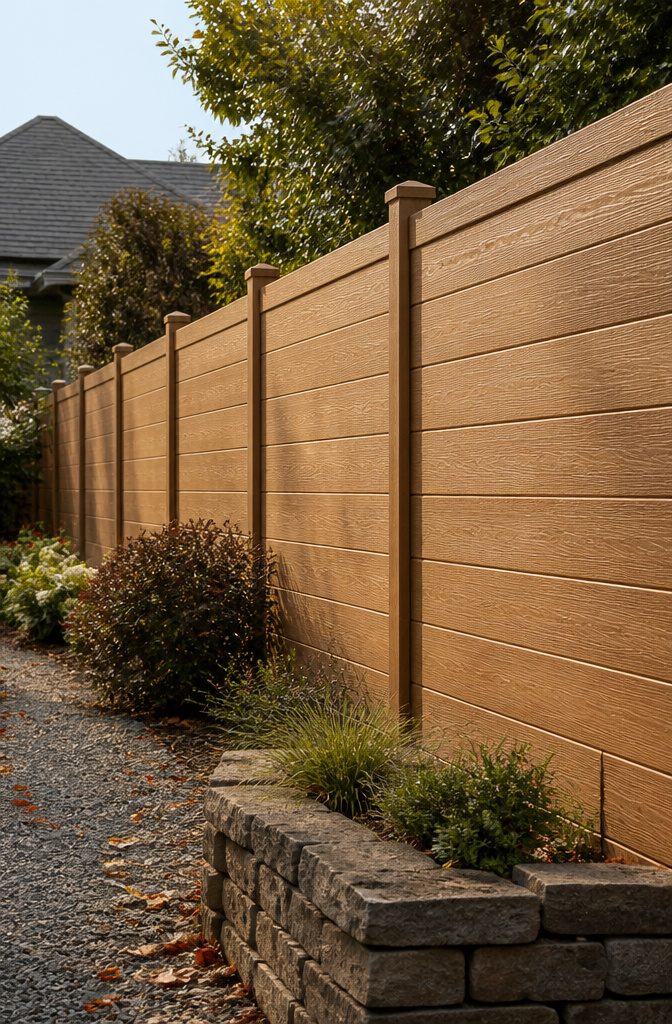
Wood-grain vinyl comes in two textures. Smooth printed patterns look like timber but feel like ordinary vinyl under your hand, while textured panels have a deep grain you can feel.
Blends such as Coastal Cedar and Weathered Blend give warm, uneven tones instead of one flat color. For anyone who loves cedar but not the sanding and staining, I think this is the strongest reason to choose vinyl.
Panels can cost a little above a standard solid, but height, length, style, and gates move the total far more than the finish does.
Wood-grain colors may also show more change over time than a solid. If you want the cleaner, more modern look, a solid tone still wins.
Recommended Products

Reinforced and Thickened Material: Qikdesign vinyl privacy screen is made of high-quality and thickened PVC material, posts on both sides are thickened and reinforced (0.2 in wall thickness), making it more durable than materials used in similar products on the market, and able to remain stable in strong winds. We can provide a 10-year warranty on our vinyl fence.

DIMENSIONS: Each panel measures 45"H x 36" W

EASY ORDERING: Everything you need to install your gate is in the box except for posts. Only ONE additional post (search BL19112) is required if you are installing in a fence (search BL19110) run. If you are installing the gate with no fence, you will need to purchase 2 BL19112 posts.
7. Two-Tone and Custom Colors
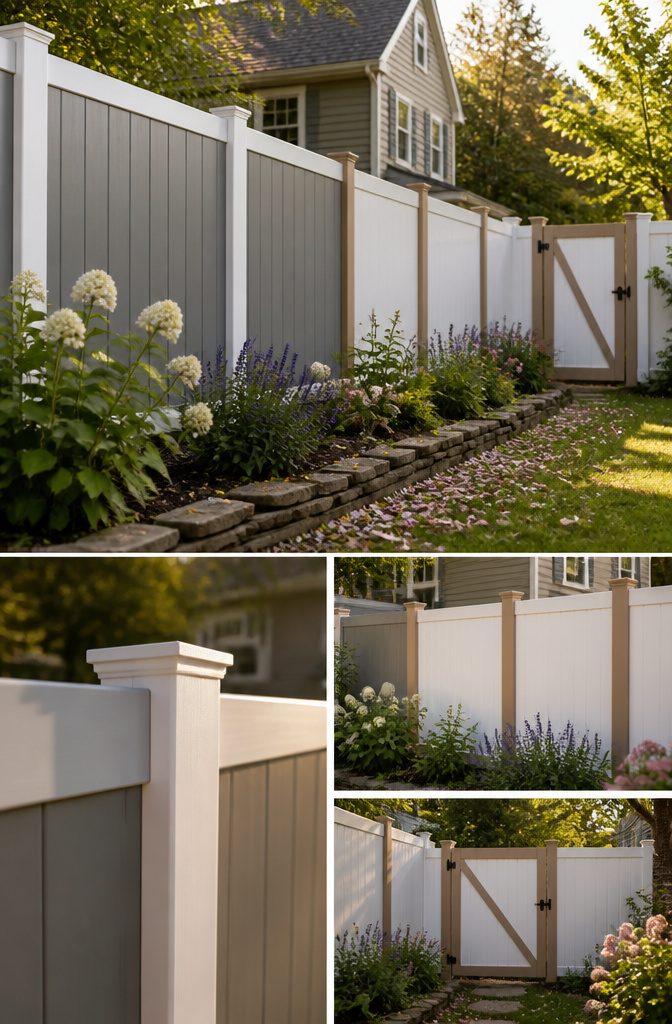
White posts and rails with gray or tan panels, or the reverse, make up the usual two-tone build.
White with gray looks modern, while tan posts with white panels read more traditional. Expect $56–85 per foot installed, and more for custom combinations, since you’re buying two products.
Color-matching helps when a neighbor’s fence or your existing run needs a partner. Some companies will match a shade, build a gate in the same color, or make the back run darker than the street side.
Brown, clay and custom colors come with limited availability and higher cost. I’d settle the color before ordering, because vinyl can’t be painted later without looking bad.
One Installer’s 14 Colors
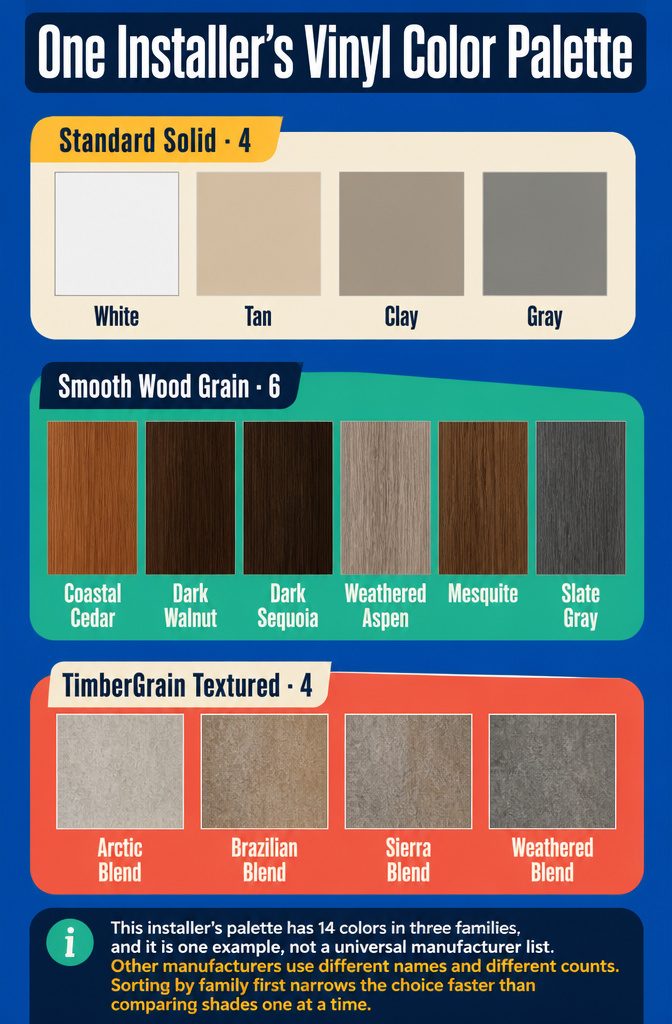
This installer’s palette has 14 colors in three families, and it is one example, not a universal list.
Other manufacturers use different names and different counts. Sorting by family first narrows the choice faster than comparing shades one at a time.
| Family | Colors | Count |
|---|---|---|
| Standard Solid | White, Tan, Clay, Gray | 4 |
| Smooth Wood Grain | Coastal Cedar, Dark Walnut, Dark Sequoia, Weathered Aspen, Mesquite, Slate Gray | 6 |
| TimberGrain Textured | Arctic Blend, Brazilian Blend, Sierra Blend, Weathered Blend | 4 |
Recommended Products

Premium construction: The vinyl construction of these privacy panels ensures that they will maintain their structure and appearance in the harshest of weather conditions. 3” x 3” support posts provide much greater stability than the smaller posts commonly found on competing brands. It is a beautifying addition to your home’s aesthetic that provides long-lasting protection.

The material is breathable, water-resistant, and blocks up to 90% of UV rays. Made from non-recycled High-density polyethylene.

Premium construction: The vinyl construction of these privacy panels ensures that they will maintain their structure and appearance in the harshest of weather conditions. 3” x 3” support posts provide much greater stability than the smaller posts commonly found on competing brands. It is a beautifying addition to your home’s aesthetic that provides long-lasting protection.
Match the House and Roof
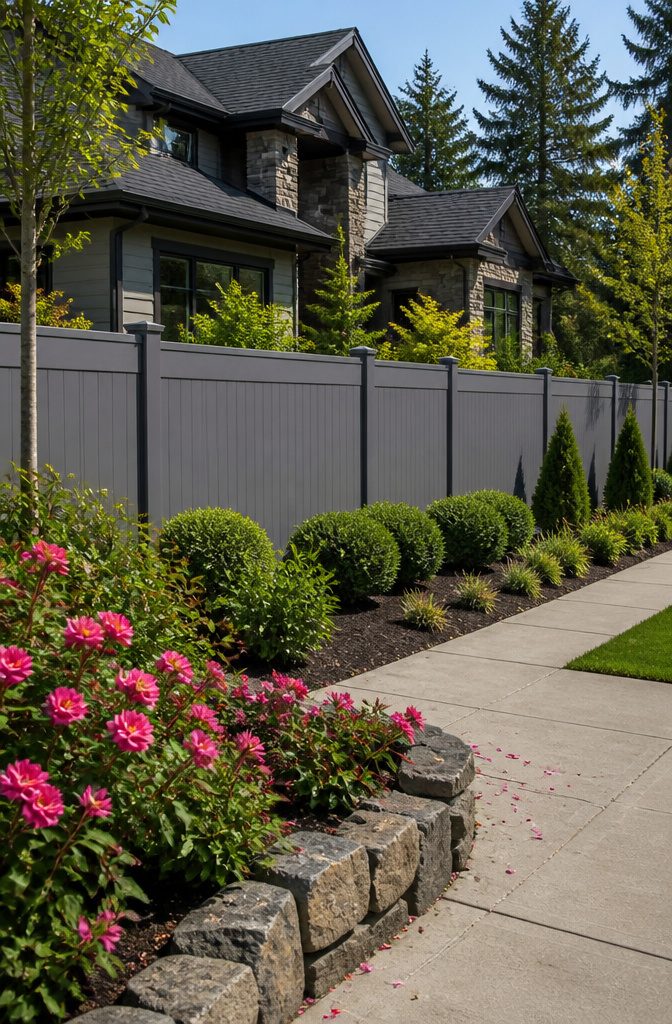
Check your HOA’s approved color list before ordering, since the HOA has the final say on fence shade.
After that, start with the house and roof. Gray suits a modern home, especially one with stone or metal accents, while tan fits a traditional home and sits well beside a wood deck.
A tone close to your trim ties the yard together, and a contrast frames a garden bed.
For natural surroundings I’d choose an earth tone. For a yard full of bright blooms, a pastel lets the plants lead.
South and west runs get the most sun, so a lighter tone there stays cooler. Neutrals are the safer pick if you may sell.
Recommended Products

[Faux Shiplap Wallpaper] A roll of 17.5 "x 118.1" wood contact paper. cover is 13.7sq.ft.Wood self-adhesive wallpaper is a matte finish so it looks realistic. Pasting it in the bedroom has a very mysterious feeling, as if in a primeval forest

Vintage Brown Fence lights - Give off beautiful Warm, and soft lighting, makes your garden look nicer, cozier, and more inviting. Energy-saving, No Heat and long lifespan means no bulbs to replace. (3000K warm white light). Design with U.S. Patent Certification
Brown Fence Slat - Designed for a 4' high fence, slats are approximately 44.5" in length to accommodate the bottom locking channel and to prevent the slats from being above the top of the fence. (Available Colors: Beige, Black, Brown, Gray, Green, Redwood, Royal Blue, Sky Blue, White)
Fading, Heat, and Upkeep
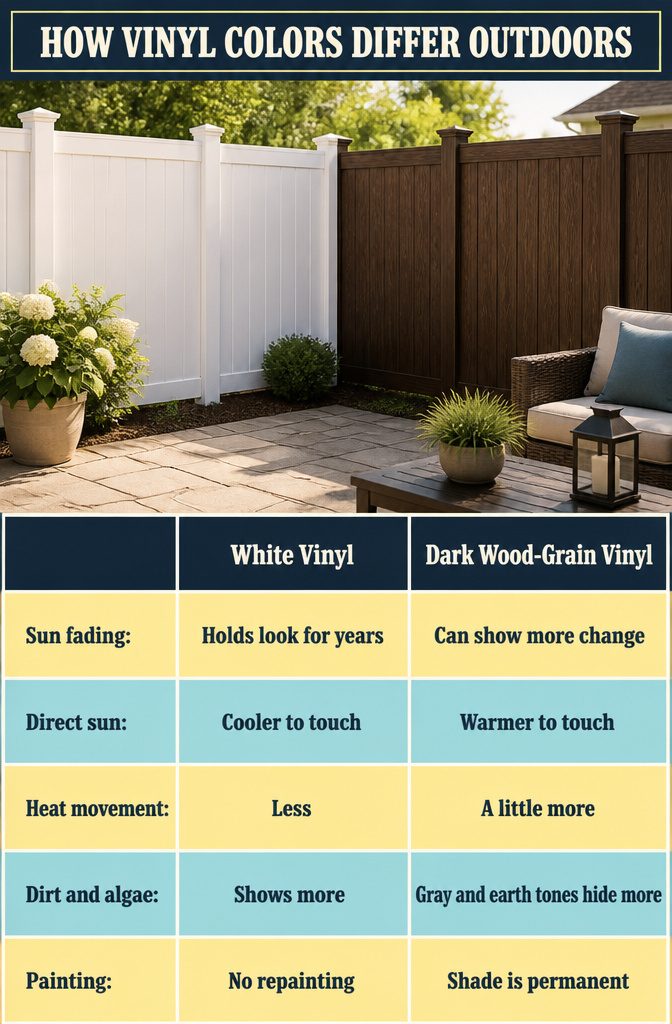
The color runs through the vinyl itself, so there is no paint to peel and no repainting later: paint over vinyl and it looks terrible, so the shade you buy is the shade you keep.
White, tan and light gray reflect sunlight and hold their look for many years, helped by UV stabilizers and titanium dioxide.
Darker and wood-grain colors take more sun and can show more change, though never suddenly. In direct sun a dark panel feels warmer to the touch than white, and darker pigments move a little more with the heat.
Upkeep flips the ranking: white shows dirt and algae, while gray and earth tones hide them. I’d pick gray if you hate scrubbing.
Recommended Products

NO-DIG GARDEN FENCE FOR SMALL DOGS: Create a visible boundary around gardens, patios, or yards—discourages wandering without permanent installation (light pet barrier).

Premium Quality: The UPGRADE privacy screen for fences is made from 170 GSM non-recycled High-Density Polyethylene (HDPE). This ensures lasting durability, reliable privacy protection, and excellent weather resistance. A high-density composition makes it a dependable solution for outdoor privacy needs.

Package List : 100 Pcs Fencing Mounting Clips with Screws
Frequently Asked Questions
What colors do vinyl fences come in?
Common options are white, tan, clay, gray, deep browns, pastels, wood-grain blends and two-tone combinations.
One installer’s palette has 14 colors in 3 families: 4 Standard Solid, 6 Smooth Wood Grain and 4 TimberGrain Textured. Names and counts differ by manufacturer, and not every maker offers black, so ask for it by name before collecting quotes.
What is the most popular vinyl fence color?
White is the classic choice and the easiest to find, since fewer suppliers stock gray, tan and brown.
Gray is a common alternative for homeowners who want a fence that hides dirt and pollen better. Check your HOA’s approved color list before you pick either one.
Can I spray paint a vinyl fence?
Painting vinyl is not recommended, because paint over vinyl looks poor.
The color runs through the material, so there is nothing to repaint or touch up later. Choose the shade you want before installation, and ask for a physical sample first.
Will a colored vinyl fence fade over time?
White and light tones fade the slowest and hold their look for many years, helped by UV stabilizers and titanium dioxide.
Darker and wood-grain colors take more sun and can show more change over time, but the change is gradual. Because the color is built in, nothing peels or chips.
Do darker vinyl fence colors get hot?
Yes. In direct sun, a dark panel feels warmer to the touch than a white one, and darker pigments also move a little more with heat.
If a run faces south or west and gets the most sun, a lighter tone will stay cooler.