
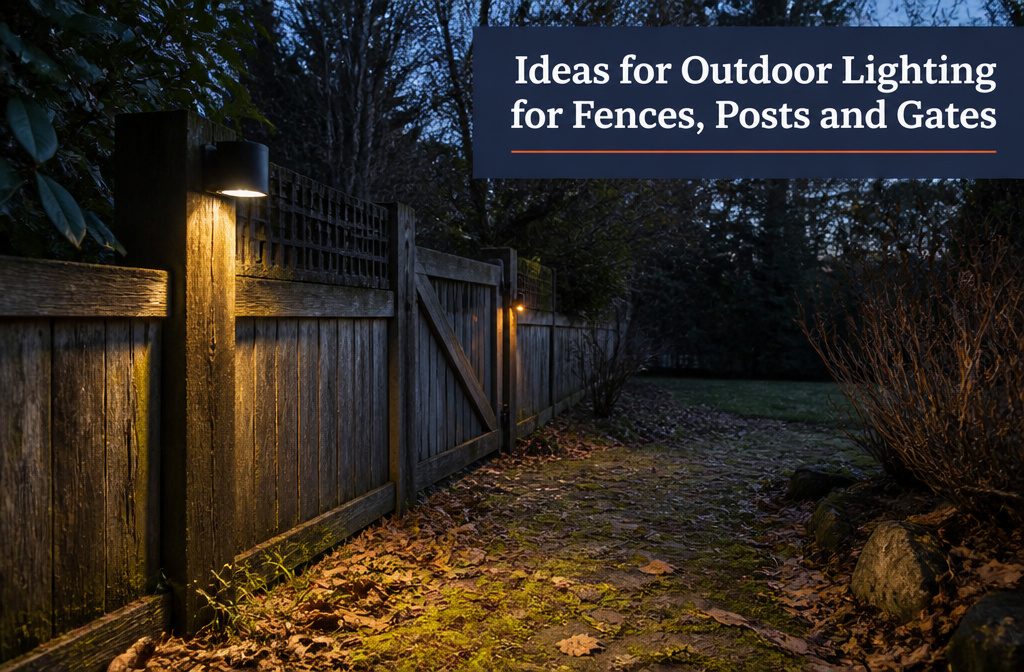
Fence lighting runs from 3-lumen solar lights to 500-lumen motion sensors, and what decides it is whether you want a glow or light to see by.
Keep anything near seating at 3–15 lumens. Save the bright units for gates and side yards, and skip Aootek’s always-on mode, which lasted 4 hours against 9 hours advertised.
1. Flush-Mounted Solar Lights
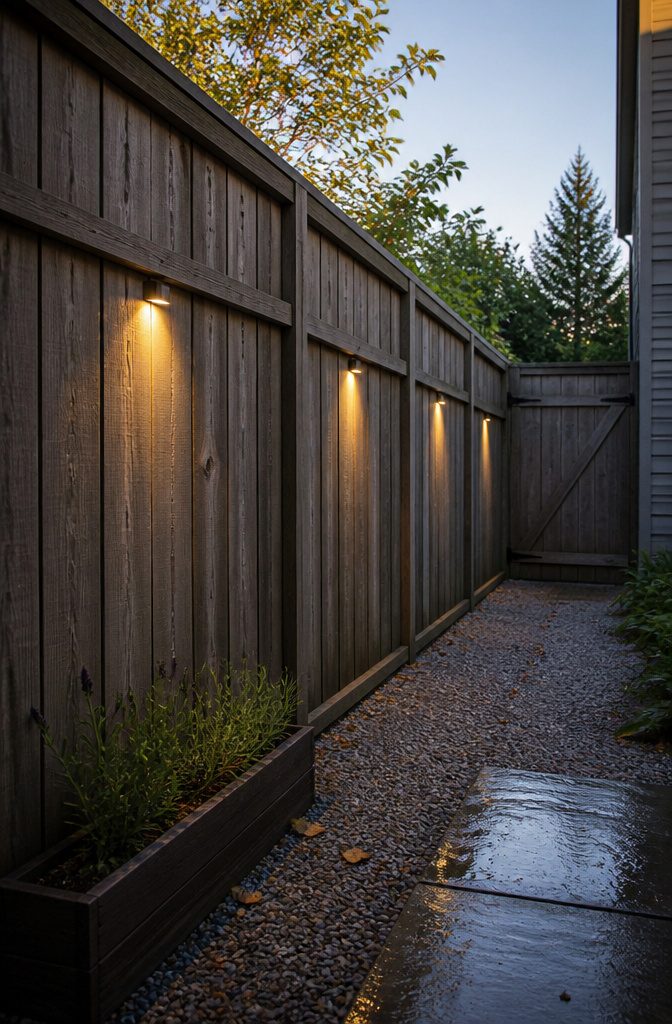
Flush-mounted solar lights screw straight onto fence boards for a soft, warm glow. Solpex’s 16-pack (1.85 x 1.77 x 3.46 inches, IP44, 3 lumens) charges in 4–6 hours on a clear day, and Bob Vila’s testers found mounting fast:
These downlight-style, flush-mounted lights only required us to drill two screws through the top of the light into our fence, and it took us less than a minute to get each light up and running.
— Bob Vila
Pre-drill, because screw heads strip, and set the mode switch before mounting, since it’s hard to reach afterward.
Doeslag’s 8-pack (IP65, Edison bulbs) looks more decorative; Melunar’s 6-pack offers 10 lumens. In a small yard, Solpex wins, but 3 lumens won’t light a walkway.
Recommended Products
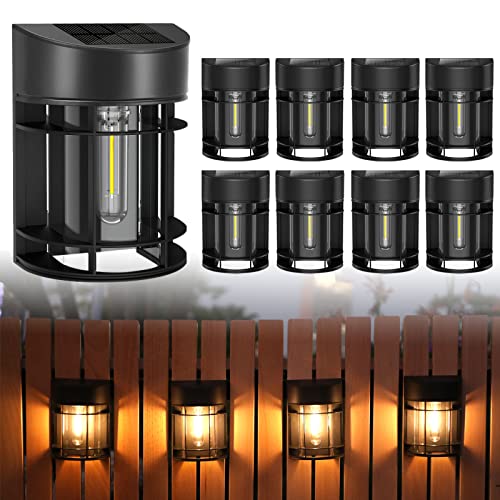
Solar Lights Outdoor- Solar fence lights aren’t just give off beautiful Warm lighting for illuminating the area surrounding your fence, they can also help to spruce up the overall aesthetics of your home yard. Design with U.S. Patent Certification

1.Enhanced PIR Motion Inductor: Hmcity Solar Lights Outdoor offer three versatile lighting modes to suit your needs. Mode 1 activates the motion sensor outdoor lights, turning the light on when it detects movement. Mode 2 keeps the light permanently on all night, providing consistent illumination. Mode 3 features smart brightness control, where the light stays on at a lower brightness all night and becomes brighter when motion is detected. These modes make these solar lights outdoor waterproof perfect for gardens, pathways, and yards.

【3 Color Temperatures + 3 Lighting Modes】TheseSolar Fence Lights feature an up-and-down design with warm, neutral, or cool white light—choose the perfect glow for any space. The easy-press switch lets you quickly cycle modes: downlight, up & down, or both simultaneously. With 100 lumens of brightness, you get soft accent lighting and clear visibility in one. Far more flexible than standard fence lights, they're ideal for courtyards, decks, porches, and wall décor.
2. Fairy and String Lights
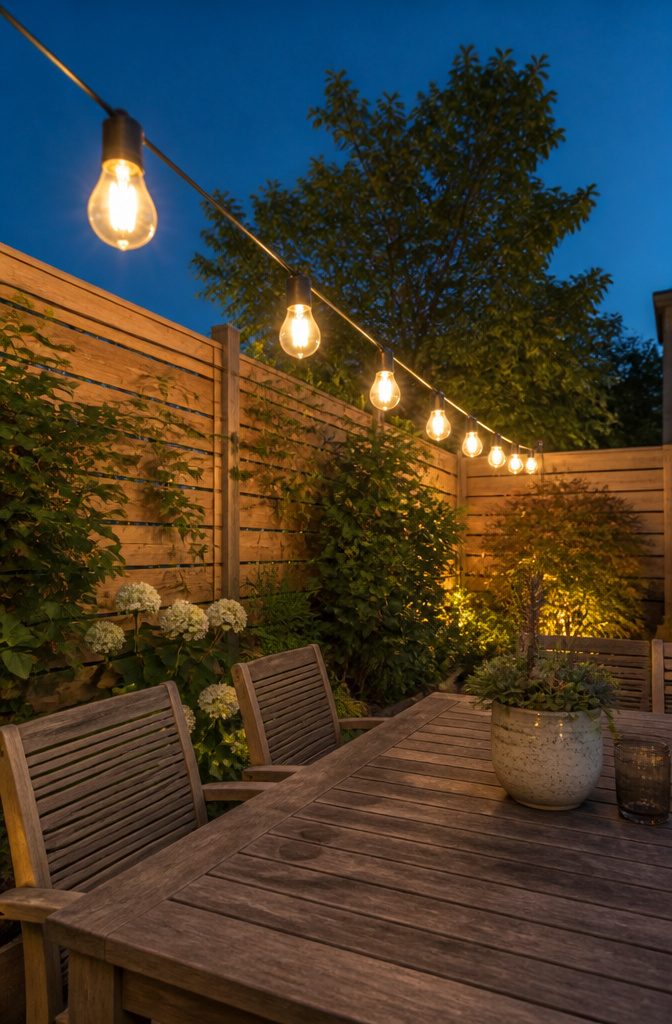
Solar fairy strands tangle when you wrap them around a horizontal board.
The Brightown 2-pack (33-foot strands, 4 x 3.7 inch panel, IP65, up to 10 hours, 8 lighting effects) needs repeated untangling that way, but it wraps cleanly around a vertical post or tree.
Brightech’s Edison-style strings hang as one straight line, which suits a fence better.
They come in 27 feet with 12 bulbs or 48 feet with 15, rated IP55 and for rain, snow and 50 mph winds. Expect about 5–6 hours lit, and add a few fasteners where bulbs sag.
For a fence, the Brightech festoon line wins. Run one line over the dining or lounge area; more strands crowd the space.
Recommended Products

Solar Powered and Auto On/Off: Warm White Christmas string lights powered by solar energy with no extra electric cost or battery replacement needed. The light sensor charges the lights during the day and turns them on automatically at night

Solar Powered and Auto On/Off: White Christmas string lights powered by solar energy with no extra electric cost or battery replacement needed. The light sensor charges the lights during the day and turns them on automatically at night

Solar Powered and Auto On/Off: Multicolor Christmas string lights powered by solar energy with no extra electric cost or battery replacement needed. The light sensor charges the lights during the day and turns them on automatically at night
3. Solar Post Caps
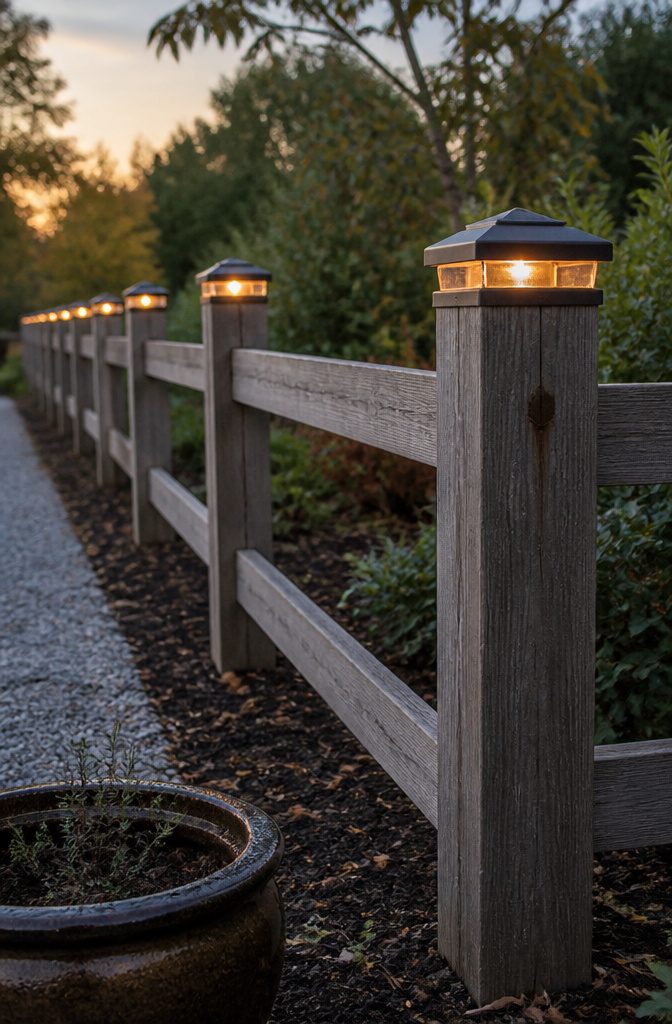
Dynaming Flickering Flame caps put one light point on each post, which marks the fence line best when the posts are evenly spaced. The 6-pack fits 4×4, 5×5 or 6×6 wood or vinyl posts.
Each cap measures 3.54 x 5.8 x 5.8 inches and is rated IP44. Set it on the post, switch it to "on," and drive the two included screws.
They strip easily, so keep your own wood screws handy. Give the caps 6–8 hours of sun for a full charge.
Buy one set for the whole fence. Mismatched styles or brightness, or caps that are too bright, make the posts compete.
I’d skip "flame" mode wherever you need light to see by, such as a seating area or path. Use the steady "on" mode there.
Recommended Products

BLACK PLASTIC DANCING FLAME SOLAR POST LIGHTS: 8 pack modern post cap lights powered by solar, each with 72 pcs yellow SMD LED, great decorative outdoor lighting and no electricity required. Solar LED flickering flameless candles lights, add a 360 degree viewing angle illuminate charming to your garden, decorate your fence, deck, porch or yard. Measurement: 4.7 x 4.7 x 2.76 inches

This set of 2 post lights is designed for 4x4 Vinyl / Wooden Posts. If your post size does not fit, please check the Bundles with this item section above to find a compatible option for your posts.

PLASTIC DANCING FLAME SOLAR POST LIGHTS: 6 pack modern post cap lights powered by solar, each with 12 pcs warm white SMD LED, they are the perfect decorative outdoor lighting and no electricity required. Solar LED flickering flameless candles lights, add a 360 degree viewing angle illuminate charming to your garden, decorate your fence, deck, porch or yard. Measurement: 5.5 x 5.5 x 10.5 inches
4. Motion-Sensor Lights
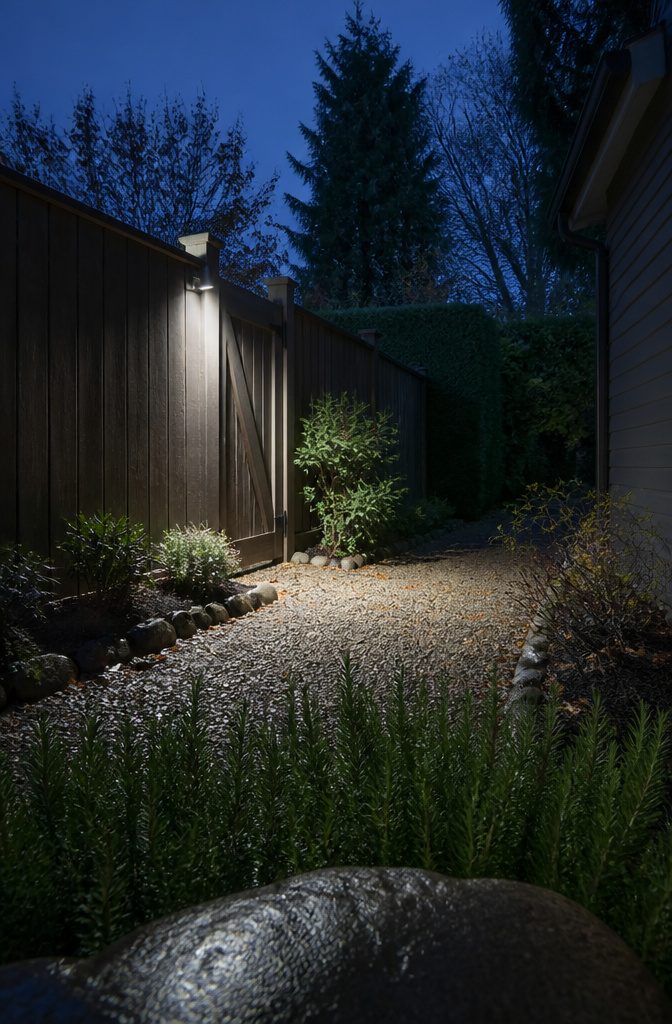
Motion-sensor lights suit gates and dark side yards, where you need light for a few seconds rather than all night. Zookki’s 4-pack puts out 400 lumens, senses across 120 degrees and picks up movement up to 26 feet away.
Aootek’s 4-pack runs at 500 lumens with 3 modes: always on, smart brightness and motion-only. Both are IP65, and the Aootek set came through rain and below-freezing temperatures.
I’d stick to the motion modes. Aootek’s always-on mode lasted only 4 hours against an advertised 9, so the battery is spent early in the evening.
The mode switch sits on the back, so set it before you mount the light. Some people will find this much light too bright near a bedroom window, so aim it low at the path.
Recommended Products

【156 High-Efficiency LEDs & 2500LM Ultra-Bright Illumination】 Experience unmatched brightness with 156 upgraded LEDs—engineered to deliver 2500LM while consuming less power than bulkier 200+ LED designs. Flood your driveway, backyard, or patio with powerful 6500K daylight-white light. Whether for home security or as Commercial Street & Area Lights, Daphino delivers the brightest, most saturated light to illuminate every dark corner of your property.

【3 Modes in 1 Motion Sensor】"Auto Mode" when movement is detected in darkness the light will turn on & after 1min to 10 minutes it will turn off depending on your setting; "D2D Mode" Automatically turns on at night and stays off at daytime, work only in the night; "Manual Override Mode" allows manual control on and off, light will keep on for 8h but will auto turn off at dawn.

This solar security light is equipped with 72 upgraded high-power SMD2835 LEDs beads, Use innovative optical lens design to reduce light loss, which can produce high-brightness output of up to 800 lumens and 6500K. Built in 1200mAh solar rechargeable battery, when the battery is fully charged during the day, the lighting is constant from dusk to dawn.
5. Hanging Lanterns
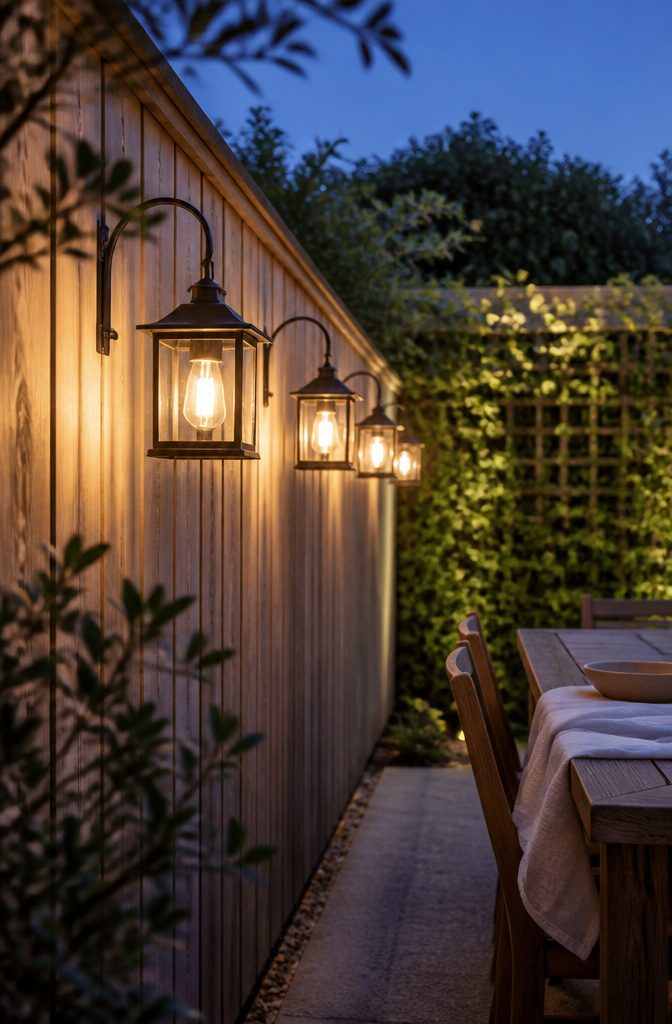
Lanterns keep the light off the ground, which suits a dining table, a patio edge or a narrow path.
The Derynome solar lantern measures 6.69 inches wide and 11 inches tall, so give it room to swing and keep it clear of the walking line.
Hang every lantern at the same height for a tidy row, and high enough that nobody clips one with a shoulder.
Only a metal bracket gets screwed to the fence, two holes per bracket. The lantern lifts off its hook, so a renter can take the light down and leave nothing but small screw holes to fill.
I’d swap the supplied screws for your own, since the heads strip easily. Expect a soft glow: 15 lumens, IP65 rated, up to 10 hours lit after 8 hours of sun.
Recommended Products

With Remote Control (Dimmable) - Allow you to adjust the brightness to your needs: 25%, 50%, 75%, and 100%. You can also choose from three lighting modes: Lighting/Breath/Flash, 3/5 hour timer modes
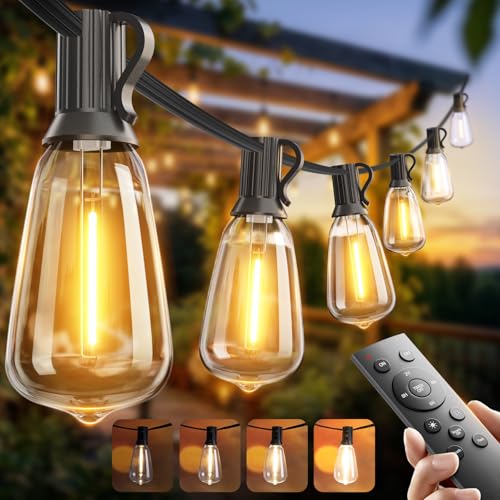
【Remote Control – Adjust Lights Without Getting Up】Sit back and use the remote to turn your lights on/off and fine-tune the brightness. Easily move from a gentle evening glow to bright lighting for cooking, gatherings, or game night, all without walking over to the outlet. The maximum remote control range is 50 feet.

Superior Brightness & Connectable - Unlike dim low-voltage string lights, our 120V outdoor lights provide 2X the brightness for full illumination. Built with pure copper wiring for improved conductivity and safety, they support end-to-end connection of up to 15 strands without voltage drop or dimness, ideal for large spaces. If you need powerful lighting for a grand setup, this is your good choice.
6. Leave Parts of the Fence Dark
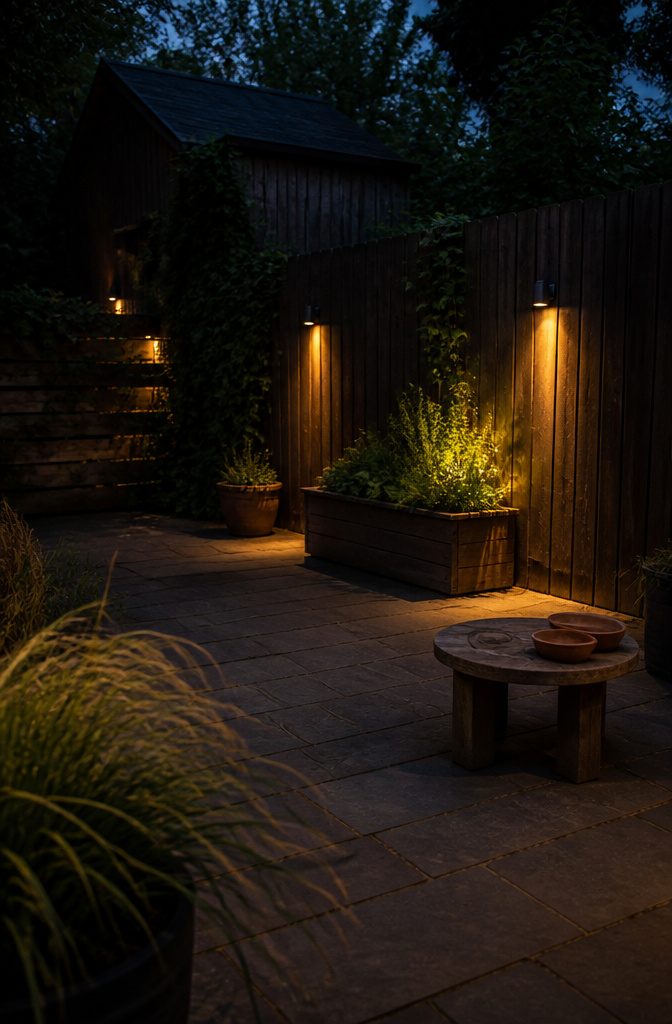
Treat the fence as the backdrop and the things in front of it as the stars.
Planters, a bench or a side table get the light, and the boards behind them stay quiet. Place fixtures at chosen points instead of spacing them evenly along every panel, and let the stretches between them go dark.
Those dark gaps give the fence depth, because the eye reads bright spots against shadow as layers. Light every board and the fence goes flat and harsh, and it competes with whatever stands in front of it.
I’d choose soft, subtle fixtures and aim for balance, so the fence looks well kept without being the loudest thing in the yard.
Recommended Products

🥇【Energy Saving&High-speed Charging】: This solar wall lights outdoor can be used as a wall sconce to stylize a porch, deck, patio, garage areas and more. Featured long lasting hanging wall lights rechargeable by built-in four solar panels, which can absorb more solar energy. The battery has a large 2000mAh capacity for extended illumination. Place the solar lamp in direct sunlight to charge the battery completely. Charging for 6-8 hours can illuminate for 8-12 hours. (Bad weather may affect lighting time.)

【Lens Design Enhances Illumination】: The lens LED design improves the efficiency of our solar fence lights. It focuses brightness, reduces glare, and ensures even light distribution, making these bright solar fence lights ideal for illuminating your fence

3 Color Temperatures Selectable: The fence lights solar powered feature 3 color temperatures: 3000K warm white, 4000K natural white, and 6000K cool white, giving you multiple lighting choices for different outdoor settings. Easily adjust the mode with a simple switch to provide comfortable illumination or create the right ambiance for your space. These solar fence lights are ideal for enhancing fences, patios, and backyards.
7. Light the Plants Instead
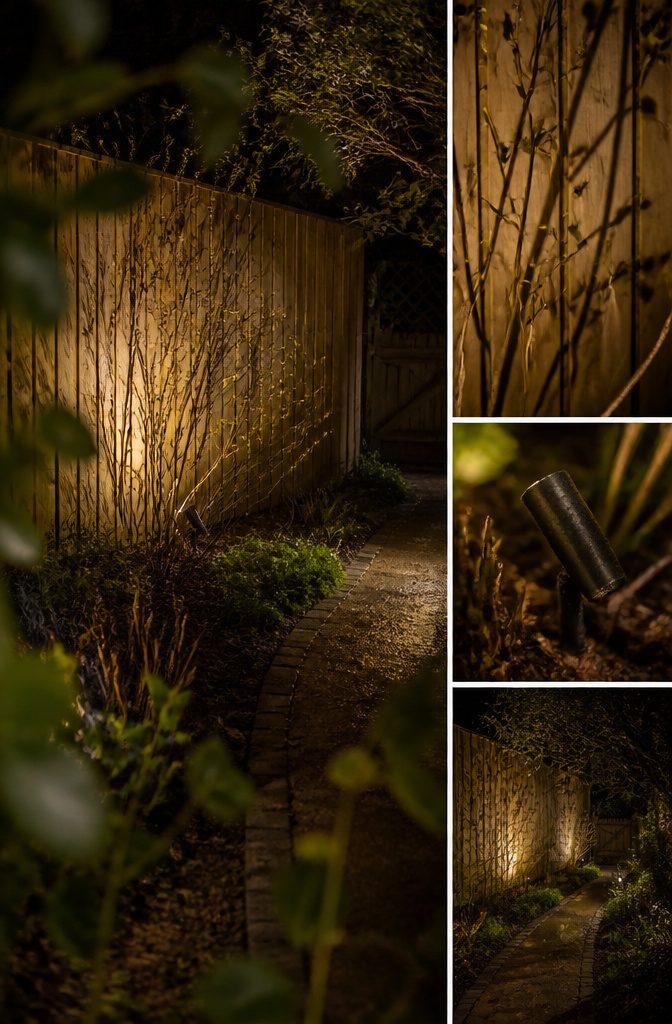
Lighting the plants rather than the boards keeps the fence from competing with the garden in front of it. LED fixtures suit shrubs, small plants and small trees, and a lit planting along a path shows guests where to walk.
For a stronger effect, put the light behind the plant and aim it at the fence.
The leaves and branches then read as dark silhouettes against the boards. I’d pick this for plants with an open, branching shape, since a dense blob of foliage gives a less interesting outline.
Adjustable fixtures mounted on the fence can be pointed at plants, paths, trees or architecture.
Check the beam direction after dark before you fix anything in place. A fixture that looks right in daylight can throw light into a window or into your eyes once it’s dark.
Recommended Products
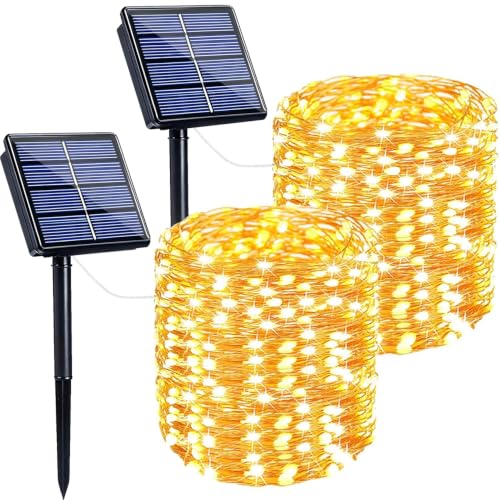
Super Bright Solar Christmas Lights Outdoor: 2-pack each 72ft 200LED solar string lights with upgraded LED bulbs, higher conversion efficiency with a larger size solar panel, larger capacity battery (1800mAh), and IP65 waterproof performance. The solar Christmas fairy lights emit a warm glow, creating the perfect atmosphere for trees, wedding, Christmas or party
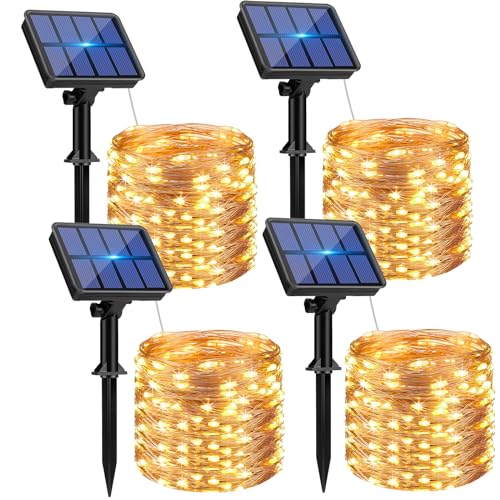
4 Packs Solar String Lights for Outside: Each Ultra-Bright twinkle lights solar with 80 LED 33 FT (26.5 ft light string +6.5 ft lead wire), total 320 LED 132 FT. Enough length and lights to easy decorative large areas like fences, trees, yards or garden, enchanting glow

【Cherry Blossom Design】Experience the magic of spring all year round with these solar Christmas lights, inspired by flower - cherry blossoms. The 60 LED bulbs in each 26ft string (19.4ft lighting length, 6.6ft lead length) add a charming touch to your garden, and multiple sets can be connected for an even more enchanting effect;
8. Graze Wood or Wash Smooth Boards
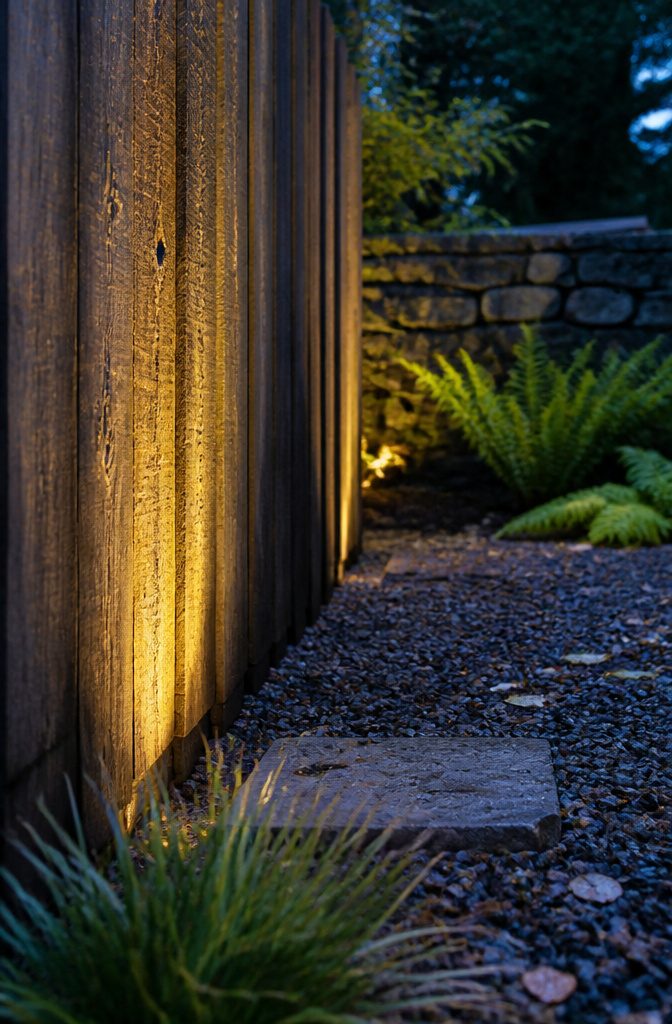
Rough cedar, weathered boards and stacked stone are the surfaces to graze. A fixture set close to the wall throws a narrow beam up, down or both, and the low angle casts small shadows into every groove and grain line.
Up-and-down LED fixtures give timber and stone that vintage, sophisticated look after dark.
Smooth vinyl or painted boards are a poor match, because grazing shows every seam and scuff and has no texture to reveal.
Wash them instead. A wall washer spreads soft, even light across the whole face of the fence, so the boundary glows without hot spots, and guests walking the yard at night can follow the edge easily.
For any fence that looks plain by day, I’d pick the washer.
Recommended Products

BLACK PLASTIC DANCING FLAME SOLAR POST LIGHTS: 6 pack modern post cap lights powered by solar, each with 72 pcs yellow SMD LED, great decorative outdoor lighting and no electricity required. Solar LED flickering flameless candles lights, add a 360 degree viewing angle illuminate charming to your garden, decorate your fence, deck, porch or yard. Measurement: 4.7 x 4.7 x 2.76 inches

【4 LIGHTING MODES & VINTAGE BLACK DESIGN】 Transform your outdoor space with our classic vintage black solar post lights. Featuring 4 adjustable lighting modes – Flickering Flame, Warm White (2500K), Natural White (4500K), and Cool White (6500K) – you can easily switch between moods with a simple press. These decorative black post cap lights are designed to add ambiance and charm to your garden, fence, deck, or porch. Please note: These are decorative accent lights, ideal for creating atmosphere rather than illuminating walkways or steps.

【REALISTIC FLICKERING FLAME & 4 LIGHTING MODES】 Bring your outdoor space to life with our vintage black solar post lights featuring realistic flickering flame effect. Unlike ordinary post lights, our dancing flame technology creates mesmerizing fire-like glow that adds warmth and charm to any evening. Plus, enjoy 3 additional steady modes: Warm White (2500K), Natural White (4500K), and Cool White (6500K) – easily switch with one button. Please note: These are decorative flame effect lights ideal for creating ambiance rather than illuminating walkways.
9. Hide Lights Under the Top Rail
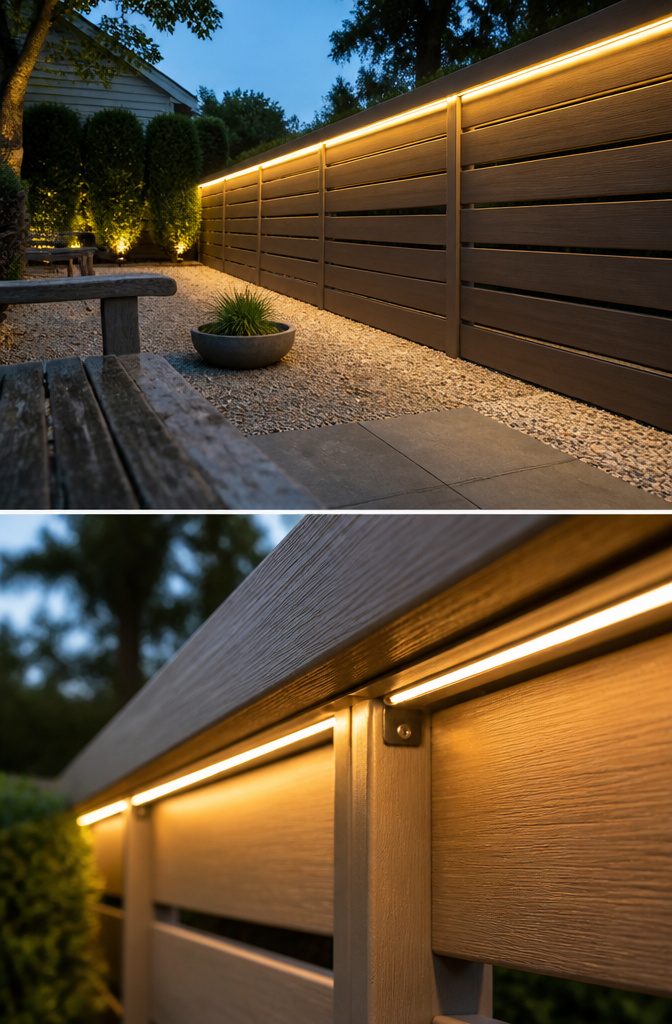
Linear lighting under the top rail suits horizontal timber, composite and slatted fences.
The strip sits out of sight, so you get a clean glowing boundary along the fence line with no visible fixtures. For a modern fence, I’d pick it over post-mounted lights, especially if you host on the patio.
Small LED points built into the fence do a different job. Space them evenly along the fence or beside the path so guests can see their way and avoid bumping into chairs or plants in the dark.
I prefer them in a minimal yard, where a neat row of small points looks tidier than a few larger fixtures.
Recommended Products

[Wide Arc Lighting Area] The solar flood lights can adjust the 3 lamp heads providing an industry leading 270°Wide angle of illumination. The solar motion light has 3 lighting modes: (1) Mode 1 -Lights set on low brightness setting at all times and will illuminate brightly when motion sensor is activated. (2) Mode 2-lights will be off and will illuminate brightly when motion sensor is activated. (3) Mode 3 -lights will be on low light throughout the night and motion sensor is inactivated.
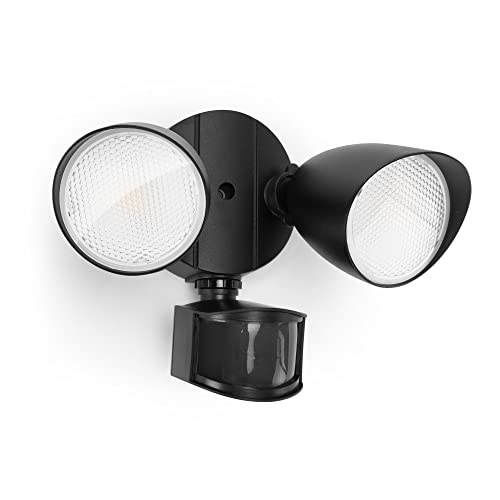
ENERGY SAVING: LED units output 32 W, 3500 Lumen, 5000 K brightness (day light white), equivalent to 150 W halogen light. Also save your electricity bill by up to 88%
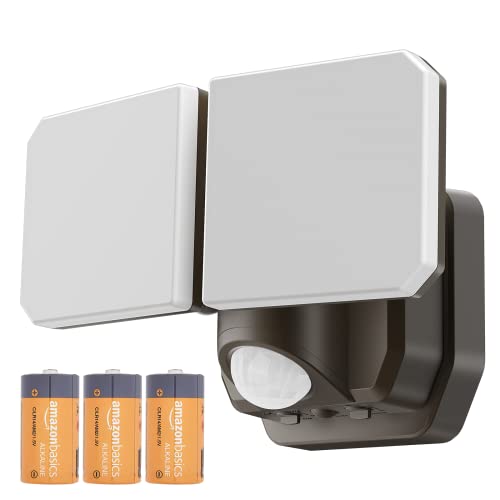
【Easy to Install & Wide Application】This is a battery-powered floodlight that is very easy to install.It does not need any wires or power supply, nor does it need to be placed in a designated place where the sun can shine, just use the matching screws to fix it on the wall or other surfaces, can be widely used in various indoor and outdoor scenes.
10. Downward Pools of Light
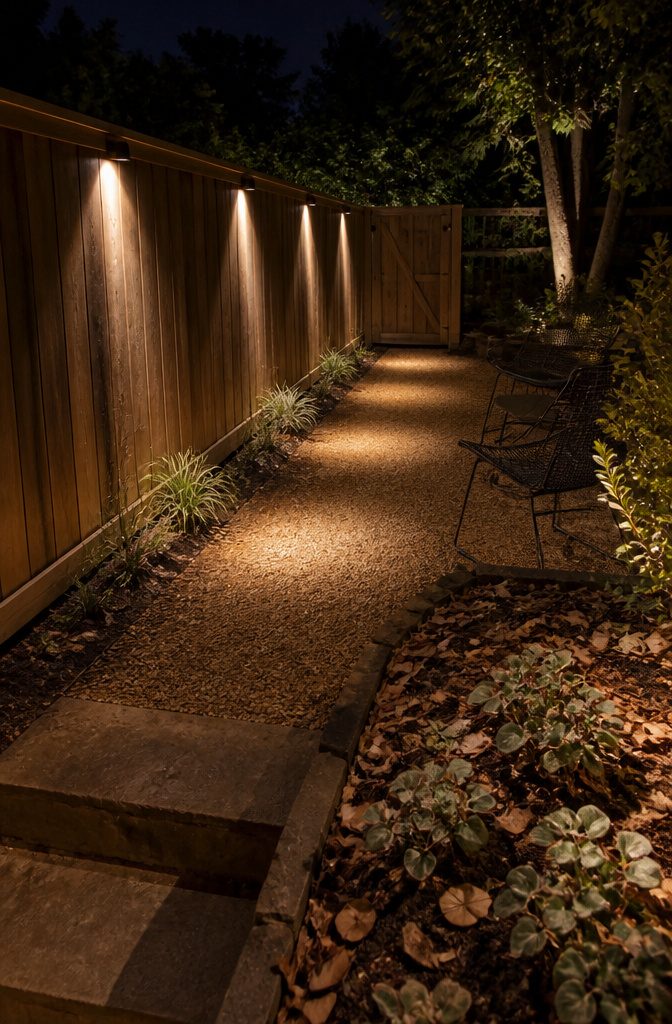
Small downlights under the top rail or on the posts, aimed at the ground, do the most useful work on a fence.
They suit paths, patios, stairs and plant beds. Stagger the fixtures instead of lining them up in a straight line; uneven spacing leaves soft overlaps and dim gaps, so the fence glows rather than looking like a runway.
A floodlight throws one hard beam across the yard, and the bright bulb sits right in your line of sight.
A downlight tucked under the rail hides the source and lights only the ground, so your eyes stay adjusted and the yard doesn’t feel harsh. For any path or step, I’d choose downlights over a floodlight.
Recommended Products

【Durable Quality, Energy Efficient】 Brightown led outdoor lights for patio, with commercial-grade wire and 32 shatterproof weatherproof LED bulbs (3 ft space)(2 spares), reduce electricity consumption by over 90% compared to incandescent bulbs. These outdoor patio lights can be linked up to 24 strings to brightly illuminate large areas year-round, and the long-lasting bulbs ensure extended use.(Not rechargeable, no remote control included)

200FT Extra-Long size:Most string lights on the market are only 50-120ft size,For large yards,pool sides,or long fences often require multiple strings to be connected,resulting in tangled wires and potential poor contact.Our 200ft extra-long string light can wrap around an entire tree,cover an entire patio,or even illuminate a medium-sized garden with one string lights,no splicing needed,Installation is time-saving,making the decor looking seamless and attractive.

APP & Remote Dual Control – Easily control your string lights with your smartphone or the included remote. Adjust brightness, change lighting modes, and manage settings anytime without getting up.
11. Light the Seating Wall
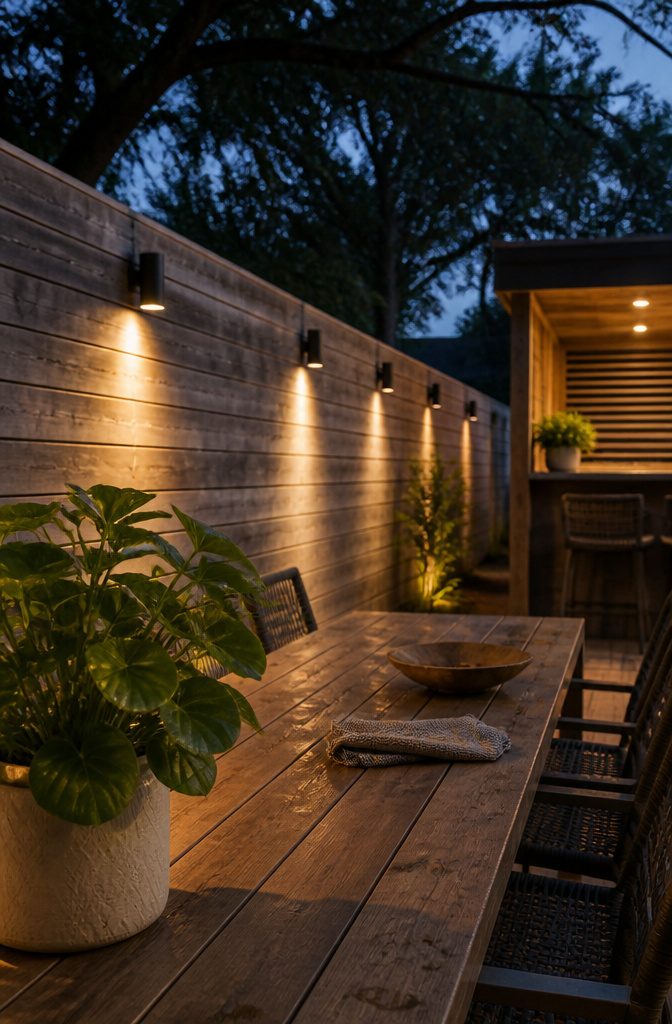
A fence behind a sofa, dining table or patio bar can act as the back wall of an outdoor room, and a little light on it makes the space look finished.
Warm wall lights, hidden lights and gentle sconces all work. I’d pick sconces for a dining table and hidden lights for a sofa, since concealed fixtures keep attention on the people rather than the hardware.
Stick with warm light for a relaxed feel, and mount fixtures where nobody will bump them.
The mistake to avoid is placing bright lights directly behind the seats.
Anyone facing the fence looks straight into them, and glare replaces the glow you wanted. Keep the light low and soft, and aim it along or down the boards.
12. Make the Gate the Brightest Point
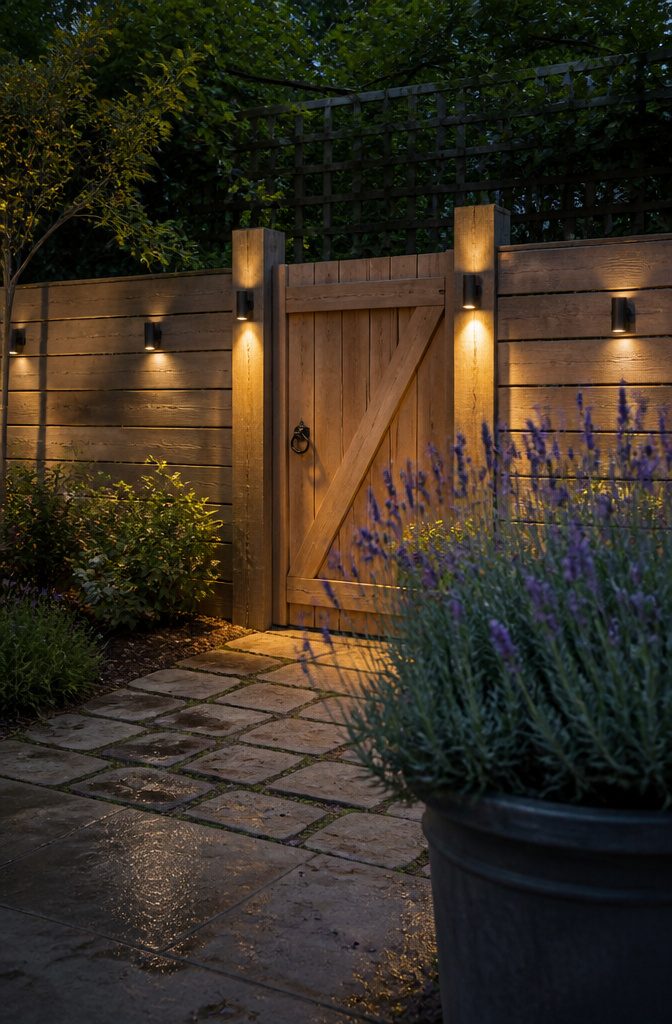
A gate that is slightly brighter than the fence on either side reads as the entrance without a sign.
Wall lights, small spotlights, or post lights around the opening all work, and the brightness gap matters more than which fixture you pick.
Keep the neighboring fence lights a step dimmer. If every fixture glows equally, the eye has nowhere to land.
This helps most when the fence is hard to see from the patio or garden. Guests spot the brighter opening first and find your door without hunting for the latch.
I’d avoid a big jump in brightness, though. A floodlit gate beside a dark fence looks harsh, not welcoming.
Glare and Brightness in Lumens
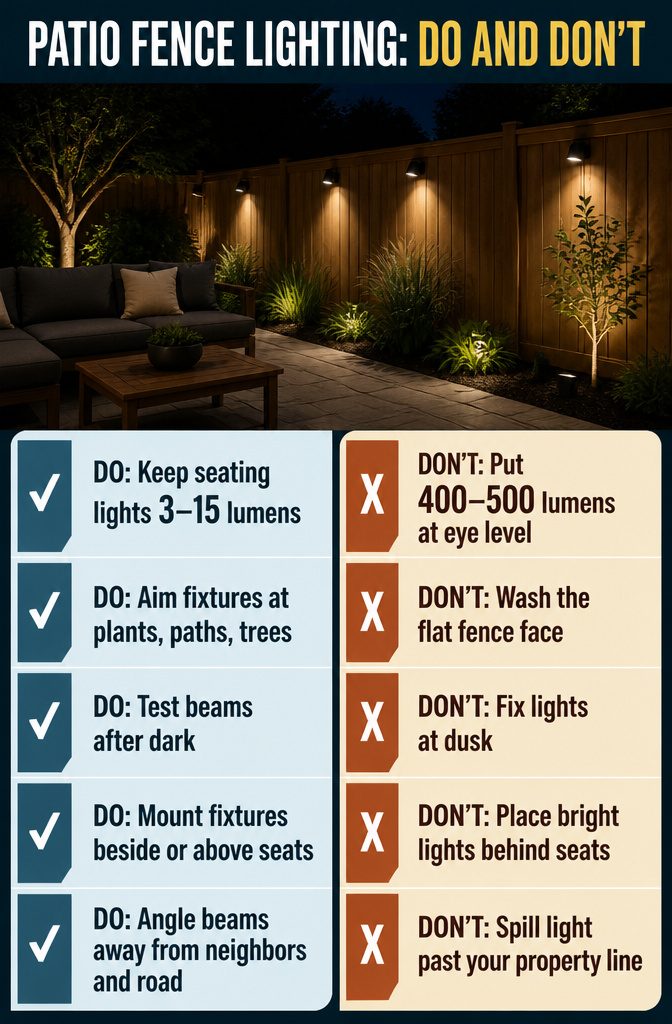
The tested lights run from 3 lumens (Solpex) to 10 (Melunar), 15 (Derynome), 400 (Zookki) and 500 (Aootek). The first three give a soft glow, and the last two are far brighter.
- Do keep lights near seating at 3–15 lumens. Don’t put a 400 or 500 lumen unit at eye level on a patio.
- Do aim adjustable fixtures at plants, walkways and trees. Don’t wash the flat fence face.
- Do test the beam after dark before screwing anything down. Don’t fix lights at dusk.
- Do mount lights beside or above seats. Don’t put bright ones directly behind them, where they glare at anyone looking toward the fence.
- Do angle beams away from neighbors and the road. Don’t let them spill past your property line.
Weather Ratings and Runtime
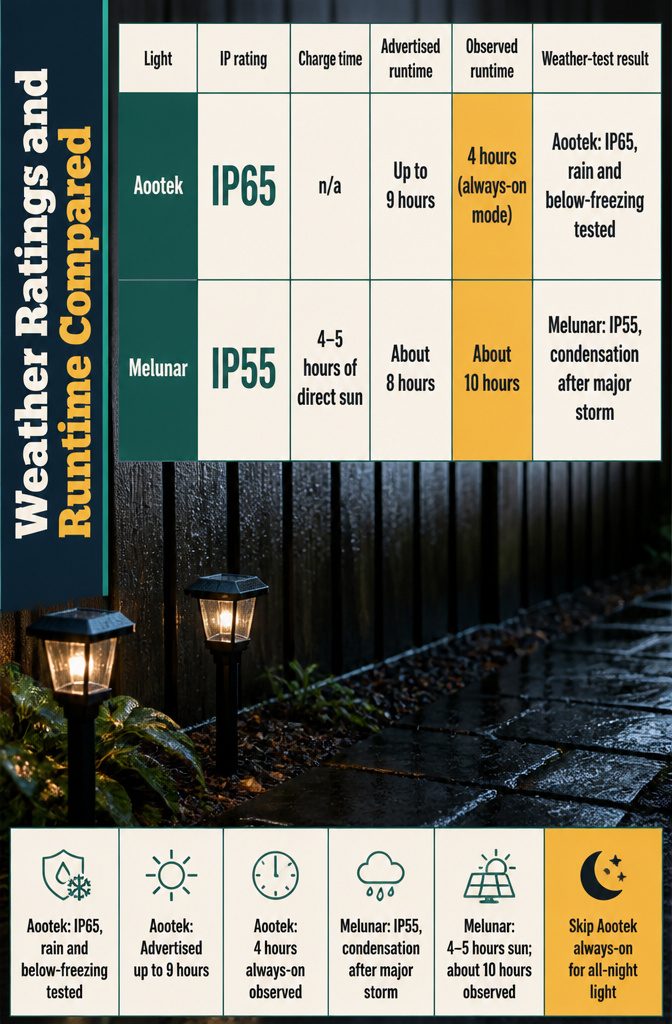
In a three-week test of nine lights, weather rating and runtime separated the good from the merely bright.
Buy weather-resistant lights: the IP65 Aootek handled below-freezing temperatures and rain, while one IP55 Melunar showed a bit of condensation after a major storm.
| Light | IP rating | Charge time | Advertised runtime | Observed runtime |
|---|---|---|---|---|
| Aootek | IP65 | n/a | Up to 9 hours | 4 hours (always-on mode) |
| Melunar | IP55 | 4–5 hours of direct sun | About 8 hours | About 10 hours |
If you want light all night, skip Aootek’s always-on mode. Its two motion-sensing modes worked as they should.
Warm Light for Safe Paths
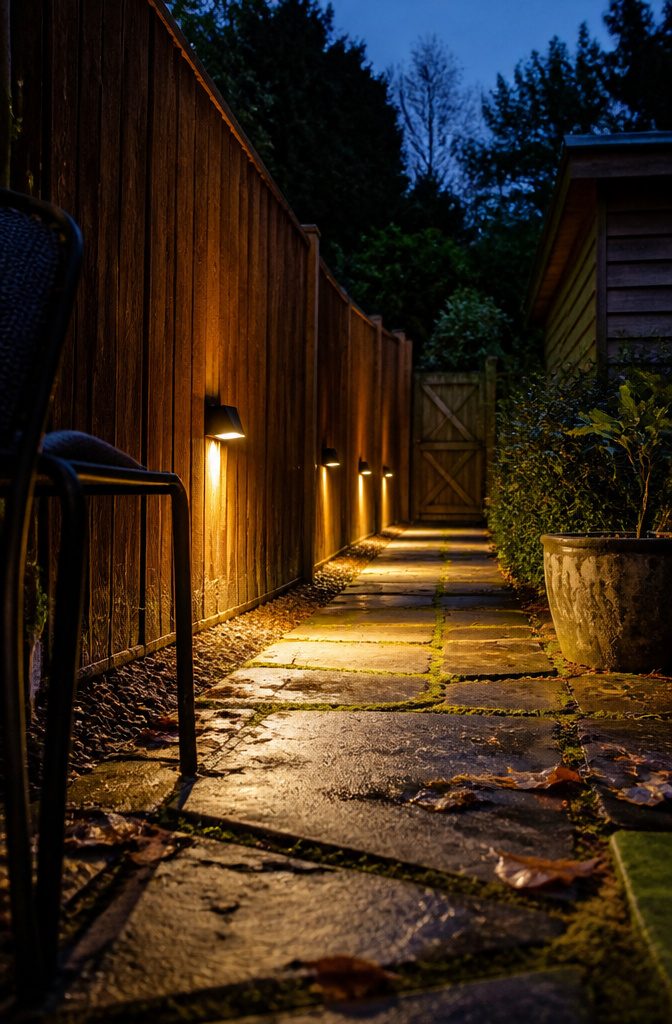
Warm, low light does more for a fence than bright light does. A soft glow adds contrast and depth to the boards, and it marks the boundary line so guests can follow the edge of the yard in the dark.
It also shows where chairs and planters sit, so nobody trips on the way to the gate.
For most yards, I’d pick steady warm white as the everyday setting. Motion-triggered lights suit a side path or gate used now and then, since they stay dark until someone walks by.
Color-changing lights work for a party, but they flatten the calm look and make a path harder to read, so keep them for occasions.
Frequently Asked Questions
What are some creative outdoor lighting ideas for a fence?
Solar post caps, hanging lanterns, downlights under the top rail, festoon string lights, LED strips, and lights on nearby plants all work well.
Light a few chosen points and leave the stretches between them dark, because the contrast gives the fence depth. Lighting the plants in front of the boards also keeps the fence from competing with the garden.
What is the best outdoor lighting for fences?
It depends on the job. Use downlights under the top rail for paths, patios, steps and plant beds, and adjustable fixtures aimed at plants and trees.
Graze rough wood or stone from close to the surface, and wash smooth vinyl or painted boards with a wall washer. Steady warm white is the best everyday setting.
What are common mistakes with outdoor fence lighting?
The usual mistakes are lights that are too bright, glare, poor placement, and fixtures that can’t handle weather.
Keep lights near seating at 3–15 lumens, and never mount bright ones directly behind seats, where they shine at anyone facing the fence. Check the beam after dark before fixing anything in place.
What are the outdoor fence lighting trends for 2026?
Solar, LED, strip and post-cap lights are the trending choices. The look homeowners want is elegant, subtle and modern, with lighting that marks the boundary without drawing attention to the fixtures.









