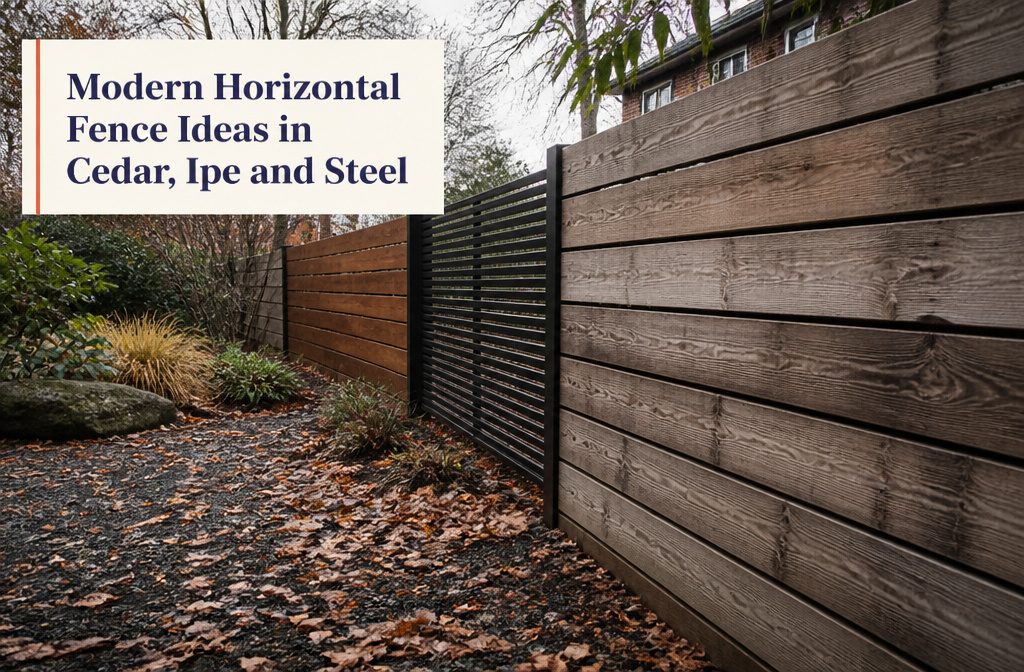
Which of these fits depends on how much privacy you need and how much upkeep you’ll accept: aluminum stays open, board-on-board blocks every sightline, and vinyl never needs refinishing.
Whatever you pick, horizontal boards sag over long spans, so posts go no more than 6 ft apart, compared with 8 or 9 ft for vertical fences.
1. Stepped Fence for a Slope
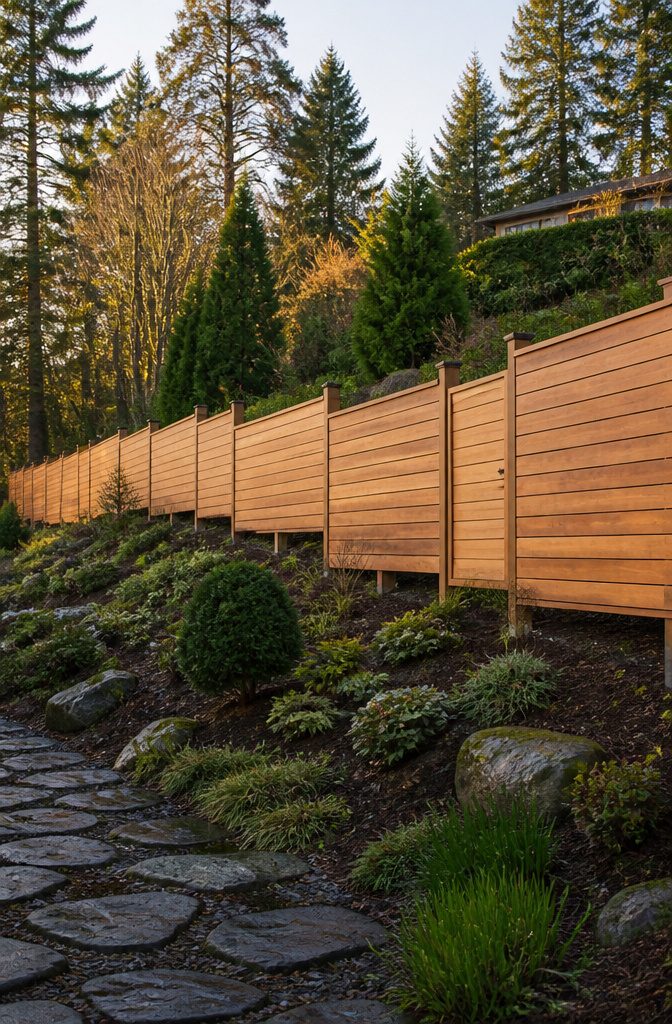
Horizontal boards look best level, so on a hill the fence steps down in level sections instead of tilting with the grade.
Every section is the same height, and the uneven ground creates the step. Each run of boards stays straight and level, which keeps the clean line that makes the style worth choosing.
Installation is harder than on flat ground, and the open space under each step needs a plan before you build.
On a steep lot with a tight budget, I’d pick a vertical fence instead, since it follows the grade more easily and usually costs less.
A gate can sit inside one of the steps.
It stays level with its neighboring run, so you keep access and the horizontal line. Cedar suits it, since the wood resists decay and insects.
Recommended Products
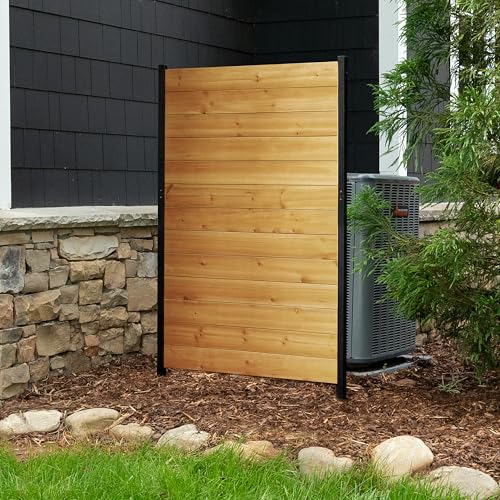
STYLISH NATURAL WOOD: This FSC certified wood screen is made with real wood meaning no two boards have the same grain color, finish, or wood knots differing it from vinyl outdoor privacy fence screen panels.
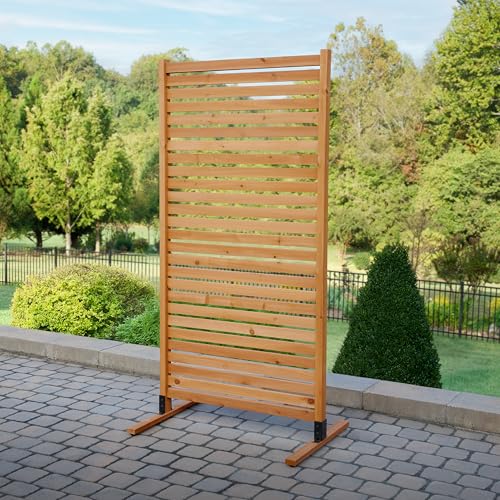
STYLISH NATURAL WOOD: This FSC certified wood screen is made with real wood meaning no two boards have the same grain color, finish, or wood knots differing it from vinyl outdoor privacy fence screen panels.

1 SCREEN PURCHASE: You will receive preassembled materials to construct 1 cedar wood outdoor privacy screen in a charcoal finish with your purchase
2. Cedar and Metal Mix
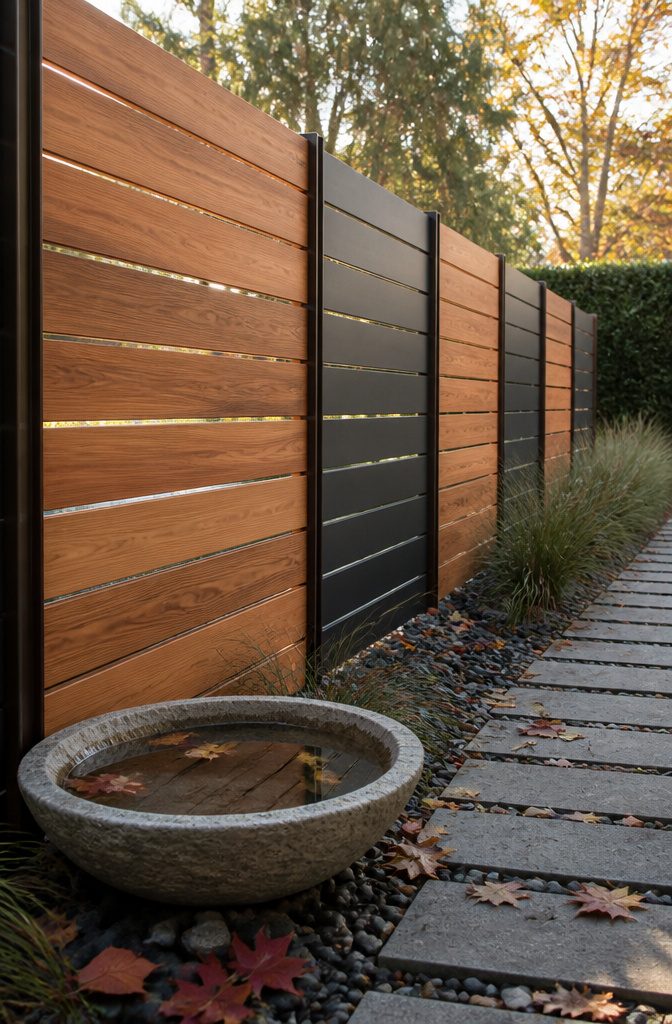
Alternate cedar panels with metal panels and set the whole run on exposed metal posts. Cedar brings a warm color and a grain that’s hard to replicate, and the metal keeps the fence from reading as rustic.
The posts have to be metal, which suits the design: they resist rot, warping and insects, the usual ways wood posts fail. Leave slight gaps between panels so light passes through while privacy stays high.
For a calmer version, I’d pick plain horizontal cedar boards on black metal posts.
The dark posts give a bold contrast, and horizontal boards are less likely to sag over time. Stain color and board spacing are yours to set.
Recommended Products

【For What Size?】Actual internal size of our fence caps is 3.6”×3.6”, which is suitable for 3.5*3.5 inches to 3.6*3.6 inches wood fence post. Application for protecting the top of wood post like deck railing, wooden fence, woody handrail, porch railing and so on. NOTE that measure your posts before use and sanding is required for the wood to fit the post cover if your wood is slightly larger.

【Fit for wood post size】: The interior dimension of this 6x6 matte black pyramid cap is 5-5/8" x 5-5/8", made for 6x6 nominal size post (5-1/2"x5-1/2" actual size). Robust and beautiful!

【Fit for wood post size】: The interior dimension of this 4x4 matte black pyramid cap is 3-5/8" x 3-5/8", made for 3.5" x 3.5" up to 3.625" x 3.625" size post(NOT for other size post). Robust and beautiful!
3. Horizontal Vinyl
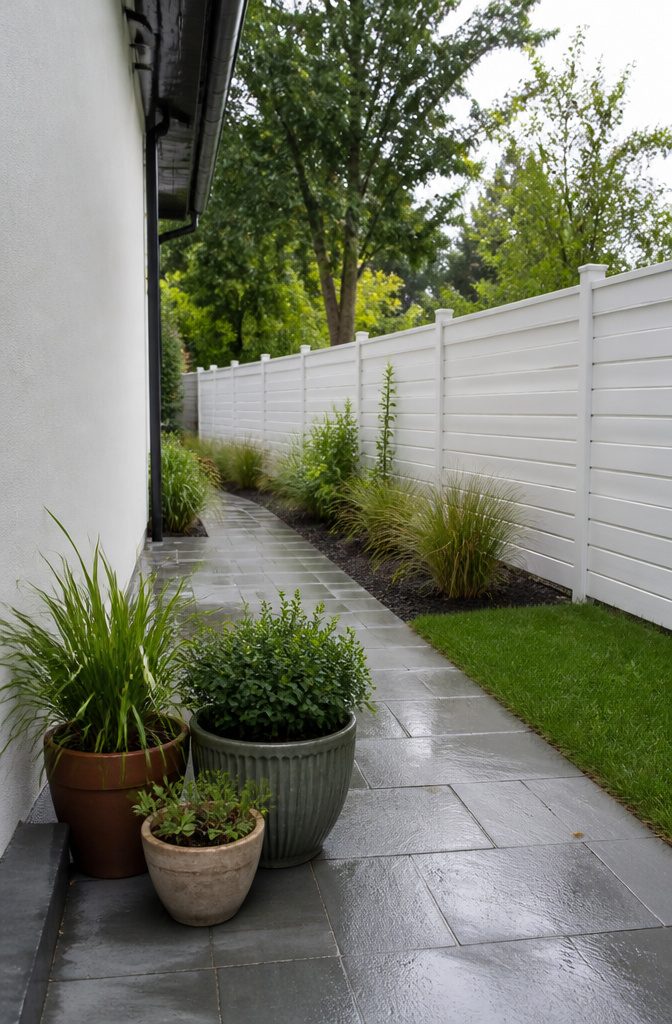
Vinyl suits anyone who wants the horizontal look without ever staining or resealing a fence. The system is horizontal vinyl boards set between vinyl posts.
The material lasts a long time and handles weather well, so upkeep is minimal. Boards come in different sizes and designs, so you can match the style to your house.
What you give up is the wood look. Vinyl reads as clean and uniform, and it can’t match the grain, warmth or aging of cedar.
I’d pick it for a fence you install once and never refinish. If natural texture is the reason you want horizontal boards in the first place, choose wood instead.
Recommended Products

DIY FENCE KIT: The Livingston metal fencing is a DIY-friendly solution with a modern design. Each fence section comes ready to assemble in a convenient box, offering cost-effective alternative to wood and vinyl fencing.

DIMENSIONS: This fence measures 40"W x 30"H ;This item brings 2 panels

Built for Long-Term Value – Not Just Initial Savings : Crafted from high-strength aluminum with AAMA 2604 architectural-grade coating, this fence system is engineered to last 30+ years with virtually zero maintenance. Rust-proof, corrosion-resistant, and built to last in any climate; no worries about rot, warping, or splintering like iron or wood. A true install-once, enjoy-for-decades fencing solution. Say goodbye to welding and painting, save you tons of time and money spent on building your fence either by hiring a contractor or on your own.
4. Horizontal Aluminum
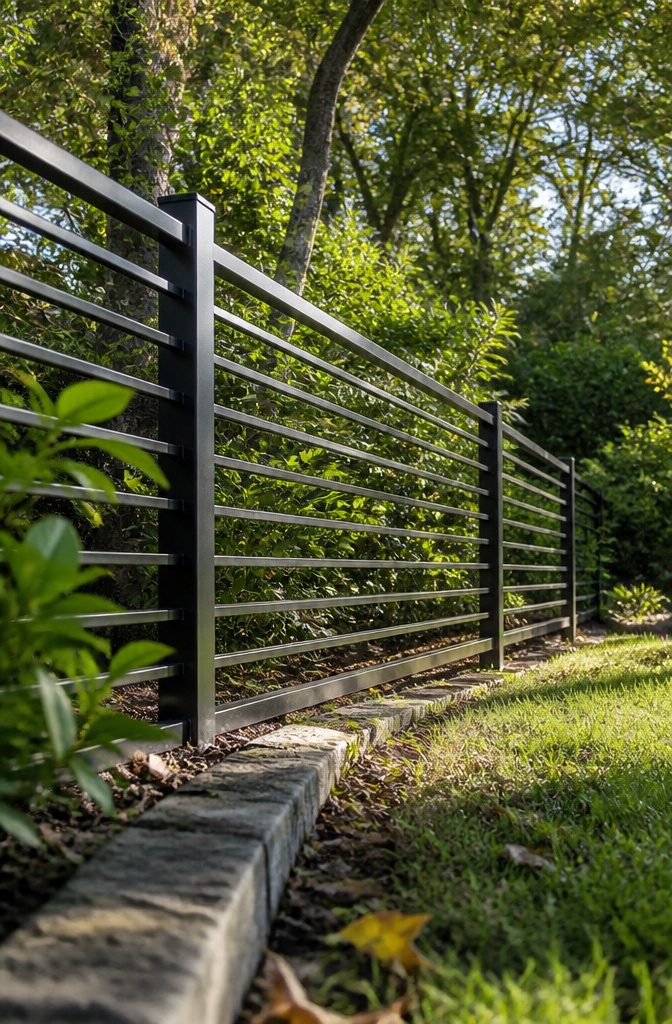
Black aluminum on metal posts gives a horizontal fence its slimmest profile.
Against lawn, shrubs and trees, the dark rails read as a thin line that frames the green instead of competing with it. For a planted yard, I’d pick black over silver or white.
Aluminum also stands up to weather better than wood and can stay rust-free longer than any other fence material. It suits a modern, contemporary look without the upkeep that usually comes with it.
The cost is privacy. Horizontal aluminum reads as more open than wood, so neighbors and passersby can still see in.
If the yard needs screening, skip it. For a front border or a garden you want to show off, it’s the better-looking choice.
5. Ipe Horizontal Fence
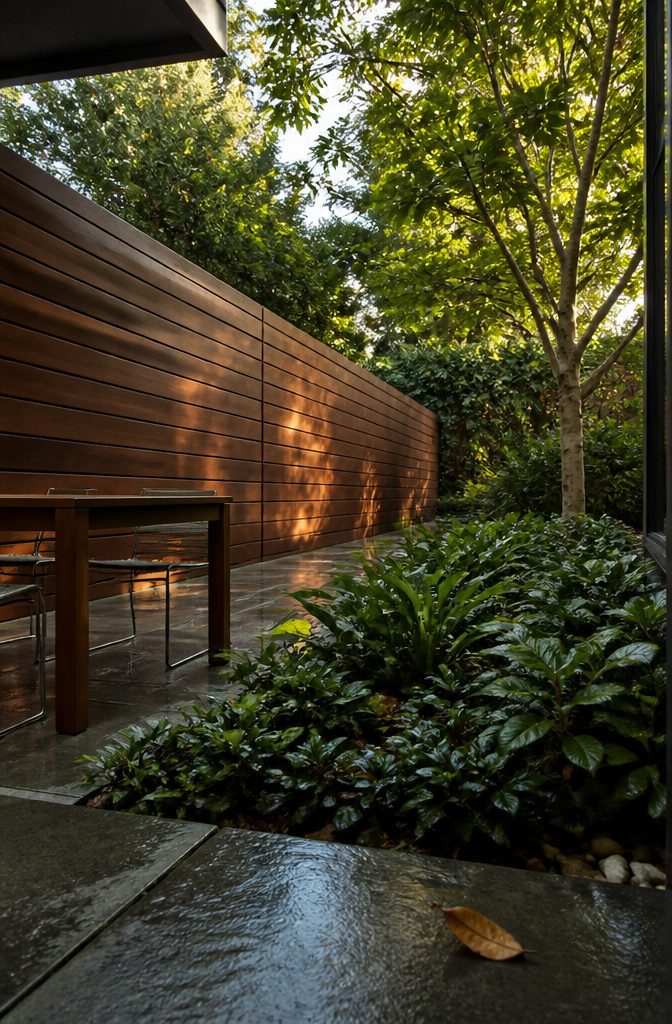
Ipe’s deep red-brown color gives a horizontal fence a rich, sophisticated look, and long boards laid level turn that color into clean, dark lines that suit a modern house.
Buyers pay for it because it lasts, and I’d pick it over the other woods here if you want a privacy fence you only build once. The higher upfront cost is the trade-off.
Ipe is very hard, so pre-drill every screw hole or the boards can split. Unless you oil it, the red-brown also fades toward silver-gray over time, so decide which look you want before you build.
Recommended Products

The answer to any black aluminum square fence post problem

Versatile Fence Posts for DIY Privacy Screens – Features dual screw hole patterns (12holes) for easy installation on hard surfaces. Compatible with 3/4"-thick boards ( 5.5" height), allowing flexible customization of your privacy fence

Upgrade Horizontal Railing Kit: The deck railing adds extra risers to reduce the gap for a protective effect, making it safer than the regular straight style handrail.Features improved safety spacing and smooth rounded edges, making it more friendly for children, seniors, and pets.Product Dimensions (40 inches high, 48 inches wide)
6. Corrugated Steel and Brick Posts
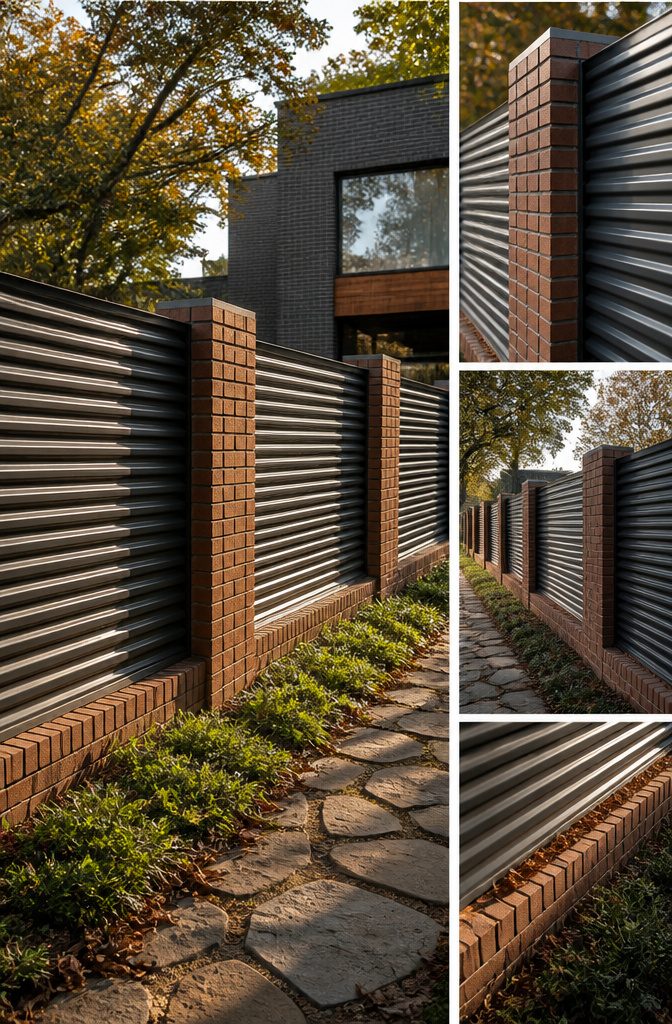
Ridged steel against brick makes the most industrial fence on this list. The waves in the horizontal panels catch light and throw thin shadows, while the brick posts stay flat and solid, so each material sharpens the other.
You can finish the posts two ways. Paint them a color that matches your house, and the fence reads as part of the exterior.
Leave the brick bare, and the fence becomes a feature on its own. I’d paint when the house is a plain color and go bare when the yard needs a focal point.
This is a near-permanent fence that should last for decades, so it suits owners who plan to stay. It fits modern, urban and loft-style homes, and it works in both the front and back yard.
Recommended Products

EASY ORDERING: Everything you need for your fence project is in the box except for the final post. Only ONE additional post, BL19112, is required for the end of your project. A gate is available by searching BL19111.

STYLISH NATURAL WOOD: This FSC certified wood screen is made with real wood meaning no two boards have the same grain color, finish, or wood knots differing it from vinyl outdoor privacy fence screen panels.

DIMENSIONS: Each panel measures 32” H x 48” W
7. Shadow-Box Horizontal Fence
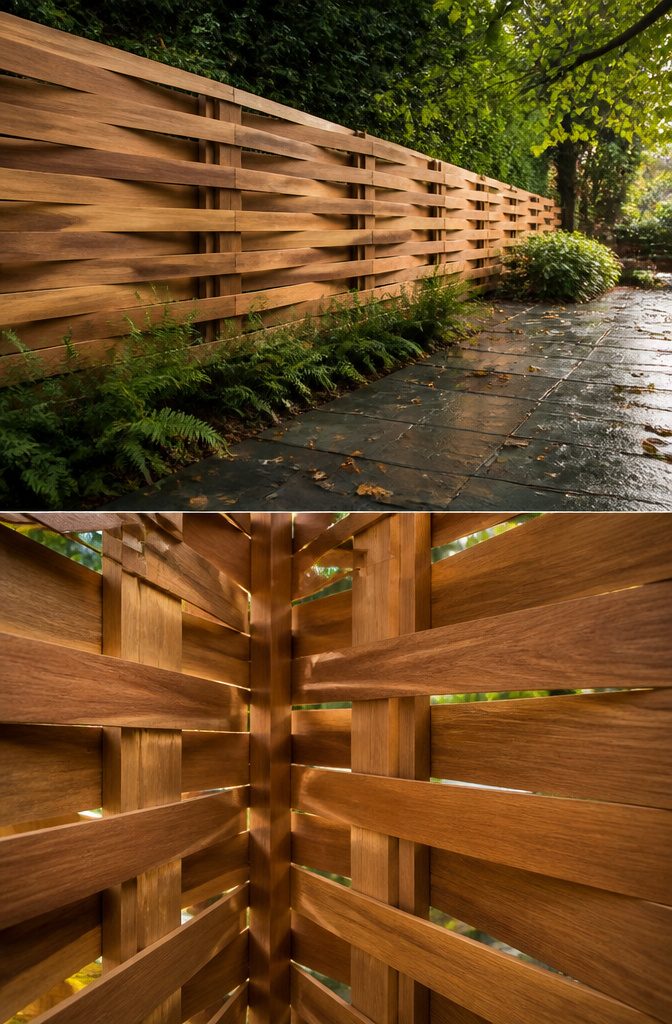
Boards fastened to alternating sides of the rails create the shadow pattern: each board covers the gap behind it, so light and shade shift as you walk past.
Because boards go on both faces, neither side of the property line gets a bare back with exposed framing, and your neighbor sees the same layered look you do.
Privacy depends on the overlap, so set the boards so no one can see straight through from any angle.
Pine is the cheapest and the most common choice.
Cedar costs more but looks better and repels insects, so I’d pick it for a fence people see up close. Spruce sits in the middle on cost and durability.
Recommended Products

SMART TWO-PIECE DESIGN: The fence posts feature a clever two-piece design (1410mm each) that assembles to a full 2660mm (8.7 ft) -taller than most competitors. The split design eliminates the need to stand on a ladder to hammer a full-length post, drastically reducing installation effort and safety risks
Understanding Post Cap Sizes: When a post cap fits a rough lumber or undressed post, the post size is the same as the measurement listed. Example: a 6″ x 6″ rough lumber or undressed post, cap fits a post that measures 6″ x 6″

The Last Post Cap You’ll Ever Need – Made from premium aluminum with a matte black powder coating, these 4x4 post caps resist rust, scratches, fading, and cracking. Featuring smooth, rounded corners for a comfortable and safe touch—No Sharp Edges. Built to outperform cheap plastic caps, they’re designed to last for years.
8. Board-on-Board Horizontal
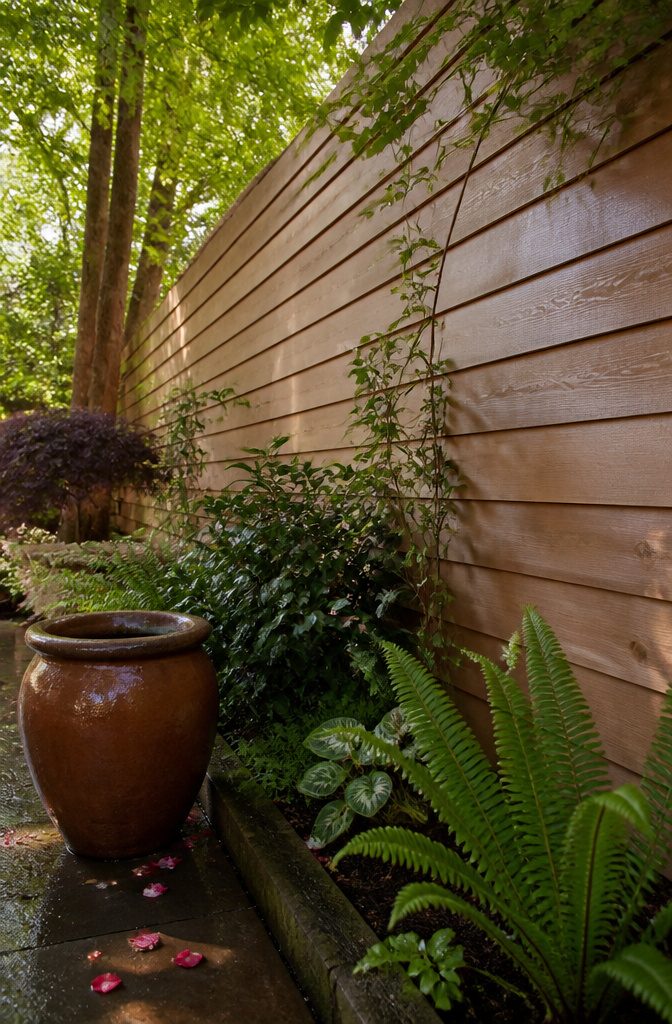
Overlapping the boards removes the gaps entirely, so no one can see through the fence from any angle. Choose board-on-board when full screening matters more than airflow or light.
It also blocks wind, and it looks finished from both sides. Cedar and redwood are the usual woods.
The overlap also forgives movement. Boards shrink and swell across their width with the weather, and treated pine often goes up damp, so a flat-set fence opens gaps as the boards dry.
Overlapped boards keep covering the seam as they shrink, which is why I’d pick this layout over a tight-board fence if you’re building with pine.
A shadow-box fence is the better call if you want breezes and dappled light in the yard.
Recommended Products

SAMPLE KIT ONLY: This is a sample kit, not a full-size panel and post. Cannot be installed into ground.

COMPLETE KIT: Includes two 3" x 36" multi T-track extruded aluminum fences, mounting brackets, hardware, and measuring tape for a fully adjustable back fence system
9. Basket-Weave Cedar
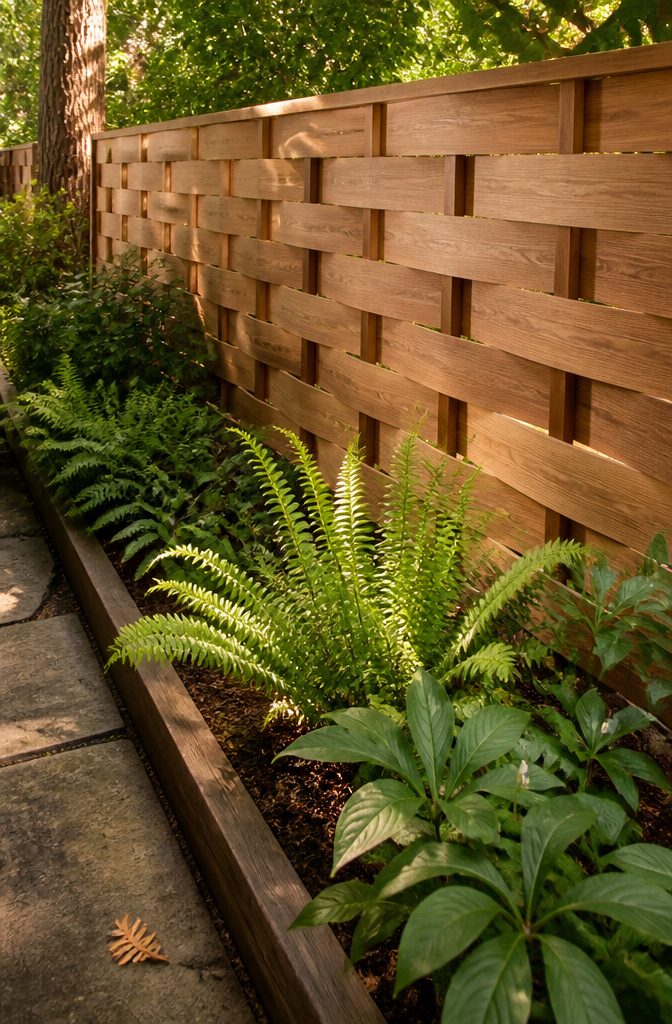
A basket-weave cedar fence alternates boards running horizontally and vertically, so the panel reads as woven texture instead of a straight run of long lines.
A standard horizontal fence pulls the eye sideways. This one breaks that up into a checkered pattern that looks handmade.
The alternating boards give you seclusion, and the weave still lets air move through. That airflow limits moisture buildup and is easier on plants growing near the fence.
I’d choose it for a backyard where you want pattern more than a clean, minimal line. Cedar resists decay, insects and rot, and its warm tone and natural grain suit most house styles and plantings.
Recommended Products

Backyard Privacy Enclosure: Our vinyl fence panel set includes 2 panels measuring 50 x 50 in, ideal for concealing outdoor items like trash bins, pool equipment, and air conditioners, keeping your backyard neat and attractive while meeting HOA guidelines

Backyard Privacy Enclosure: Our vinyl fence panel set includes 3 panels measuring 50 x 50 in, ideal for concealing outdoor items like trash bins, pool equipment, and air conditioners, keeping your backyard neat and attractive while meeting HOA guidelines

Rail Kit: you will receive 6 white vinyl rails and 6 matching caps that enhance your home's exterior appearance and extend outdoor performance; They add visual interest and a modern touch while blending smoothly with any white architectural scheme
10. Varied Slats and Spacing
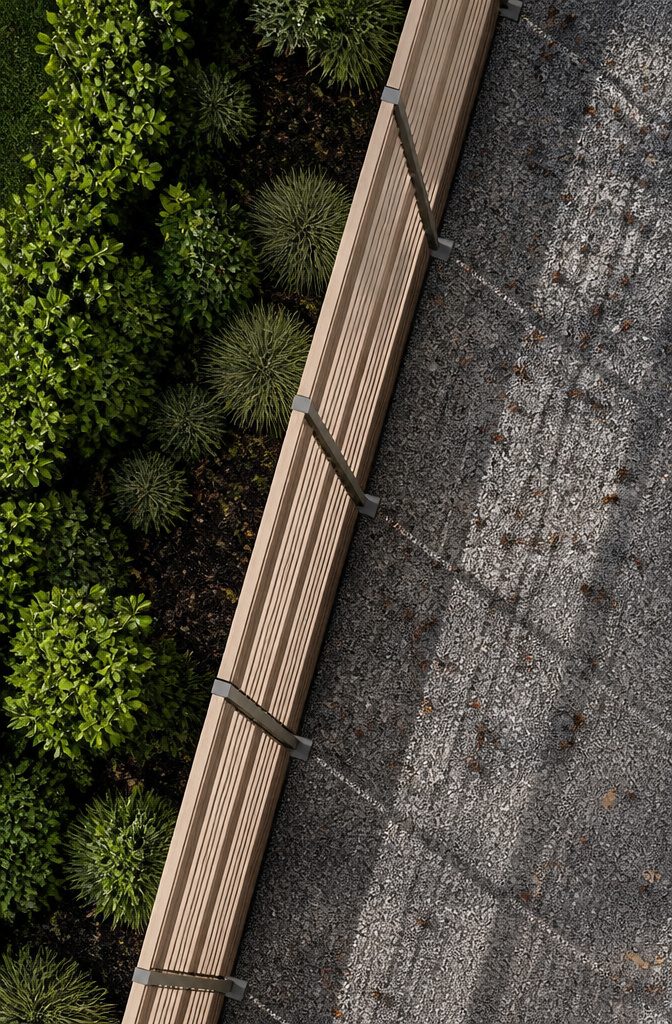
Alternating a 6 inch board with a 4 inch board gives a plain horizontal fence a rhythm that looks custom, and the posts and rails behind it stay the same.
A wider gap every few courses does something similar by breaking the wall into bands.
I prefer the bands on a long run, since they give the eye places to rest. Repeat the same pattern on every section, because a sequence that drifts from panel to panel looks like a mistake.
Sketch the board order first so the top board lands where you want it instead of ending in a leftover sliver.
Recommended Products

【Perfect for Steps】The light provides soft and comfortable glow with louver plate. It illuminates every tread without any glare.

Convenient Package: each set comes with 6 pieces of 1" x 1" black aluminum fences, providing enough quantity for daily use; You won't have to worry about running out while you're in the middle of building or fixing your fence

【Perfect for Steps】The light provides soft and comfortable glow owing to stamped louver plate. It illuminates every tread without any glare. The linear design makes it a perfect choice for steps, especially those with lower risers.
11. Front-Yard Horizontal Fence
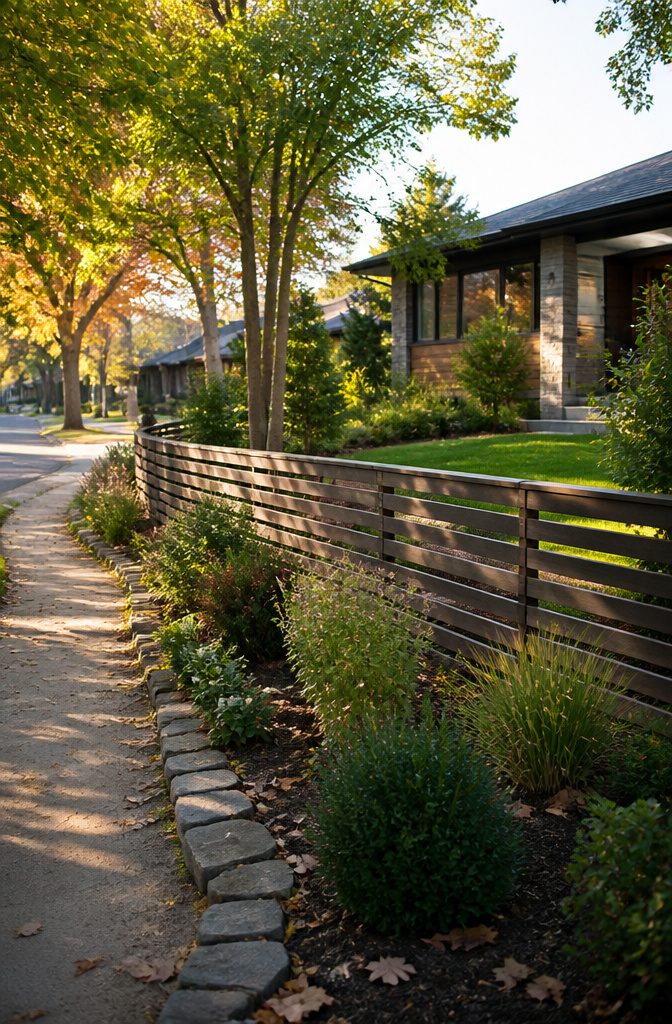
Horizontal boards guide the eye along the length of the property, so a front yard reads wider than it would behind vertical pickets.
The style suits everything from craftsman to contemporary homes, and gaps between boards let air and sightlines through, which keeps the yard connected to the street. For the front, I’d choose a lower, more open build over a solid wall.
Height limits are local, and front yards are usually held lower than the rest.
Chesterfield County, Virginia, for example, allows 4 feet in front yards and 7 feet in side and rear yards. That is one county’s rule, so check your own zoning before you buy boards.
12. A Top Cap Finishes It
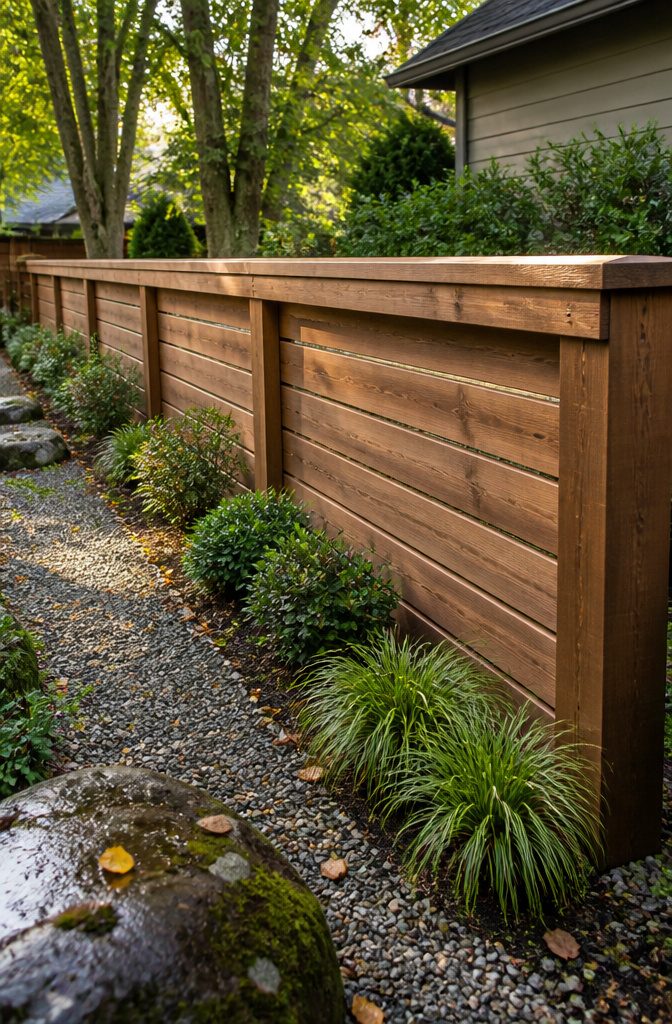
A 2×6 cap board laid across the tops of the posts gives the fence a finished edge and keeps water from soaking into the exposed board ends.
Wood or metal both work as a cap, and it adds some stiffness that helps the fence resist warping and sagging over the years.
Each horizontal board spans the gap between two posts, so spacing matters more here than on a vertical fence. Set posts no more than 6 ft apart, compared with 8 or 9 ft for vertical styles.
If a run still looks long, a center vertical support between posts keeps the boards from sagging. I’d treat the cap as part of the build, not an add-on.
13. Flush Gate or Iron Gate
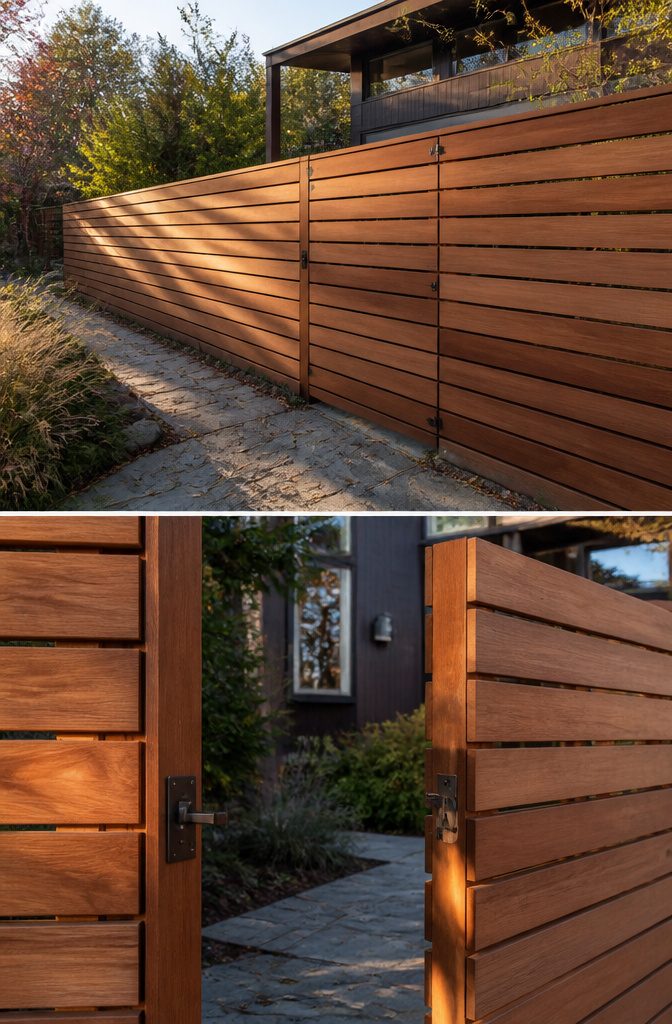
A flush gate is the better default on a modern fence. Build it from the same boards, gaps and trim as the fence so the horizontal lines run straight across the opening and the gate nearly disappears when closed.
Frame it with 2×4 lumber and half-lap joints at the corners, then run a diagonal brace from the upper hinge side down to the lower latch side to stop sagging.
Heavy-duty T-hinges work best, set with a 3/4-inch spacer to keep them aligned. A wide opening may call for a double gate with a center cane bolt.
A decorative iron gate on a wood fence turns the entrance into an accent, and its scrolls, finials or geometric patterns can echo the house.
Privacy and Gap Spacing
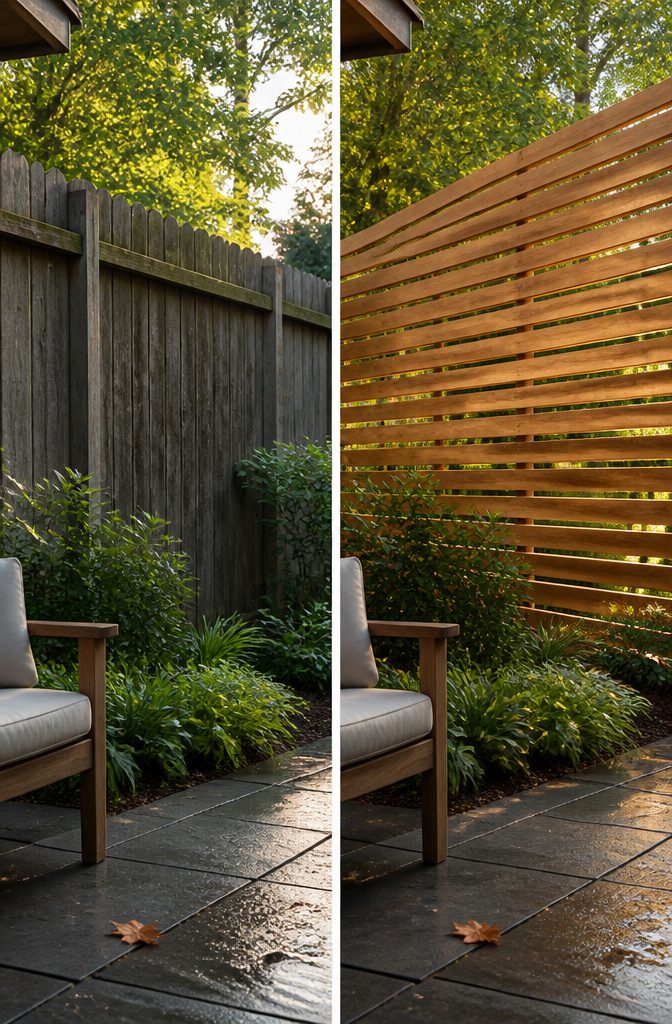
Tight boards block views, while wider gaps let in light and air.
For full privacy, set a 1/4 in. spacer between boards so the gap stays small and even. Boards swell and shrink across their width with the weather, and treated pine often goes up damp, so its gaps widen as it dries.
Wider spacing gives a semi-private fence that still screens the yard but lets the breeze through. The horizontal lines also draw the eye outward, so a small yard feels wider.
Around a pool, horizontal members spaced less than 45 in. apart belong on the pool side, so a child outside can’t use them as a ladder. Check permit rules with your local building department before you plan that stretch.
Cedar, Pine or Composite
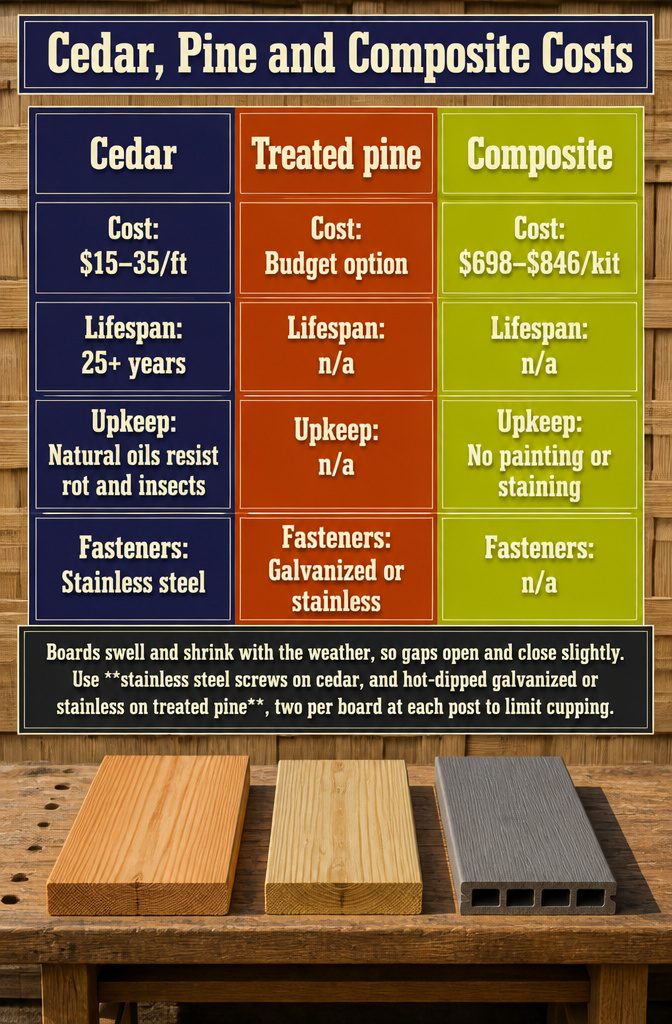
Cedar costs 20–30% more than pressure-treated pine. A 150-foot run at $2,250–4,500 is still the one I’d pick, because long horizontal lines show every bow and cedar stays straighter.
| Material | Cost | Lifespan | Upkeep |
|---|---|---|---|
| Cedar | $15–35 per linear foot; $45–90 premium | 25+ years with care | Natural oils resist rot and insects |
| Treated pine | Budget option | n/a | n/a |
| Composite | $698–$846 per 6 ft x 6 ft kit | n/a | No painting or staining |
Boards swell and shrink with the weather, so gaps open and close slightly. Use stainless steel screws on cedar, and hot-dipped galvanized or stainless on treated pine, two per board at each post to limit cupping.
Frequently Asked Questions
How much does a horizontal cedar fence cost?
Cedar runs about $15–35 per linear foot, and premium builds cost $45–90 per linear foot.
A 150-foot run comes to roughly $2,250–4,500. Cedar costs 20–30% more than pressure-treated pine, but it stays straighter, which matters on long horizontal lines.
What is the best wood for a horizontal fence?
Cedar is the best all-round pick. Its natural oils resist rot and insects, it holds straighter than treated pine through temperature swings, and it can last 25+ years with care.
Treated pine is the budget option. Ipe costs more upfront but suits a privacy fence you only want to build once.
What are the advantages of a horizontal fence over a vertical one?
Horizontal boards draw the eye outward, so a small yard looks wider.
You also set the gap spacing yourself, from tight boards for full privacy to wider gaps for a semi-private screen with airflow. Vertical fences are easier on a steep lot, since they follow the grade and usually cost less.
How far apart should posts be on a horizontal fence?
Place posts no more than 6 ft apart, compared with 8 or 9 ft for vertical fences.
Each board spans the gap between two posts, so a longer span lets the boards sag. If a run still looks long, add a center vertical support between the posts.
Should I build a horizontal fence myself or hire a professional?
It depends on your building experience, your tools and how complex the project is.
DIY saves labor costs, while a professional brings expertise and a warranty. A first-time builder may find a pro worth the money, especially on a sloped lot or with hard wood like ipe that needs every screw hole pre-drilled.
How tall can a horizontal privacy fence be?
Local zoning sets the limit, and front yards are usually capped lower than side and rear yards.
Chesterfield County, Virginia, allows 4 feet in front yards and 7 feet in side and rear yards. Your area may differ, so check your zoning before you buy boards.
Can a horizontal fence go around a pool?
Yes, with care. Horizontal members spaced less than 45 in. apart belong on the pool side, so a child outside can’t use them as a ladder.
Pool barriers need a permit in Virginia, so check with your local building department before you plan that stretch.