
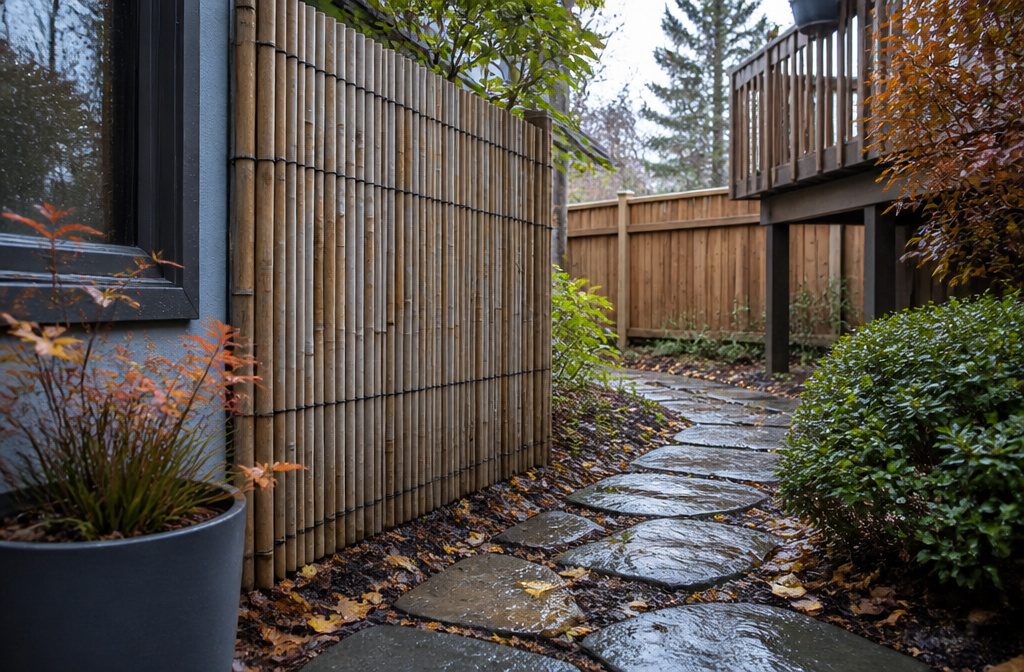
Installed prices run from $3–5 per linear foot for bamboo to $15–30 for vinyl, but the cheapest fence is the one that covers only the sightline that bothers you.
Labor is about 50% of the total, so a low-cost material still adds up across a whole property line.
1. Pressure-Treated Wood
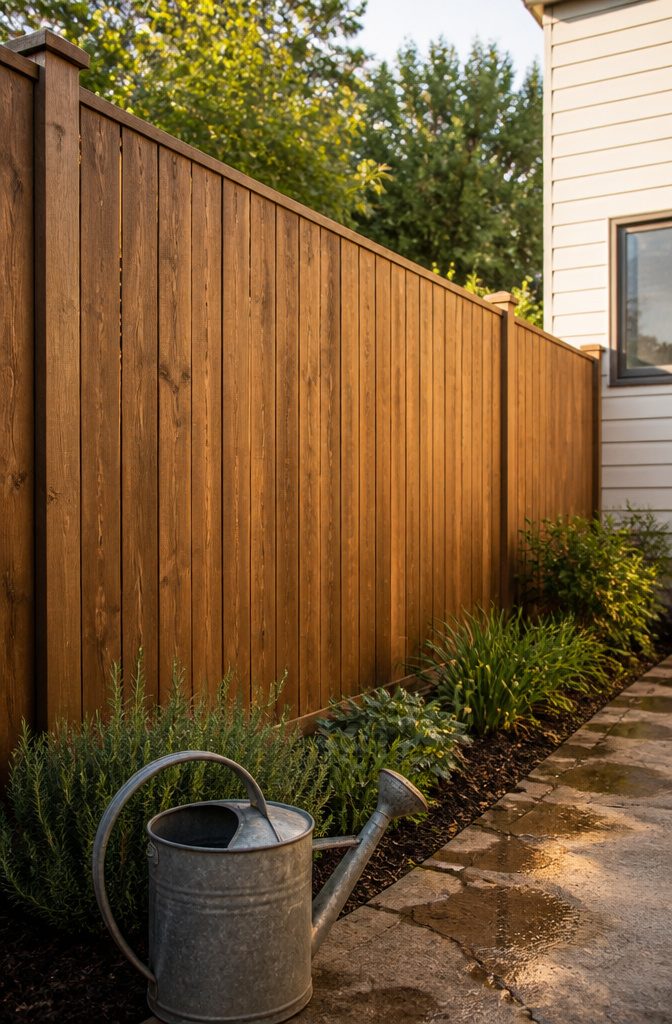
Pressure-treated panels give solid coverage at an average installed cost of $12–20 per linear foot, which is why they remain the default budget privacy fence.
The treatment resists decay and insects, and pine is usually the cheapest wood to start with. Boards that sit tight together block sightlines better than open designs, so wood wins for a yard neighbors can see into.
Reclaimed or mixed boards can cut material cost and give the fence more character than uniform panels. Vertical boards look clean, and horizontal ones look more modern for about the same money.
Upkeep is what wood asks in return.
A stain or sealant extends the fence’s life, and it lets you match the tone to your house. Budget time to reapply it.
Recommended Products
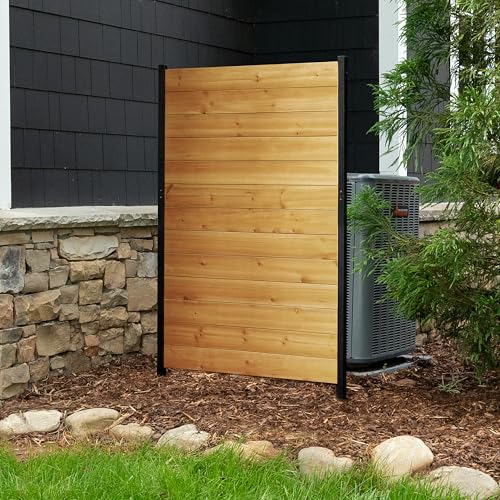
STYLISH NATURAL WOOD: This FSC certified wood screen is made with real wood meaning no two boards have the same grain color, finish, or wood knots differing it from vinyl outdoor privacy fence screen panels.

Versatility: This wooden privacy screen provides a discreet enclosure, creating a sense of mystery and concealment. It is perfect for elevating the overall aesthetic of your outdoor space. Quickly creates a secluded retreat while adding a touch of elegance that complements any décor, indoors or out.

STYLISH NATURAL WOOD: This FSC certified wood screen is made with real wood meaning no two boards have the same grain color, finish, or wood knots differing it from vinyl outdoor privacy fence screen panels.
2. Bamboo Fencing
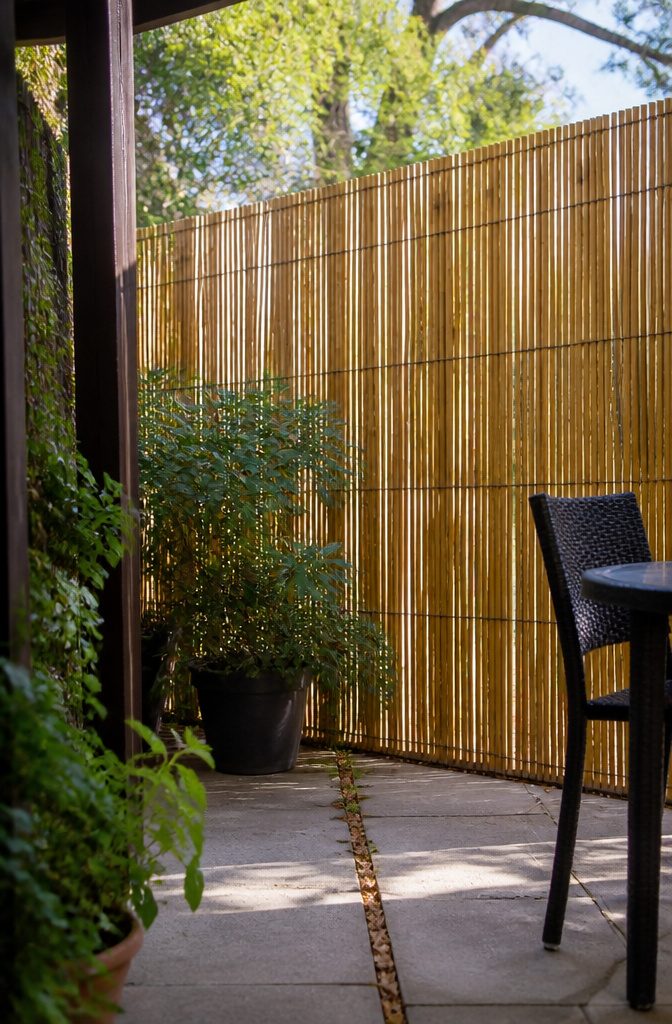
Bamboo gives a yard a tropical, Asian-inspired look for $3–5 per linear foot installed, which usually undercuts wood. Canes or poles are tied together with wire or rope and sold as loose poles, panels or rolls.
Rolls cost the least, and I’d choose them for a balcony rail or a patio edge where you want screening more than a wall.
Privacy depends on the form.
Rolls of thin canes pass light and glimpses, panels with tighter spacing block more, and none matches a solid board fence. Bamboo resists pests and weather, yet extreme weather and insects can still damage it.
Sealing slows that wear. Plants set in front of it soften the look and hide gaps.
Recommended Products

Natural Reed: The bamboo curtains for patio outdoor uses strictly selected natural wild reeds as weaving materials, which are fine and uniform, tough and straight, and have a delicate and smooth feel. The bamboo privacy fence is made using original hand-woven methods. The workmanship is fine and unique, creating a classical work of art. The faint scent of grass fills the surroundings, creating a simple and elegant atmosphere.

QUALITY – Our premium bamboo slat fence are all hand made, using the high quality bamboo from the subtropical monsoon climate region. Garden fence is made of split bamboo and can be used to section off parts of the garden or line a path or driveway to add a tropical charm to your outdoor living space. Bamboo is eco-friendly materials, all bamboo stakes are hand selected and hand treated.

Carefully Treated: Crafted from premium split bamboo, these garden fences provide an elegant way to section off garden spaces, line pathways, or enhance your driveway. Bamboo is a sustainable, eco-friendly material, and each bamboo stake is carefully selected and hand-treated for superior durability
3. Chain Link With Slats
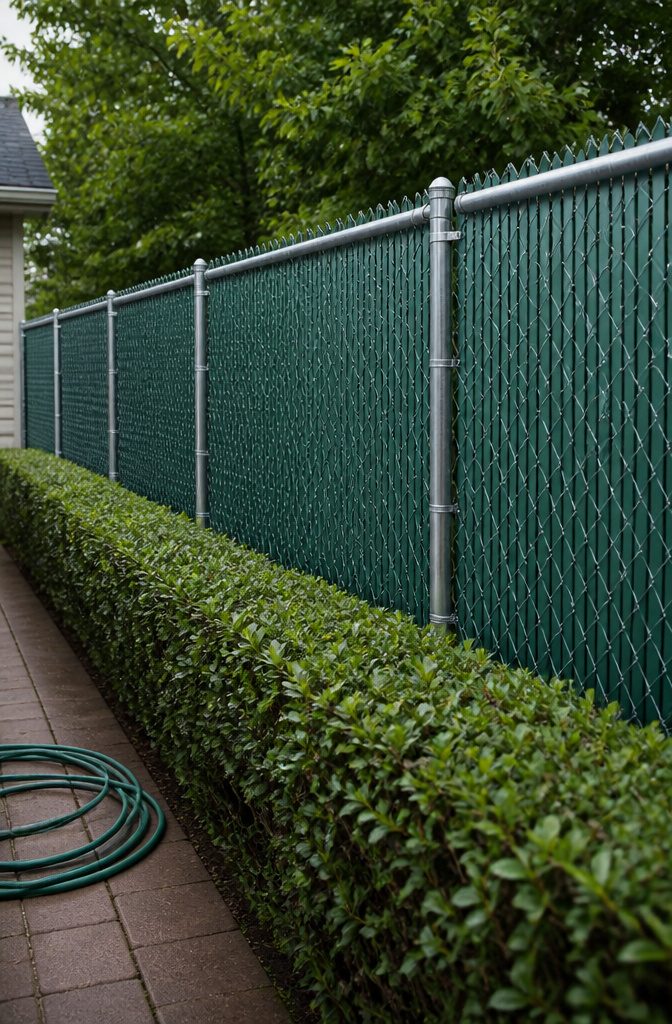
Chain link costs $8–20 per linear foot installed, and on its own it hides nothing. Slats woven vertically through the mesh close the gaps the day you finish and need little care beyond an occasional rinse.
Rolled privacy inserts do the same job and go up faster, though cheaper plastic versions can fade and crack in strong sun.
Climbing vines are the cheapest add-on, because a few small plants cost less than any slat kit. They take a season or two to fill in, and they need pruning so they don’t weigh down the wire.
A hedge planted just in front looks best, since the fence disappears behind it. I’d choose slats if you need privacy now, and a hedge if you can wait.
Recommended Products

Quality: These black fence tapes are made of weather resistant PVC material and are designed for long-term use.
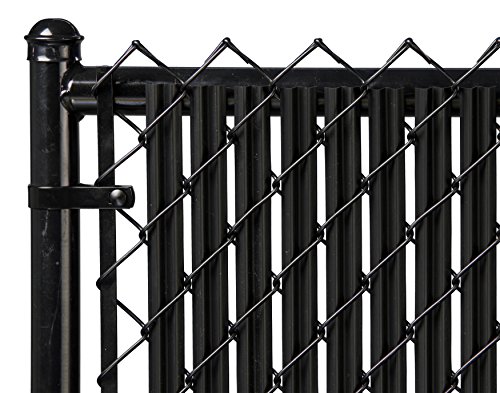
Black Ridged Slats for 4ft chain link are deliberately cut to about 44.5in long. These fence inserts are designed primarily for 4ft 11 or 9 gauge chain link with a two inch diamond. Also works in economy chain link with a larger diamond pattern, but privacy will be less. Slats must be installed correctly and be fully inserted inside the wire mesh of your fence to achieve the desired results. Cannot be used to extend the fence height. Not suitable for fences on a steep slope.

Perfect Fit & Easy Installation: Our Privacy Screen Fence measures precisely 5' x 50', making it a perfect fit for fences 5 feet or slightly taller. It can be easily installed on chain link fences, existing cyclone wire fences, wooden retaining walls, welded wire fences, and more. For easy and secure installation, we've included grommets placed vertically every 1 foot and horizontally every 2 feet, with 4 grommets at each corner. We also provide 80 zip ties for added convenience.
4. Living Fences and Greenery
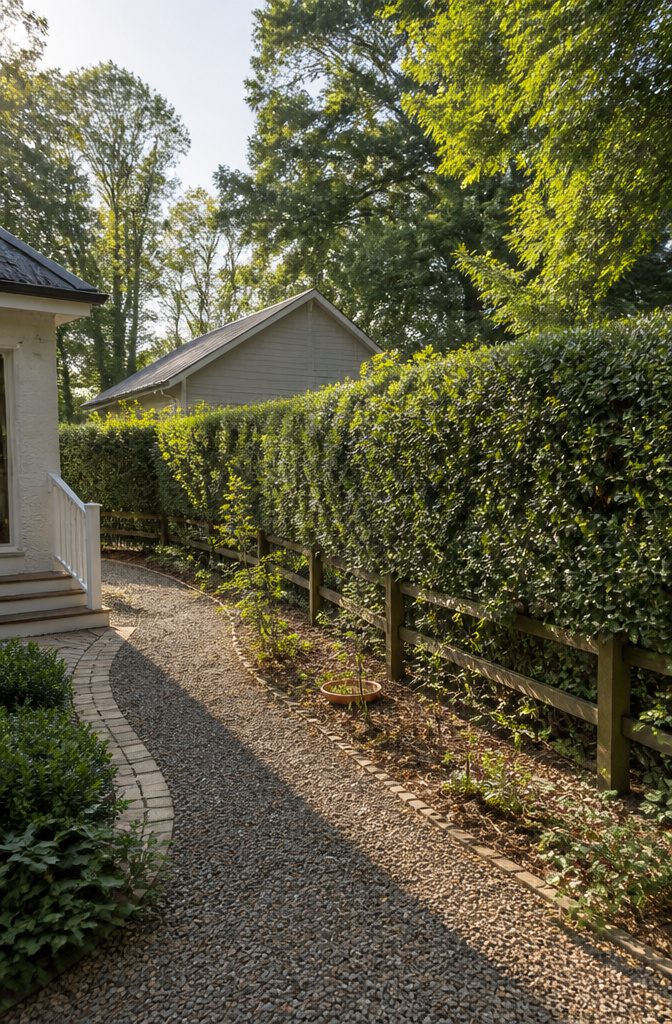
Hedges cost about $5–10 per linear foot installed.
Boxwood, privet, holly, yew, laurel and arborvitae are the usual picks, and you can choose evergreen or deciduous to suit your climate. Young plants take seasons to fill in, so expect gaps at first.
After that, a hedge needs regular pruning and watering to stay dense and keep its shape. Looked after, it can last for decades.
For faster cover, I’d pair a 3–4 foot fence with shrubs or climbers that supply the rest of the height.
You get the privacy of a taller fence with less lumber and less labor, and the plants soften the look of the fence while they grow.
Recommended Products

Rapid Growth Rate – Quickly matures into a tall and full evergreen, ideal for creating privacy and defining property lines naturally

Realistic Natural Look: Artificial ivy wallscreen measures 98" long and 39" wide, this artificial ivy privacy fence screen is constructed with vein-detailed green faux ivy leaves. Adjustable leaf orientation lets you tweak the look for a fuller, more organic appearance. lifelike foliage builds an elegant green backdrop and elevates visual effect for your patio, garden and living area, bringing you immersive green scenery.

REALISTIC GREENERY: Artificial leaves beautify any room or space with a natural look that provide every indoor or outdoor space a blooming, earthy feel without the need for watering
5. Entry-Level Vinyl
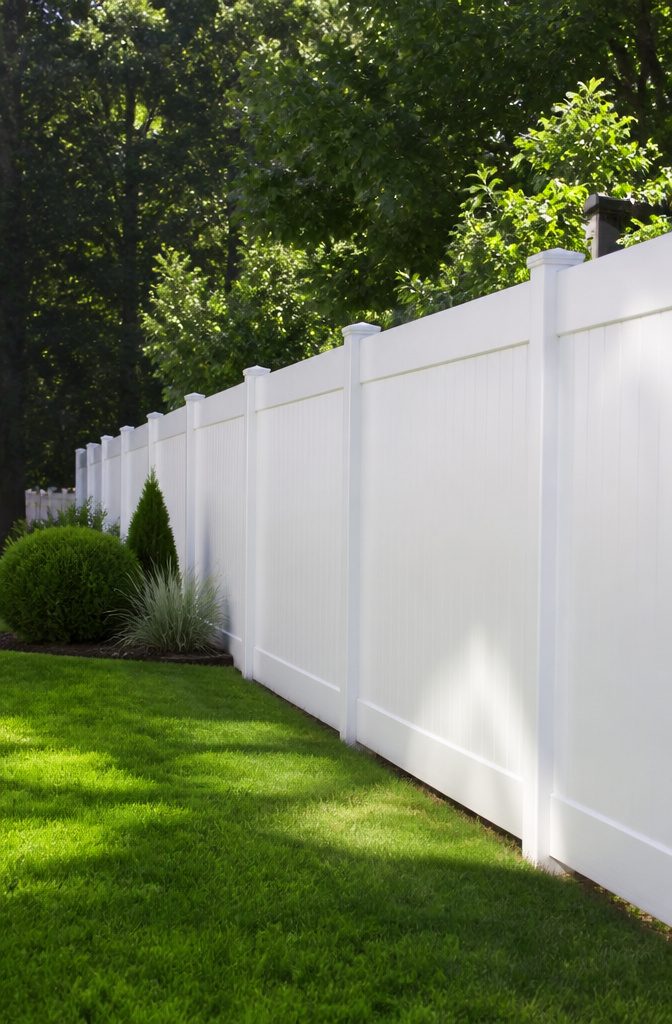
Vinyl is the priciest option on this list, at $15–30 per linear foot installed. A 100-foot run costs $1,500–3,000.
In return, you never stain, seal or repaint it, and it stands up to moisture and temperature swings. White or tan panels resist fading and suit most houses.
Buy the basic privacy panel, not a premium style. The solid panel provides the privacy, and the plain version still lasts for years.
Vinyl suits people who would rather pay once up front than spend weekends on upkeep. If this year’s budget is tight, choose a cheaper option from this list.
Recommended Products

PRECISE 1/4 IN. DECK BOARD SPACING TOOL FOR UNIFORM GAPS: Deck spacer tools maintain consistent 1/4 in. spacing between boards during installation, creating a clean, professional appearance and ensuring structural spacing performance.

Innovative Design: The wooden fence panels posts features a U-channel design—simply attach the brackets to the posts and slide in (3/4" x 5.5") wood planks to lock. Easy DIY installation and plank replacement, even for one person, saving time, effort, and labor costs in the short and long term

Tool-free snap-in design, no screws required. Installation can be done with bare hands, and the positioning is quick, while disassembly is also convenient.Made from high-quality, high-density nylon, it is tough, durable, and reliable, and can withstand repeated impacts. It is UV-resistant, salt- and alkali-resistant, and corrosion-resistant.
6. Split-Rail Fencing
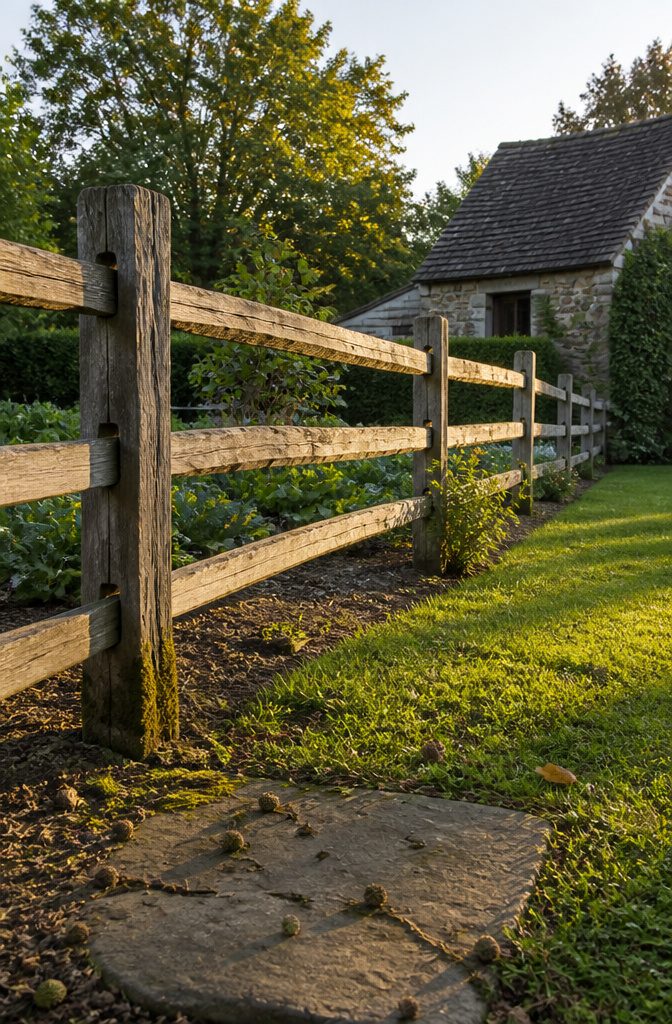
Split rail runs $11–29 per linear foot installed. The price stays low because it uses fewer materials: posts with two, three or four rails slotted between them, and nothing filling the gaps.
Locust, cedar, redwood and spruce are the usual woods. More rails give you more height and a tighter look, and each one adds to the cost.
It gives no privacy. Anyone can see straight through it, so I’d treat it as a boundary marker for a compact yard where screening isn’t the goal.
If you still want some cover, plant along the rails or attach a screen to them. At that point you’re paying for two fences, and a solid style may cost less.
Recommended Products

WINDPROOF OUTDOOR PRIVACY SCREEN: A 25 in deep base and stainless bolts keep this freestanding wooden privacy screen planted in gusts, so your patio privacy screen stays up without babysitting it every storm.

1 SCREEN PURCHASE: You will receive preassembled materials to construct 1 cedar wood outdoor privacy screen in a charcoal finish with your purchase

Upgrade iCover Privacy Screen For Fence: Our privacy screen is made of heavy-duty knitted net, measuring 4 ft high by 50 ft long. It is suitable for fences with a height of 4 ft or slightly higher. Please accurately measure your fence before purchase
7. Pallet Fencing
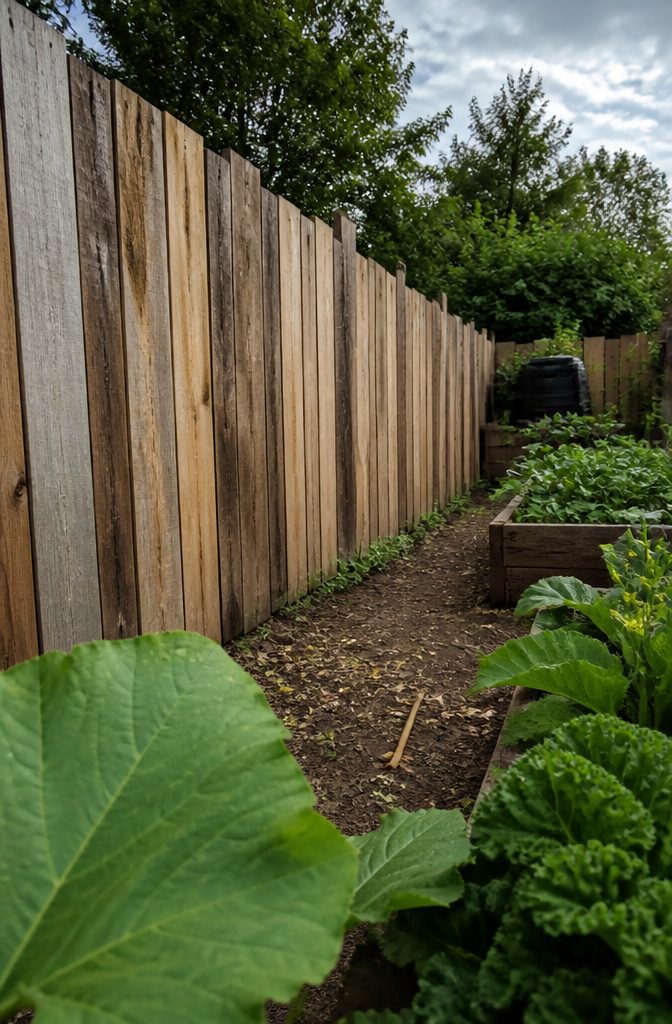
Pallet fencing runs about $10–20 per linear foot installed, which puts it at the low end of privacy options.
It suits vegetable beds, side yards and casual backyards where a rustic, mismatched look is the point. Pallets are easy to find, and reusing them keeps lumber out of the landfill.
The low price shows up in the boards.
Reused slats vary in thickness, width and condition, so the fence looks uneven unless you sort and sand them first. Gaps between slats let sightlines through, so butt the boards tight if you want real privacy.
Weathered or cracked wood also rots sooner than new lumber, which means patching and a sealer coat. For a formal front yard, I’d skip it.
Recommended Products
Natural Reed: The bamboo curtains for patio outdoor uses strictly selected natural wild reeds as weaving materials, which are fine and uniform, tough and straight, and have a delicate and smooth feel. The bamboo privacy fence is made using original hand-woven methods. The workmanship is fine and unique, creating a classical work of art. The faint scent of grass fills the surroundings, creating a simple and elegant atmosphere.

Natural Reed:The Bamboo Curtains for Patio Outdoor uses Strictly Selected Natural wild Reeds as Weaving Materials,Which are Fine and Uniform,Tough and Straight,and have a Delicate and Smooth feel,Each reed Curtain is Hand-Woven by Artisans,Preserving the Natural Texture and Fragrance of the reed,adds a cozy,Natural Touch,Where Sunlight Meets Serenity

Premium Materials: Our bamboo fence is made from high-quality bamboo, handcrafted and sourced from the subtropical monsoon climate zone. Each bamboo stick is carefully selected and processed to ensure durability and aesthetic appeal. The split bamboo is perfect for partitioning garden areas, laying paths, or driveways, bringing a touch of tropical charm to your outdoor space. Bamboo is an eco-friendly material, representing our respect and appreciation for nature.
8. Corrugated Metal
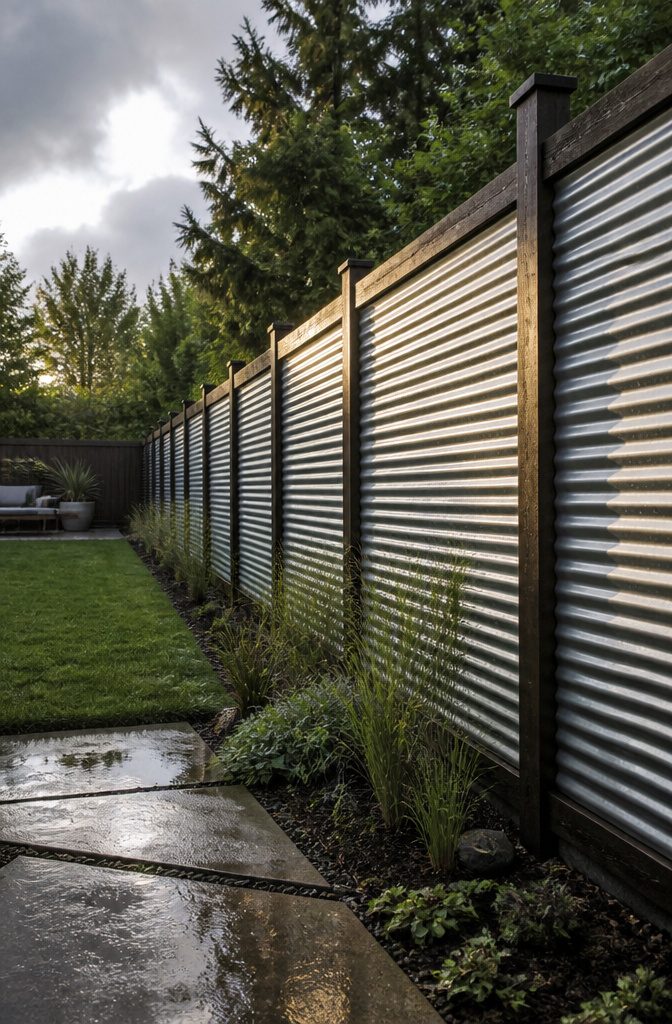
Corrugated metal costs $10–20 per linear foot installed.
The panels come in different colors, shapes, and sizes, and they cut easily, so an awkward corner or a curved run is no problem. They are also easy to install, need little upkeep, and hold up in harsh weather.
Used alone, the ribbed panels give a yard a clean, industrial look. I prefer them with wood posts and rails, because the wood frame warms up the metal and gives the fence a rustic feel.
Vinyl posts and rails work too, and they cut maintenance further. Pick the wood if you want character, and the vinyl if you want to forget the fence exists.
Recommended Products

Quality: These green fence tapes are made of weather resistant PVC material and are designed for long-term use.

Single-Wall Privacy Slats: Designed specifically for 4' high fences, these bottom locking privacy slats are approximately 44.5" in length, ensuring a ideal fit and avoiding slats from extending above the fence top.

Black Fence Slat - Designed for a 4' high fence, slats are approximately 44.5" in length to accommodate the bottom locking channel and to prevent the slats from being above the top of the fence. (Available Colors: Beige, Black, Brown, Gray, Green, Redwood, Royal Blue, Sky Blue, White)
9. Composite Panels
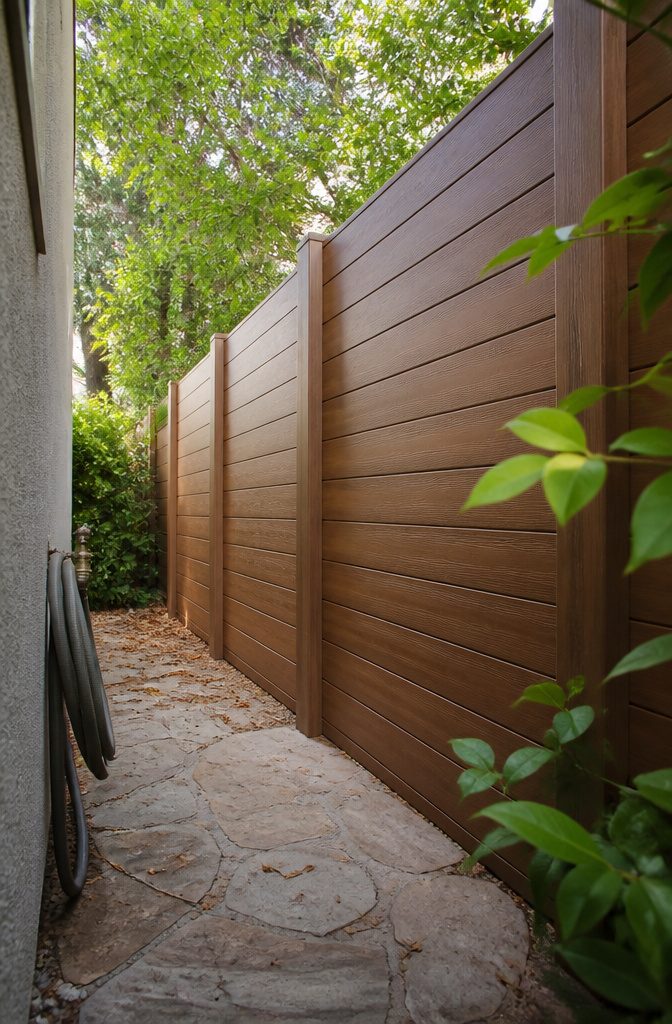
Composite panels give you the look of wood without the three things that wear wood out: moisture, insects and warping.
That matters most along a narrow side yard or behind shrubs, where replacing a bad board is a chore because you can barely reach it. Upkeep stays minimal, so there is no painting or staining schedule to keep up with.
I’d pick composite over wood for a fence you want to forget about, but it is not the cheapest way in.
Expect to pay more up front than you would for wood, with the savings coming later in skipped staining and repairs.
On a tight yearly budget, look at entry-level lines rather than premium ones, and choose composite only if you plan to stay put for a good while.
Recommended Products

Rapid Growth Rate – Quickly matures into a tall and full evergreen, ideal for creating privacy and defining property lines naturally

Rapid Growth Rate – Quickly matures into a tall and full evergreen, ideal for creating privacy and defining property lines naturally
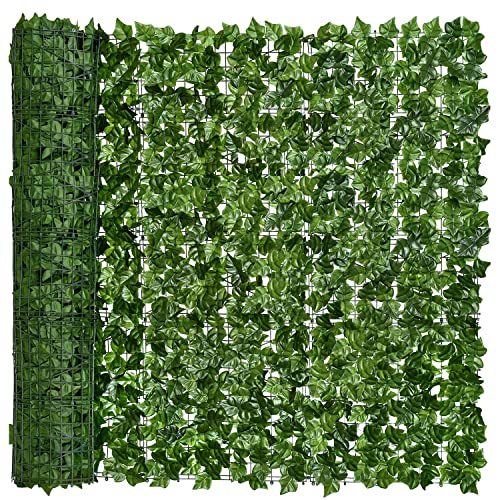
Realistic green Ivy look: Artificial ivy leaves are natural looking to provide every indoor or outdoor space a blooming, earthy feel without the need for watering,Use zip ties or tape to install, it can be cut to get the size and shape you want, can be used as wall decoration, fence, privacy screen.Tip:All of our products Size are folded and put into 39inch Long bags, when you receive the product, you need to open and unfold the fences to get the real size products.
10. Decorative Barriers
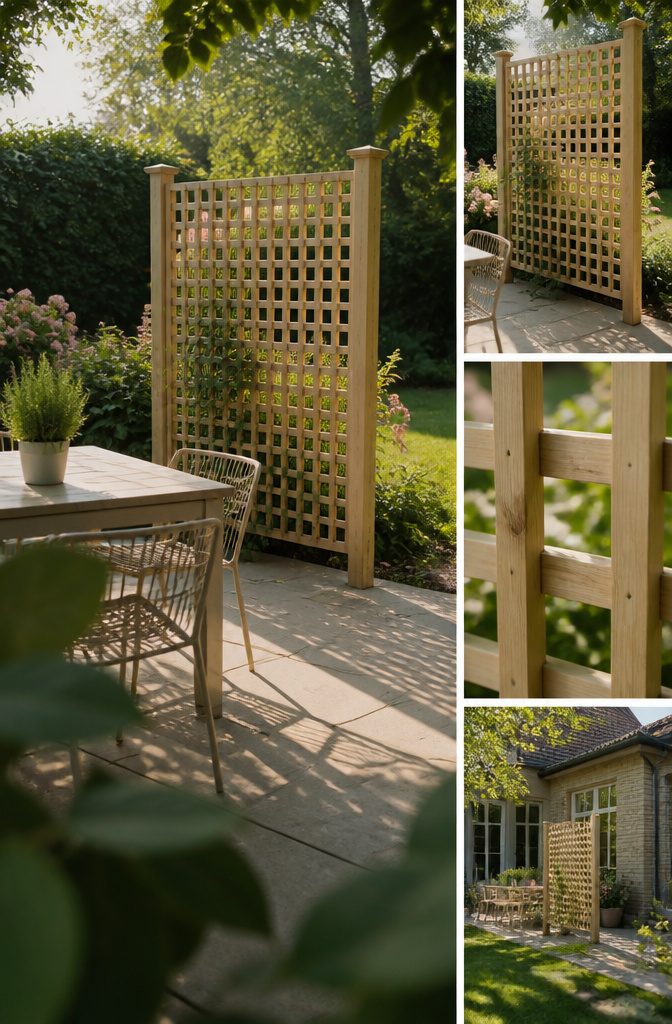
Trellises, lattice panels and garden screens block a sightline without enclosing the yard, which makes them cheaper than fencing the whole property.
They work best as short runs placed where someone actually looks. Along a patio edge, a lattice panel or screen shades the seating area from the yard behind it.
Where a neighbor’s window faces your table, a single screen set in that line of view is enough, so cover only the sightline that bothers you.
A trellis fits narrower spots like a balcony rail or porch side, and a climbing vine will fill it in over a season or two.
If the problem runs the full length of your property line, I’d skip these and choose a solid fence.
Recommended Products

Brown Fence Slat - Designed for a 5' high fence, slats are approximately 56.5" in length to accommodate the bottom locking channel and to prevent the slats from being above the top of the fence. (Available Colors: Beige, Black, Brown, Gray, Green, Redwood, Royal Blue, Sky Blue, White)

Order is for a 4-Pack of fencing, giving a total of 32 feet of fencing in length
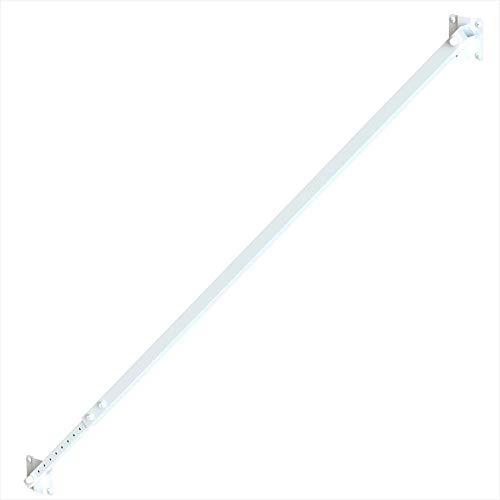
Anti-Sag Gate Brace For Vinyl, Wood and Other Gates Door Telescoping Adjustable
11. Simplified Fence Design
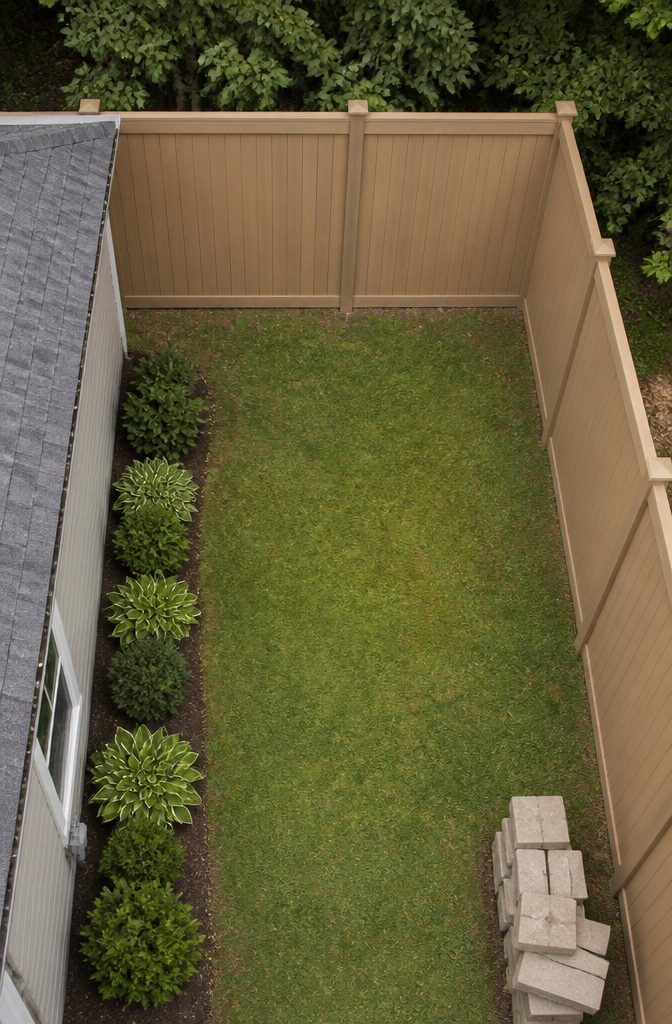
A fence with straight runs, square corners and little ornament costs less, because every angle, stepped section and decorative cut adds material and labor hours. Skip scalloped tops and lattice; a flat top gives the same privacy.
For most small yards, panels beat pickets. Panels cut installation time and make the estimate predictable, since you count sections and posts instead of hundreds of boards.
Pickets allow custom spacing, heights and patterns, but each one must be measured, spaced and fastened, and the extra handling and longer timeline raise the total.
I’d choose pickets only when a specific look matters more than the savings, or when the yard has odd lengths that panels can’t follow.
12. Partial Fencing
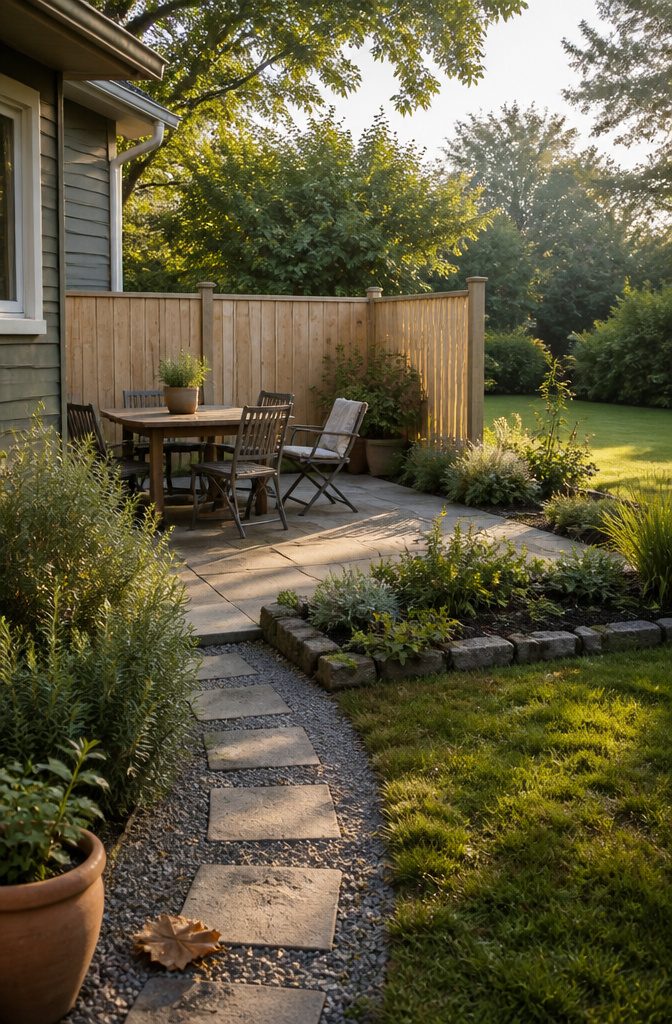
Most yards have one spot where privacy matters: the patio table, the hot tub, the chair where you drink your morning coffee.
Fence that spot and leave the rest open. Every foot you skip is a foot of posts, panels and labor you don’t pay for, so screening only the seating area costs far less than wrapping the whole lot.
Angles help. An L-shaped screen behind the seating, or a diagonal run across a corner, blocks the sightlines a neighbor’s window actually has.
Sit where you’ll sit and have someone walk the property line; wherever they come into view, a panel goes. A freestanding section can also set the seating apart from the garden beds, which zones the yard without a full perimeter.
What Drives Fence Cost
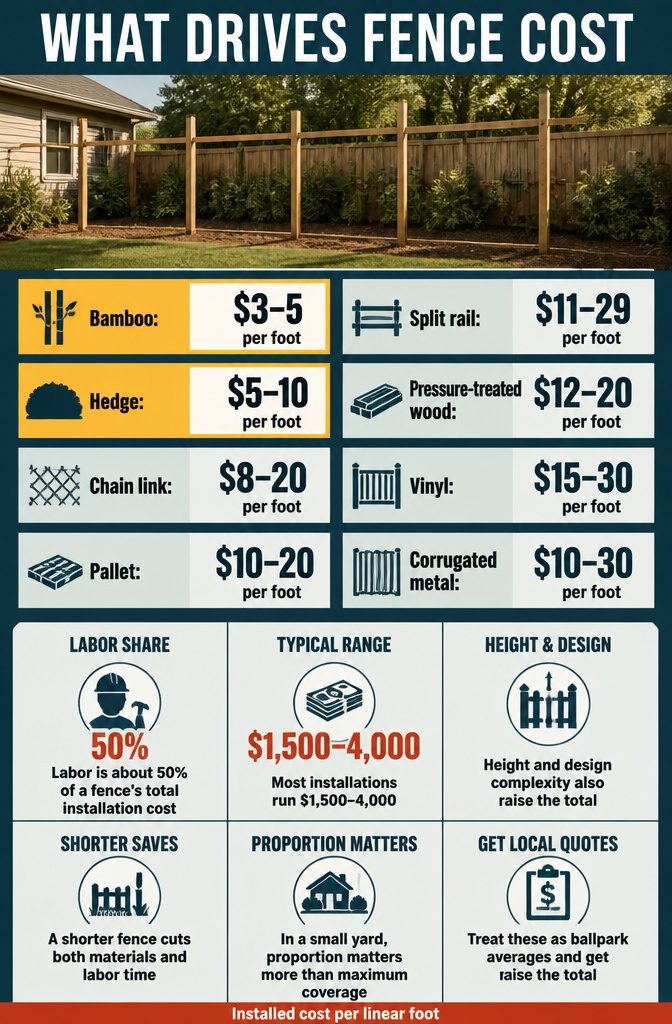
Labor is about 50% of a fence’s total installation cost, and most installations run $1,500–4,000, so a cheap material can still add up. Installed cost per linear foot:
| Fence type | Cost per linear foot |
|---|---|
| Bamboo | $3–5 |
| Hedge | $5–10 |
| Chain link | $8–20 |
| Pallet | $10–20 |
| Corrugated metal | $10–20 |
| Split rail | $11–29 |
| Pressure-treated wood | $12–20 |
| Vinyl | $15–30 |
Bamboo and hedge are the cheapest per foot. Height and design complexity also raise the total.
A shorter fence cuts both materials and labor time, and in a small yard, proportion matters more than maximum coverage. Treat these as ballpark averages and get local quotes.
Privacy and Curb Appeal
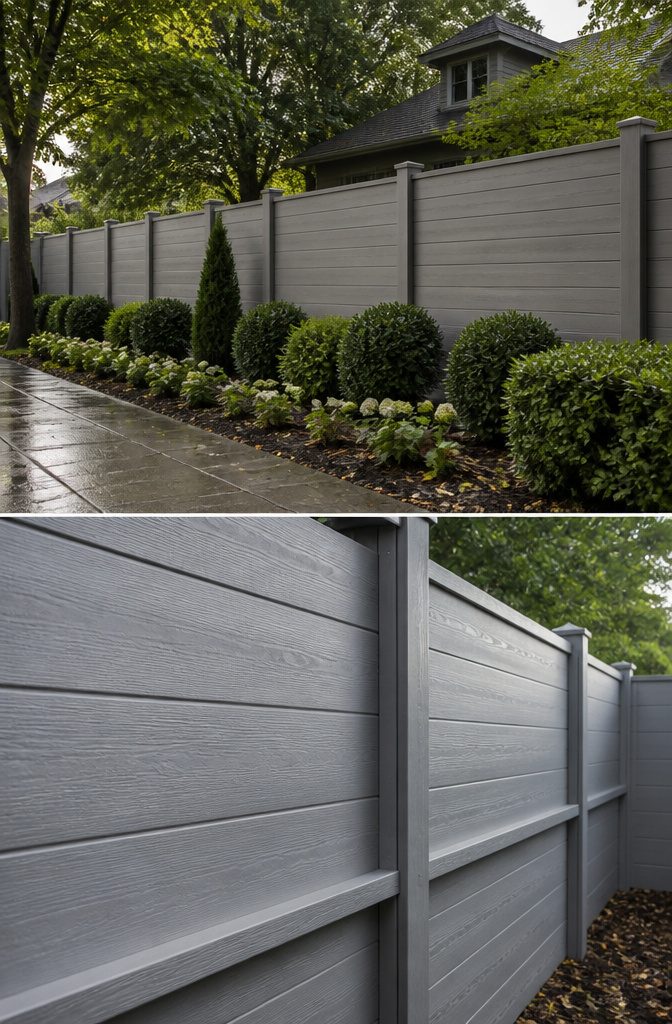
Clean lines, neutral colors and one consistent material do more for curb appeal than any decorative detail.
A fence that suits the house and the plantings looks planned, and buyers tend to notice that from the street before they see anything else.
Upkeep decides how it looks years later.
Living fences need regular pruning and watering, and bamboo holds its color better when sealed. Vinyl, composite and chain link are the low-maintenance options, and I’d pick one of them if weekend chores aren’t your idea of a good time.
A budget fence that is well designed and kept up still adds usability, safety and value. A neglected one undoes all three.
Matching the Fence to Your Yard
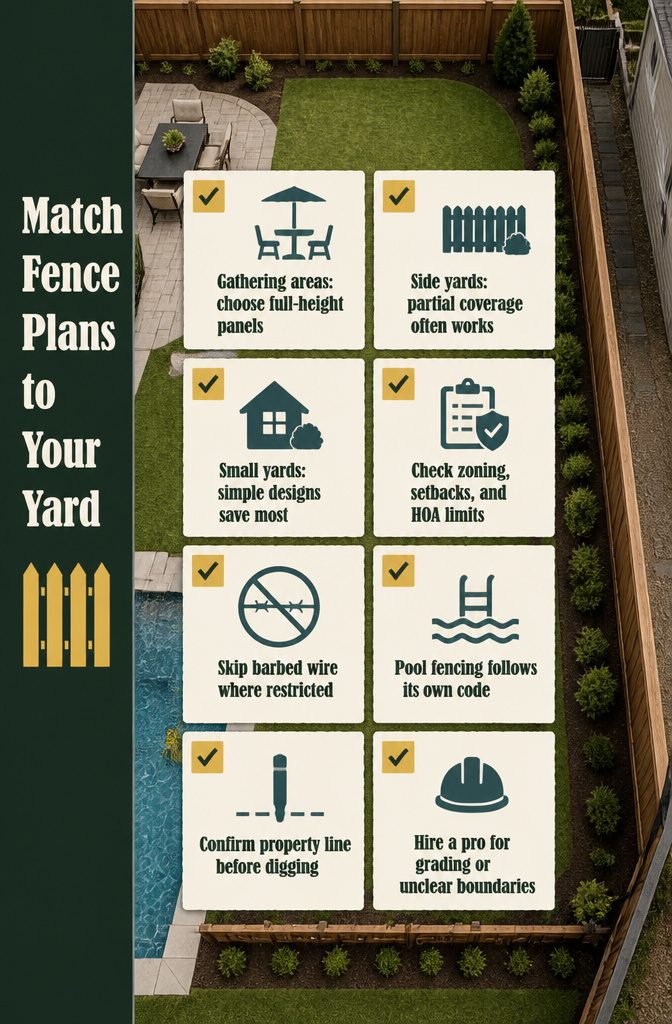
Decide how the space gets used before you price any materials:
- Gathering areas: a patio or seating spot is where full-height privacy panels pay off.
- Side yards: partial coverage is usually enough and costs less.
- Small yards: fewer materials and less labor mean a simple design saves the most.
- Check that local zoning and setback rules allow your height, placement and material, especially near sidewalks and neighbors. HOAs often add their own limits.
- Barbed wire is restricted in some residential areas, so skip it.
- Pool fencing follows its own code.
- Confirm your property line before digging.
DIY saves on labor. I’d still hire a pro where grading is uneven or the boundary is unclear, because mistakes there cost more than the labor you saved.
Frequently Asked Questions
What is the cheapest way to fence a yard on a budget?
Bamboo at $3–5 per linear foot installed and hedges at $5–10 are the cheapest materials per foot.
Fencing only the spot that needs privacy, such as the patio seating area, cuts the bill further because you skip posts, panels and labor everywhere else. Chain link with slats ($8–20 per foot) or with climbing vines is another low-cost route.
How much would 50 feet of privacy fence cost?
Using installed per-foot ranges, 50 feet runs about $150–250 for bamboo, $250–500 for a hedge, $600–1,000 for pressure-treated wood and $750–1,500 for vinyl.
Chain link, pallet and corrugated metal land around $400–1,000. These are ballpark averages, so get local quotes.
What is the lowest-maintenance fence for homeowners?
Vinyl, composite and chain link need the least upkeep.
Vinyl never needs staining, sealing or repainting, and composite resists moisture, insects and warping. Chain link with slats needs little beyond an occasional rinse.
Is it cheaper to use fence panels or pickets?
Panels are usually cheaper.
You count sections and posts instead of hundreds of boards, which shortens installation and makes the estimate easier to predict. Pickets take more measuring, spacing and fastening, so the extra labor raises the total.
Should I hire a fence contractor or build a DIY fence for a small yard?
Build it yourself if the yard is simple and you want to save on labor, which is about 50% of installation cost.
Hire a pro where the ground is uneven or the property line is unclear, because mistakes there cost more than the labor you saved.
How do local building codes affect fence ideas for small yards?
Zoning and setback rules can limit your fence’s height, placement and material, especially near sidewalks and neighbors.
HOAs often add their own limits, and barbed wire is restricted in some residential areas. Check the rules and confirm your property line before you dig.
Can an inexpensive fence still add value to my property?
Yes.
A budget fence that is well designed and kept up improves usability, safety and curb appeal, and those raise a property’s appeal to buyers. A neglected one loses all three.
Does fencing a small yard cost less than fencing a large yard?
Yes.
A small yard needs fewer materials and less labor, and labor is about half of a typical installation bill. A simple design with straight runs and square corners saves the most.









