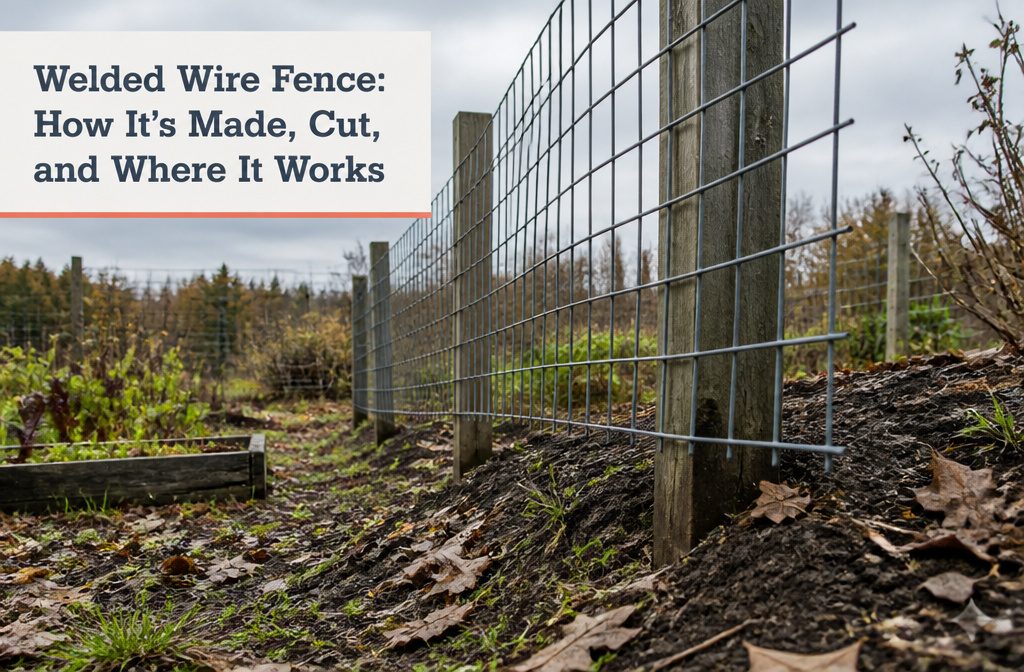
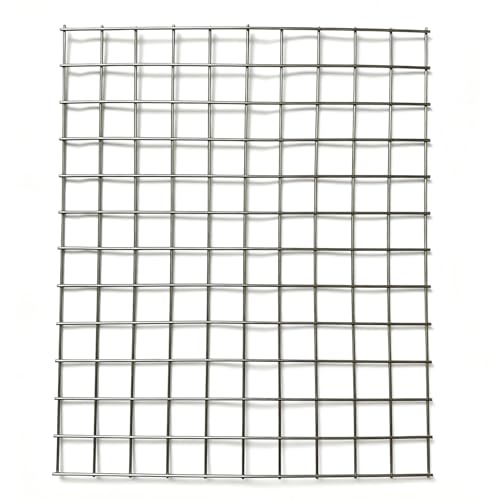
Fence mesh made of straight wires spot-welded at every crossing is flat and stiff, and it can be cut to fit without unraveling.
The rigidity has a cost: a hard hit bends the wires for good, and on a slope the panels leave gaps under the bottom edge. For small snakes, choose ¼ by ¼ inch openings.
How the Mesh Is Made
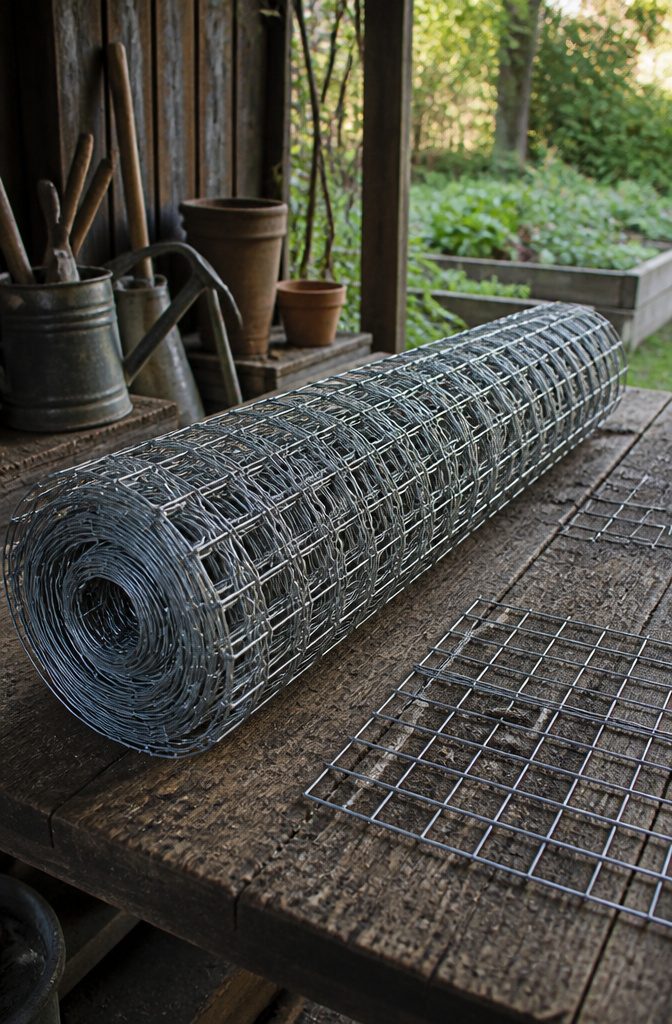
Welded wire is a grid of straight wires with a spot weld fused at every intersection, which makes a stiff, flat sheet that holds its shape.
Woven wire is built the other way: overlapping wires twist into linked zigzag shapes, so the mesh stays loose and flexible.
Woven fencing runs from 9 to 23 gauge, with mesh sizes from ½ inch to 8 inches. Openings stay uniform in shape and size across the whole roll, so the last section you unroll matches the first.
Finishes are the same ones welded wire comes in: galvanized before weld (GBW), galvanized after weld (GAW), or vinyl-coated. Check which one a roll carries before you buy, because the labels look alike on the shelf.
Recommended Products

WELDED WIRE FENCE ROLL FOR ANIMAL ENCLOSURES AND GARDEN PROTECTION – 2 in. x 3 in. mesh welded wire fence roll designed for animal enclosures, rabbit fencing, chicken runs, garden protection, and property boundaries, providing secure containment while maintaining visibility and airflow.

High-Quality Anti-Rust Process This hardware cloth is made from high-strength low-carbon steel wire, combining excellent strength with flexibility. After precision welding, the entire product undergoes a premium anti-rust treatment—hot-dip galvanization—with special reinforcement at all seams and corrosion-prone areas to ensure uniform, dense coating and outstanding rust resistance. This process grants the product superior weather resistance, making it an ideal choice for wire mesh fencing and long-term outdoor applications.
Premium 304 Stainless Steel – Highly durable, rust-resistant, and corrosion-proof, ensuring long-lasting performance in various environments.
How Each Handles Pressure
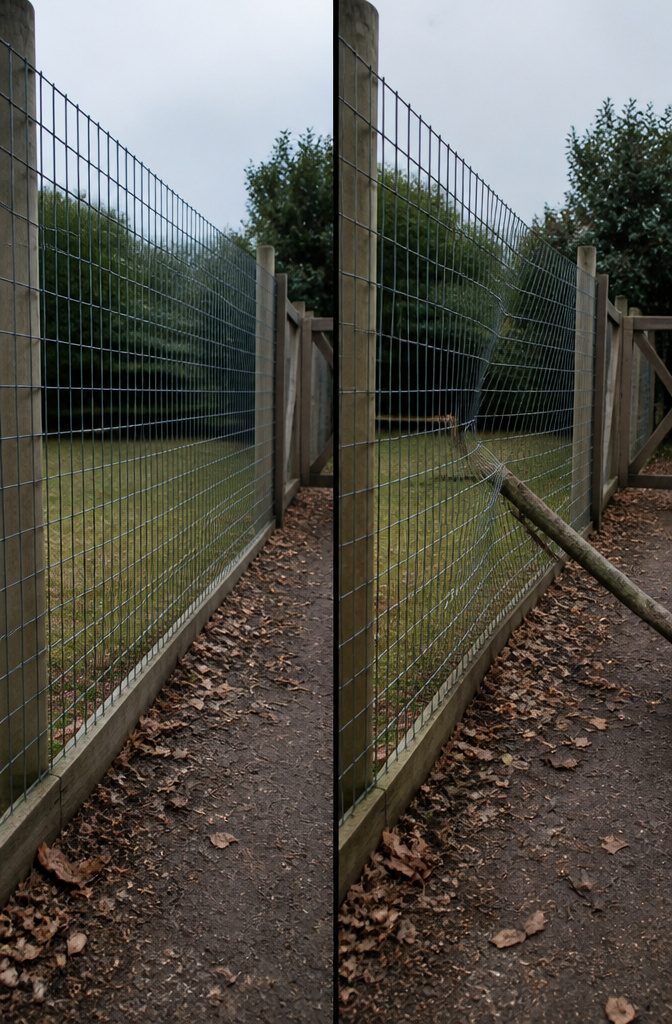
Welded wire holds its shape because every wire crossing is fused, and that same rigidity is its weakness.
A fallen branch, a ladder slipping against it or a dog hitting a panel at speed can bend the wires, and they stay bent. Pushing them back rarely restores a straight line.
Woven wire gives instead. Its strands are twisted or looped around each other, so the mesh stretches under a pull, flexes under a push and can take a lot of pulling and twisting without breaking.
For garden beds, a dog run or any fence where you want a clean, flat line, I’d choose welded wire.
For uneven ground, or anywhere large animals lean and rub, woven wire is the better call. Welded gives a firm line but does not forgive a hard hit.
Recommended Products

Premium Heavy-Duty Construction: Crafted from high-quality low-carbon steel wire with hot-dip galvanized coating applied after welding for maximum durability. Our 1/4" 23-gauge hardware cloth (12" x 35ft roll) offers exceptional strength while remaining flexible enough for easy installation. Resists breaking, bending, and warping for long-lasting performance

High quality raw materials: Our hardware cloth chooses the strength, toughness and ductility of low carbon steel wire as the inner core. This determines the basis of the high quality of our products.23Gauge Galvanized After Welding Wire Metal Mesh Roll Use this to protect vegetables and flower roots, bulbs, rhizomes, etc from tunneling animals. pack:A roll of hardware cloth
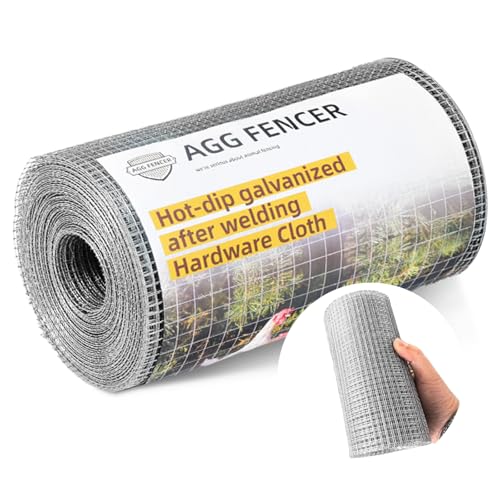
Product details: The length of this hardware cloth is 8 inches/ 20.32cm, the width is 25ft/ 7.62m, and the hole size is 1/4 x 1/4inch. It is very suitable for repairing damaged chicken coops, gaps under houses and other small-sized damaged holes
What Happens When It’s Cut
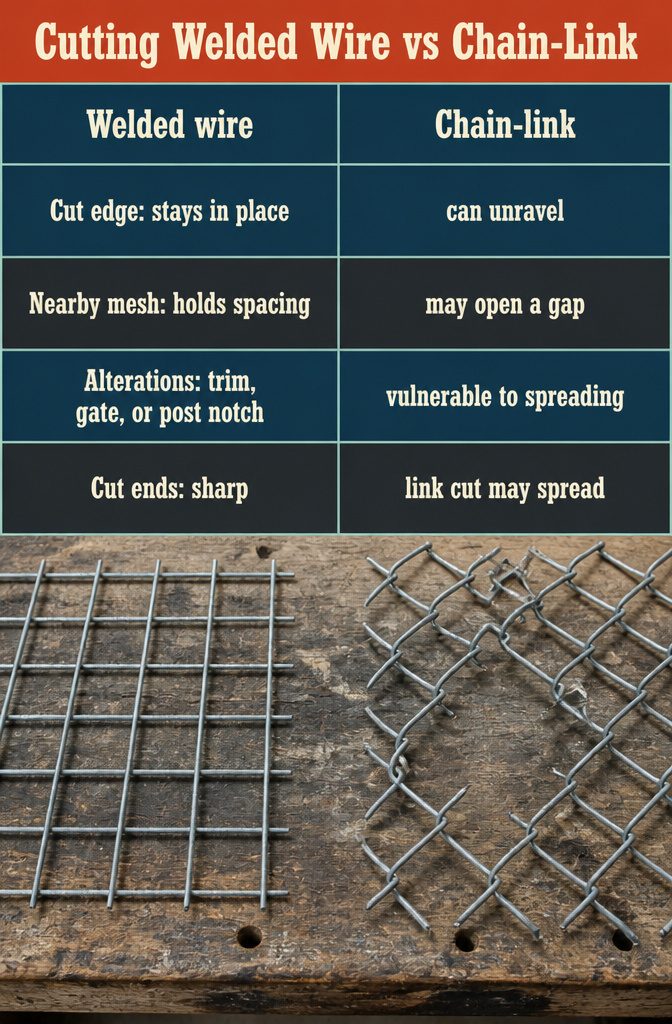
Every wire in welded mesh is fixed to its neighbors at each crossing, so a cut leaves a clean edge that stays where you put it.
You can trim a panel to fit a corner, snip out a gate opening, or notch around a post, and the wires beside the cut hold their spacing.
Cut ends are sharp, so file them down or fold them in where people or pets brush past.
Chain-link is woven, and that changes the outcome.
Once a link is cut, the mesh can untangle and lose its effectiveness, and a small snip can become a larger gap. For a fence you expect to alter or repair, I’d pick welded wire.
Recommended Products

FOREHOGAR welded wire garden fence is made of galvanized wire and then coated with black vinyl. Rustproof and with long service life.

FOREHOGAR welded wire garden fence is made of galvanized wire and then coated with black vinyl. Rustproof and with long service life.

FOREHOGAR welded wire garden fence is made of galvanized wire and then coated with black vinyl. Rustproof and with long service life.
Where Each One Works Best
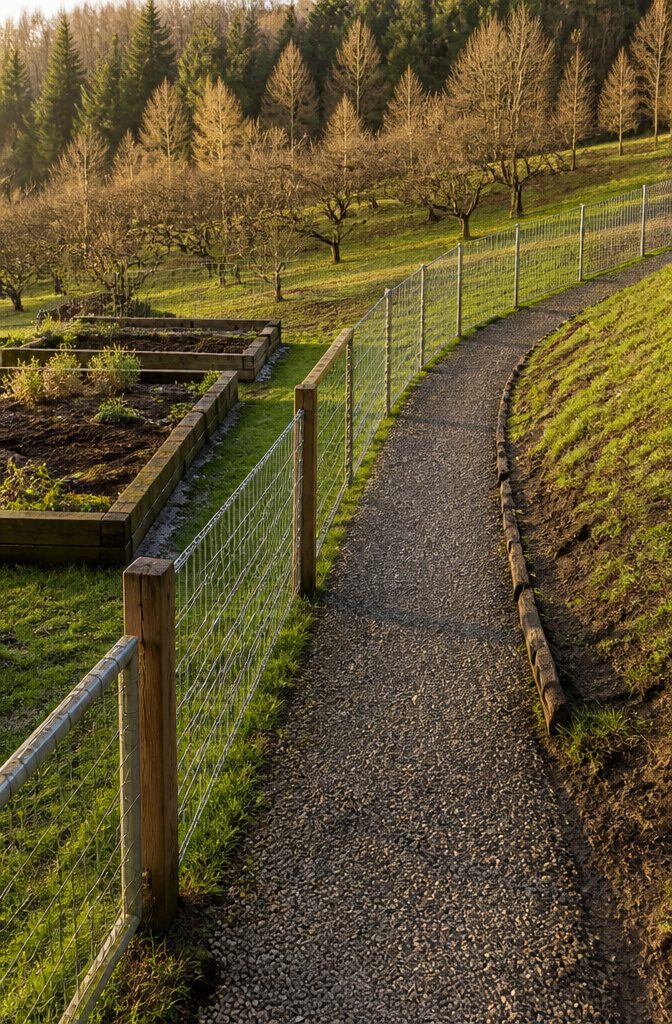
Welded wire makes a firm, definite barrier.
The mesh holds its shape, which suits a small flat yard, a raised bed edge or a dog run. On level ground I would pick it every time.
Slopes change the answer. Woven wire is the type used for grazing livestock, and it is easier to install over uneven ground because it can be racked to follow changes in grade.
Rigid welded wire can’t flex that way, so on a slope it leaves gaps under the bottom edge or has to be stepped down in sections.
Choose welded wire for a flat yard and woven wire for a sloped one. A slight dip can be handled by stepping welded sections, but a steady slope belongs to woven.
Recommended Products
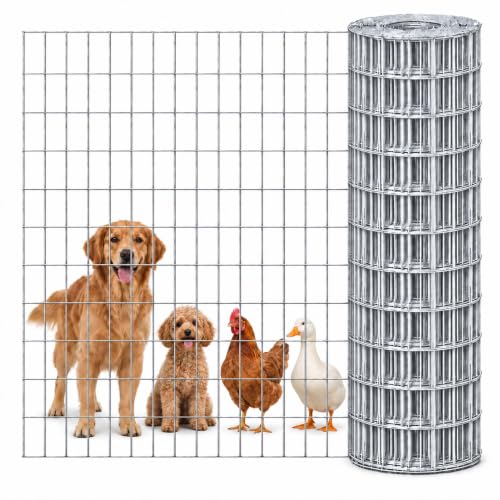
12GA PROJECT-READY GRID: The 12 gauge low carbon steel wires form a substantial mesh for livestock areas, farm dividers and property projects. Welded intersections help the rectangular openings remain aligned while the roll is positioned and fastened.
15GA MESH FOR CUSTOM LAYOUTS: The 15 gauge steel wire offers a practical balance of structure and workability for garden frames, chicken coops, rabbit areas and backyard projects. The roll can be measured and shaped according to the planned layout.

👍【Heavy Duty Steel Frame】 Our outdoor dog kennel weighs 105 pounds. It is made of fully welded, galvanized, PVC coated square steel pipes and wire mesh to prevent rust and corrosion. The pipes are 19 mm on a side and 1 mm thick, and the mesh is 3.3 mm in diameter. Compared to other dog cages, it has a longer service life and is suitable for all kinds of medium and large dogs.
Common Uses for Welded Wire
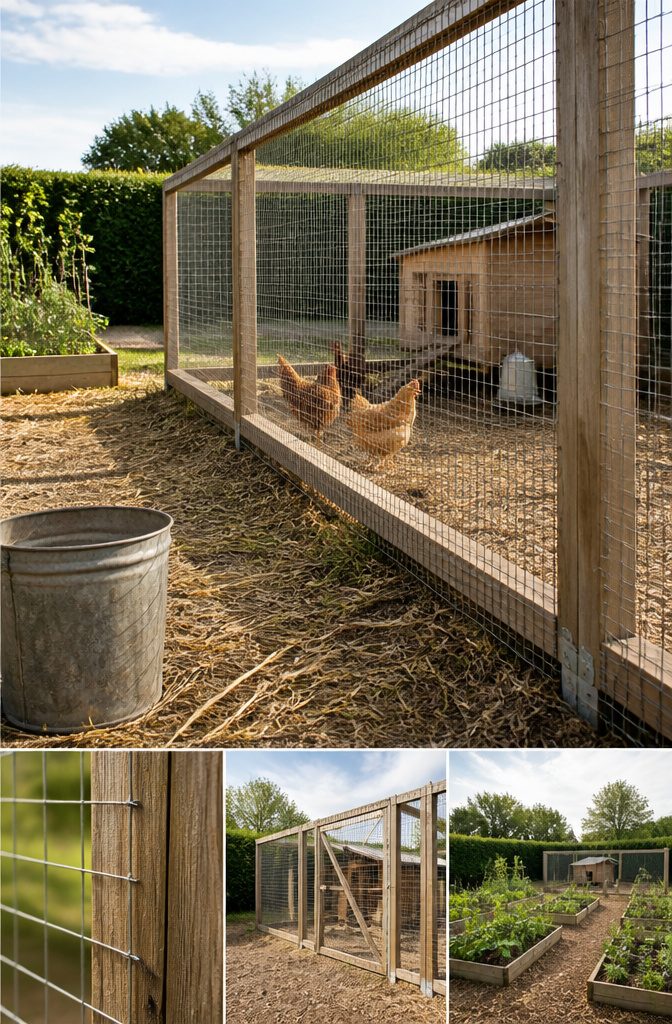
Welded wire does four jobs well: keeping animals out, edging garden beds, blocking the gap under a deck, and enclosing chicken coops. All four need a flat, rigid barrier that is cheap to install, and welded mesh fits that.
The chicken run is the most complete example. A wood-framed version can keep chickens in and a dog out.
Cut 4×4 posts to about 4 feet and space them under 8 feet apart. Set each post on a Simpson Strong-Tie EZ-Spike, one per post, so there is no digging and no concrete.
Cut the wire to size for each section and staple it to the inside of the frame with a narrow crown stapler and 1-1/2 inch galvanized staples.
Recommended Products

# 2'' x 4" Opening Square Mesh Weave; With 2 inch by 4 inch mesh, the welded wire is flexible and tight enough to leave out large ground crawling arachnids

This Multi-Functional Wire Mesh offers a wide range of applications:Animal Protection (poultry fencing/ livestock enclosures),Garden Defense (raised planter boxes/flower and tree enclosures),Building Protection (gutter guards/eaves screening/balcony protection/guardrails for windows),machine protective covers, breeding nets, passage enclosures, as well as decorative purposes.Designed to meet all your diverse needs with superior durability and flexibility.

Sturdy Fencing This fence wire is made of 13 Gauge galvanized steel wire braiding. The steel wire is mechanically pressed into a serpentine shape and then braided. It is beautiful and strong and prevents the wire from shifting
Opening Size for Small Animals
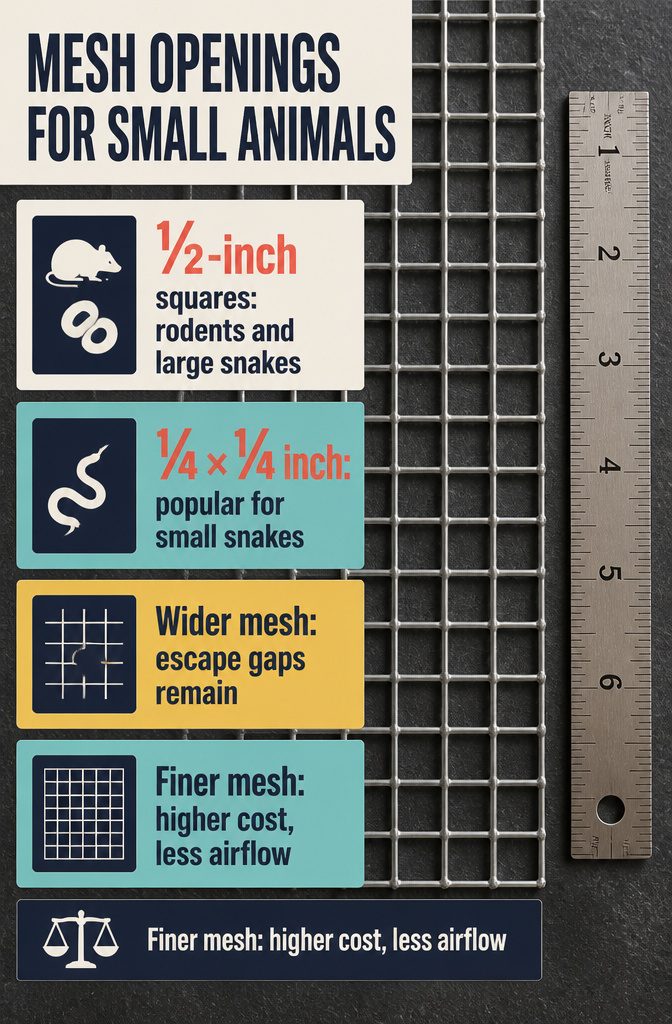
Pick the opening size for the smallest animal you need to stop, not the typical one.
- Square ½-inch openings are a popular choice for keeping out small animals, including rodents and large snakes.
- For complete exclusion of small snakes, ¼ by ¼ inch openings are the most popular size.
- Mesh wider than the size matched to your animal leaves gaps that the animal can use, even if the wire itself is sturdy.
- A tighter opening costs more and blocks more airflow, so don’t go finer than the animal requires.
Recommended Products

【OUTSTANDING RUST RESISTANCE 】 The 2′×50′ hardware cloth is made of No. 16 heavy-duty galvanized steel wire and provides double coating to maximize rust resistance and service life. Vinyl coating provides additional protection. Can be easily cut with scissors. Molded or folded as needed without any problems

Material and size: The size of the hardware cloth is 16 inch×50 ft and 1/2 inch×1/2 inch thickness, adopt 19 guage hot-dipped galvanized material

High-quality and Durable Material: The welded wire garden fence mesh is made of high-quality galvanized steel wire, which is strong and not easy to break, and the black vinyl coating on the surface provides additional protection against rust and corrosion
Coatings and Outdoor Life
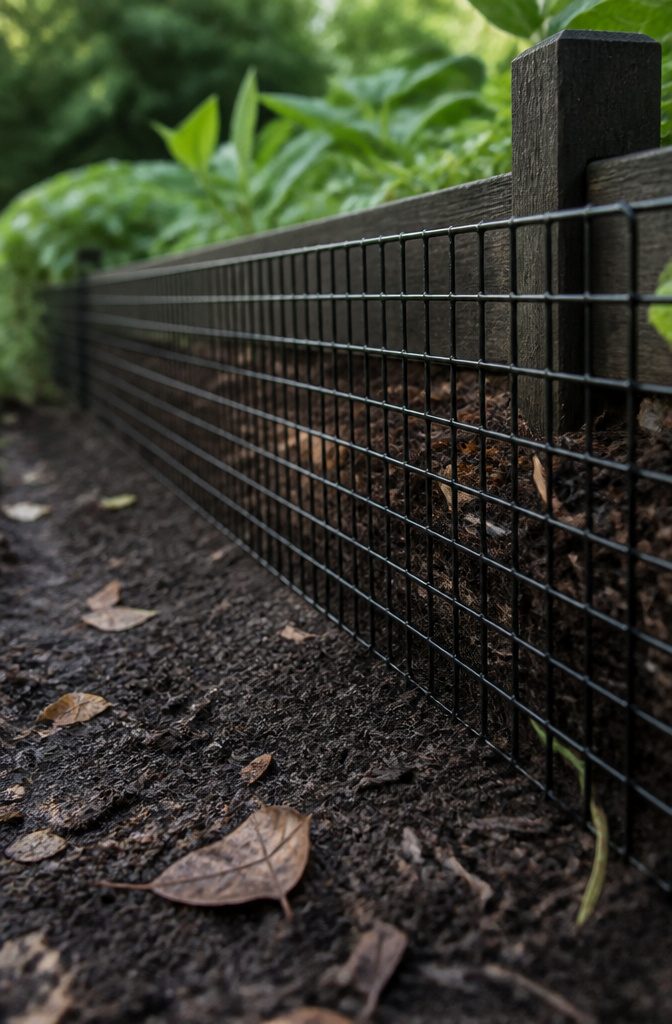
Hot-dip galvanizing after welding is the finish to look for, and it beats the electro-galvanized mesh sold at big box stores.
Critterfence’s black square mesh adds a PVC coat on top. It measures 17 gauge after coating and at least 20.5 gauge before.
It is rated for up to 30 years, approved for salt spray and engineered for soil contact, so you can bury it directly in the ground. That makes it a sound choice for a bottom wire along a garden bed.
Black also helps the look.
The dark coating makes the mesh the least visible from a distance. If you frame it in treated wood, a black solid deck stain protects the lumber and keeps the whole fence reading as one dark line.
Recommended Products

【Heavy-Duty 22-Gauge Black Vinyl-Coated Hardware Cloth (1/4inx24"x100')】 Built tough! 22-gauge galvanized steel with double-layer black vinyl coating resists rust and harsh weather—thicker than standard 23-gauge! Perfect for chicken wire fencing, vinyl fencing, and underground gopher wire mesh—no corrosion, even in wet soil.
Material and size: The size of the hardware cloth is 48inch×100ft square and 1/4inch×1/4inch thickness, adopt 23guage hot-dipped galvanized material
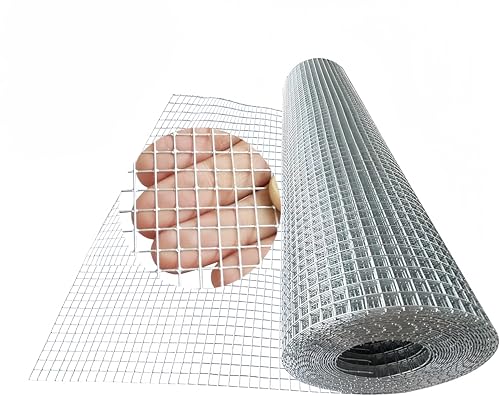
High quality raw materials: Our hardware cloth chooses the strength, toughness and ductility of low carbon steel wire as the inner core. This determines the basis of the high quality of our products.It can be used to make individual baskets or line raised garden beds. pack:A roll of hardware cloth
Frequently Asked Questions
Recommended Products

The Jotesnew welded wire garden fence is made of 16 gauge heavy-duty galvanized steel wire and provides double coating to maximize rust resistance and service life. Vinyl coating provides additional protection.

FOREHOGAR welded wire garden fence is made of galvanized wire and then coated with black vinyl. Rustproof and with long service life.

【High quality raw materials】Our hardware cloth chooses the strength, toughness and ductility of low carbon steel wire as the inner core. This determines the basis of the high quality of our products.
How do you put up a welded wire fence with T-posts?
Set the T-posts, unroll the wire along them, and attach it with T-post clips, bending each clip closed with pliers.
One installer used about 2 clips per post. Join rolls by wrapping the cut wire ends around the end of the existing fence, and wear gloves while doing it.
Measure the run first, because a roll sold as 50 feet can come up shorter, as one 50-foot roll measured 45 feet.
What are the different types of wire fencing?
The two main types are welded wire and woven wire. Welded wire has a spot weld at every crossing, which makes a stiff, flat sheet.
Woven wire twists into linked zigzag shapes, so it flexes, and chain-link is a woven type. Both come galvanized before weld, galvanized after weld, or vinyl-coated.
How long does a welded wire fence last?
It depends on the finish. A mesh that is hot-dip galvanized after welding and PVC-coated, such as Critterfence’s black square mesh, is rated for up to 30 years.
Look for galvanizing after welding rather than the electro-galvanized mesh at big box stores. Lifespan also ends early if a hard hit bends the wires, since they stay bent and the panel may need replacing.