
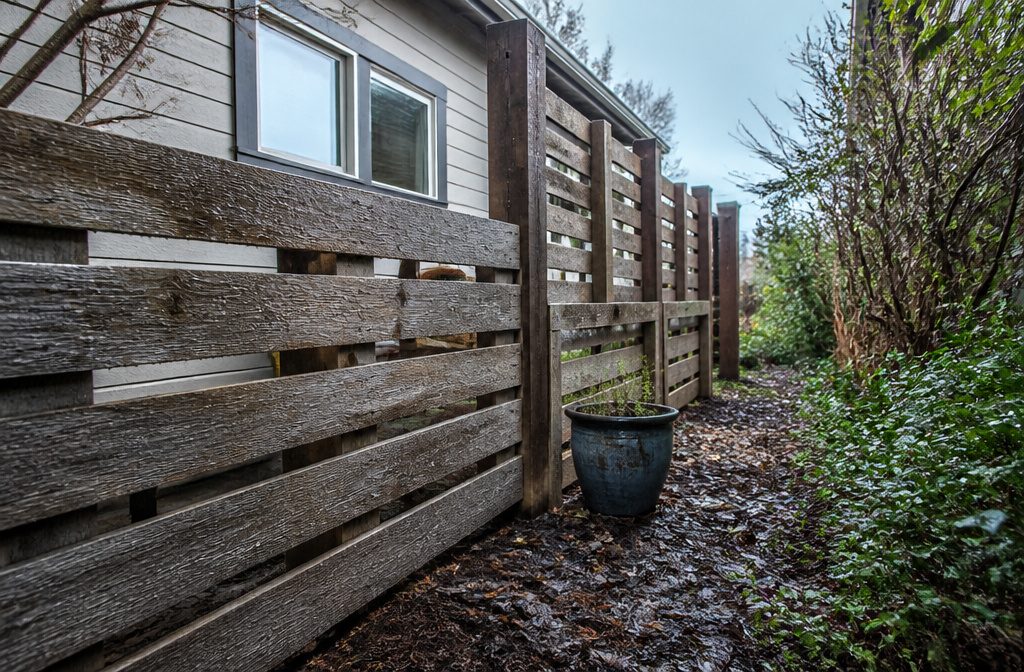
Whole pallets on posts take the least work and plank walls built board by board take the most, but height decides which you need.
Most pallets are too short to block a neighbor’s view, and stacking only holds with posts buried one-third deep: a 9-foot post gets a 3-foot hole.
1. Privacy Wall With Planters
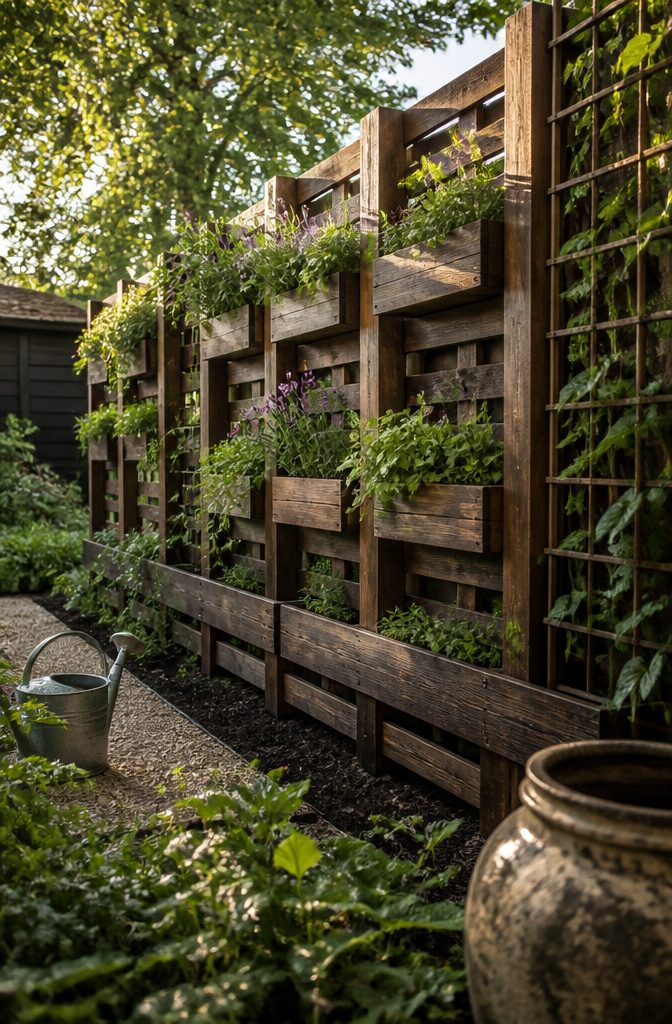
A privacy wall with planters starts with a base row of sturdy pallets anchored in the ground.
More pallets go up vertically on top of that base, with gaps left open for planter boxes. Herbs or flowers fill those gaps and add color and scent.
A trellis fixed to one side gives climbing plants something to grab. Seal the finished wall with a weather-resistant coating, since it stands outdoors and holds wet soil.
I rate this version as partial privacy.
Every planter opening is a gap in the screen until the plants fill in, so it screens best once the planters and climbers have grown in. Along the sightline you care about most, I’d skip the openings.
2. Vertical Garden Fence
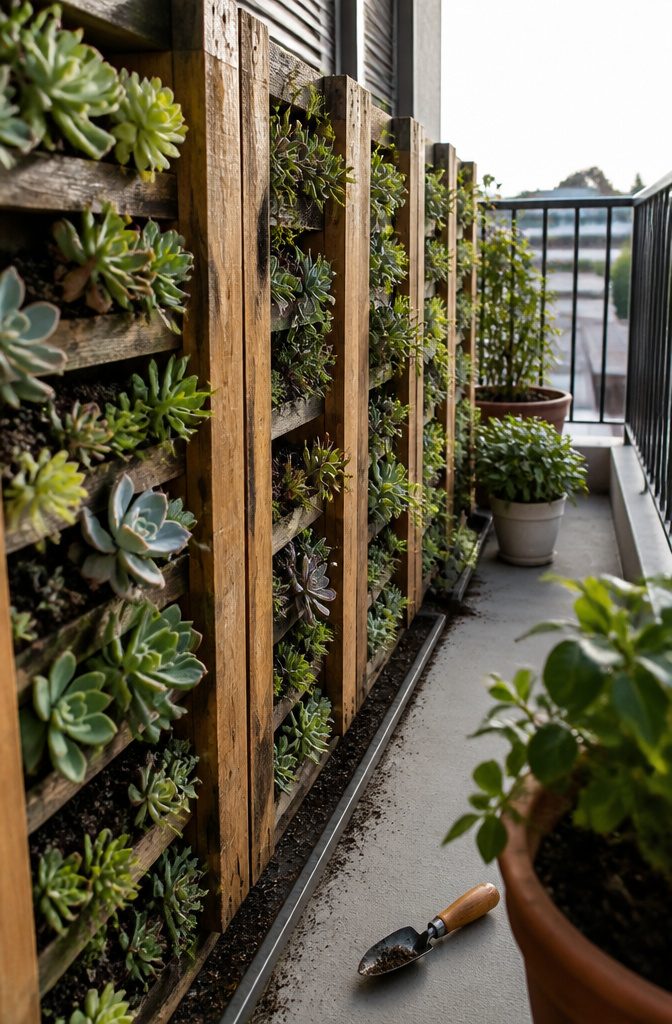
Stand the pallets upright and attach them with about 6 inches of space between each one. Line the insides with landscape fabric first, so potting mix can’t spill out through the slats.
Then pack potting mix into the gaps between slats and tuck in succulents. Pick hardy varieties that can handle outdoor conditions, and water them regularly.
I’d choose this version for a small yard or balcony, since it grows upward and uses almost no floor space.
On a balcony, wet potting mix is heavy, so check what your floor or railing can carry before filling every gap.
3. Planted Fence With Lights
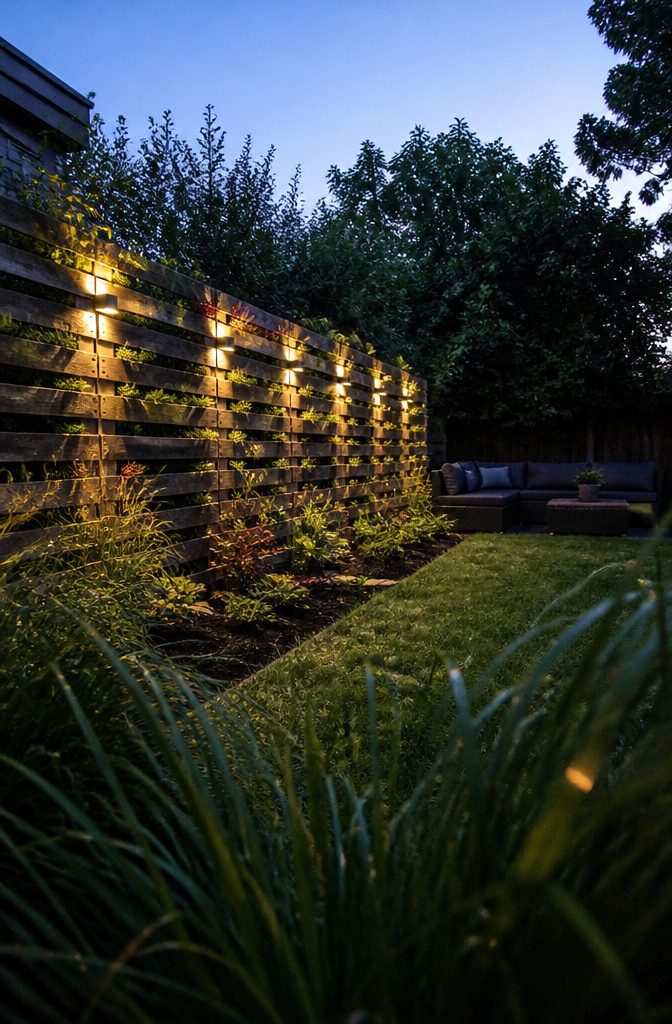
Fescue, bluegrass and sedum all grow in the gaps between pallet slats, so pick the one that suits your climate and soil type.
Sedum is the one I’d choose if you want color, while the two grasses give a softer green backdrop. Tuck the plants into the openings and let them fill in along the fence.
Outdoor-rated LED lights mounted on the slats light both the wood and the plants after dark. Solar-powered ones are the eco-conscious choice, and they skip the need for an outlet nearby.
Upkeep is light. Water regularly, especially in warmer months, and prune now and then so the fence stays tidy.
4. Painted and Stained Fence
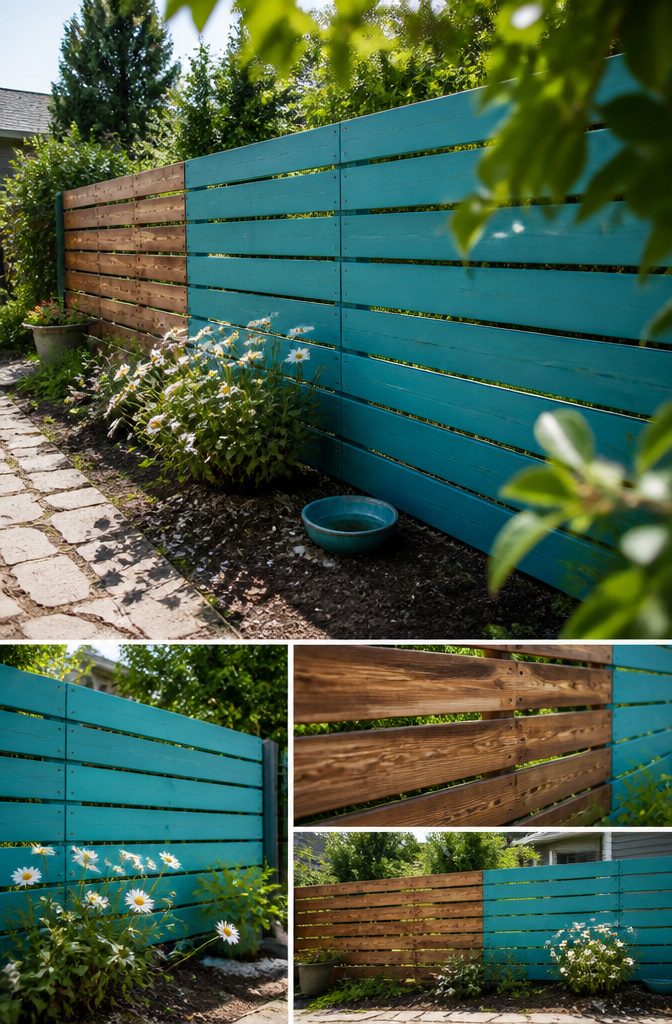
Sand off rough edges and clean each pallet thoroughly before any color goes on. Paint and stain only look even on a smooth, clean board, and a fence in sun and rain needs a weather-resistant product to last.
Bold color works well on pallets. Turquoise or yellow looks playful, black makes sunflowers or other plantings stand out, and red along a driveway reads fresh and modern.
White suits fences around flower beds. For an ombré, step through shades of one color from panel to panel, or stencil a pattern onto the boards.
For a rustic look, I’d choose stain over paint. Stain lets the grain and the uneven character of reclaimed boards show, while paint covers them.
5. Rustic Plank Fence
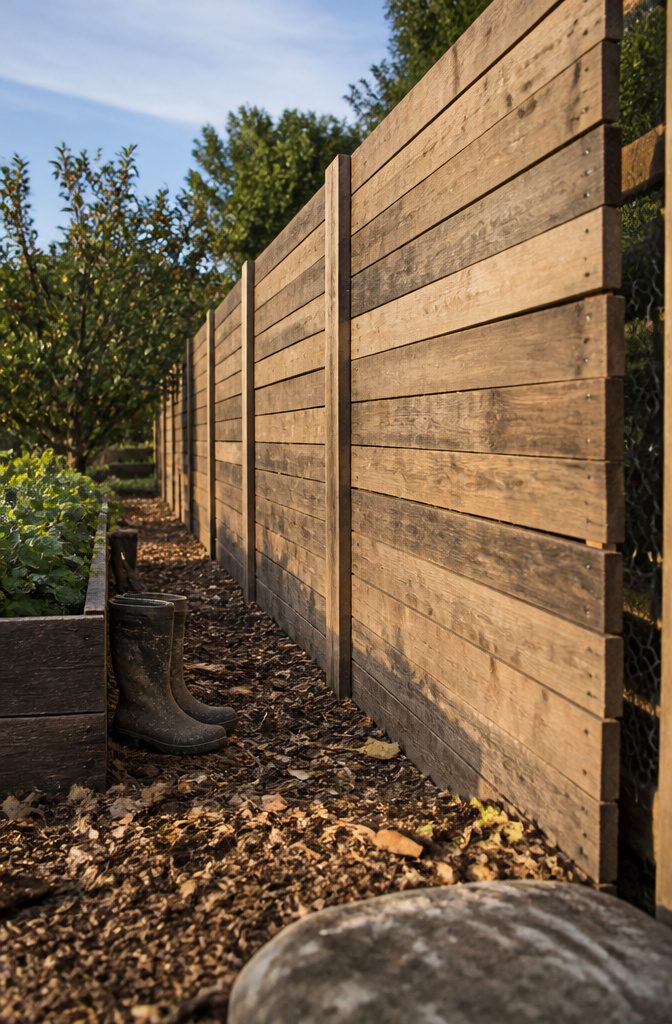
Taking pallets apart gives you a continuous plank wall instead of a row of stacked pallets.
Pull the planks off the support beams, then cut the beams to equal lengths to serve as posts. Set them in holes, check each with a level, backfill and tamp the dirt.
Nail the planks onto the beams to form a solid panel, trimming boards where they need to fit. Add a layer of chicken wire or mesh to the inside of each panel for stability.
The cost is labor.
Prying apart every pallet, cutting, and nailing board by board takes far longer than fastening whole pallets in place, so I’d pick this style only if you want the solid, rustic look. Leave the wood natural or paint it.
6. Garden Fence
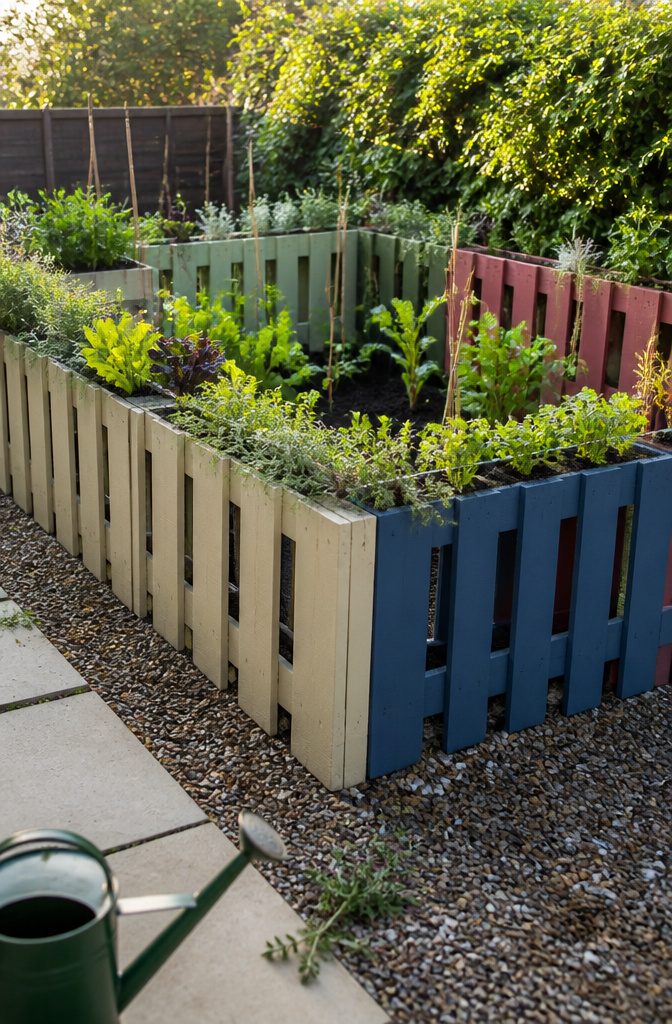
Young seedlings are the most exposed plants in a garden, because critters can trample or eat them before they get established.
A pallet fence around the vegetable bed is a low-cost barrier for that stage, and it keeps the cost of protecting a small plot down.
Pallets also work inside the garden.
Stand them up to enclose sections of raised beds and paint each section a contrasting color. The result marks out the layout and looks deliberate.
My favorite version adds planting space on top of the pallets, so the fence itself grows food. In a small yard with little ground, that is an extra row of herbs or greens.
7. Chicken Yard
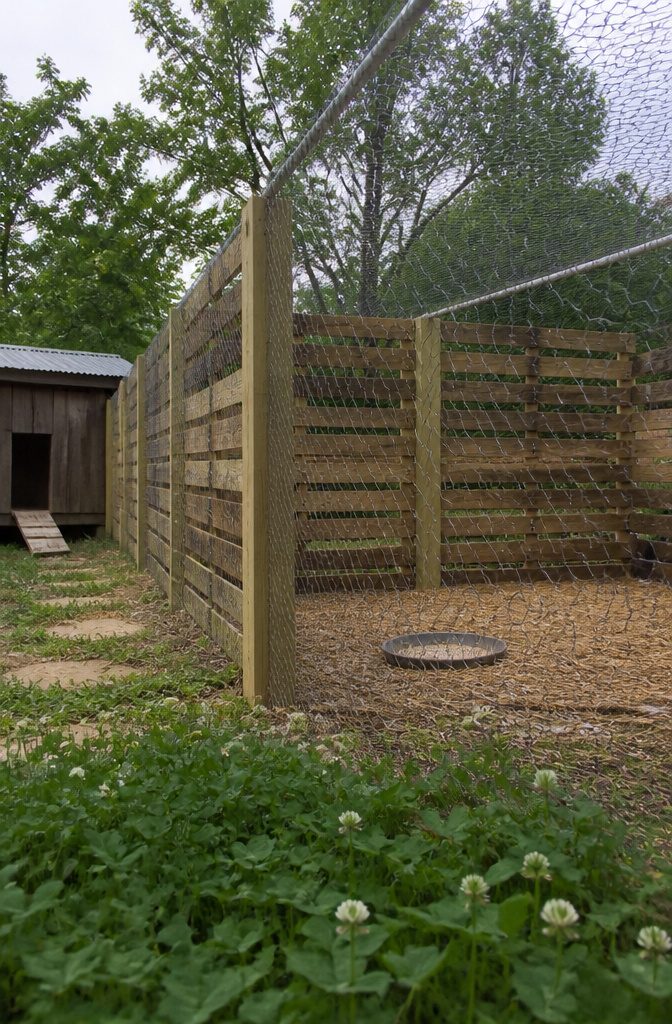
Pallets suit a chicken run because each one is a ready-made panel, and 4×4 posts set between them hold the line steady.
The slat gaps are the weak spot. Small animals can slip through, so staple chicken wire across the slats on the inside face.
Height is the other problem. Many breeds can fly over a fence this tall, so cover the top of the run with chicken wire or netting if you want the flock fully contained.
Wire on the sides and netting overhead makes a cheap, workable combination, and I’d choose it over stacking extra pallets to raise the walls.
8. Compost Bins
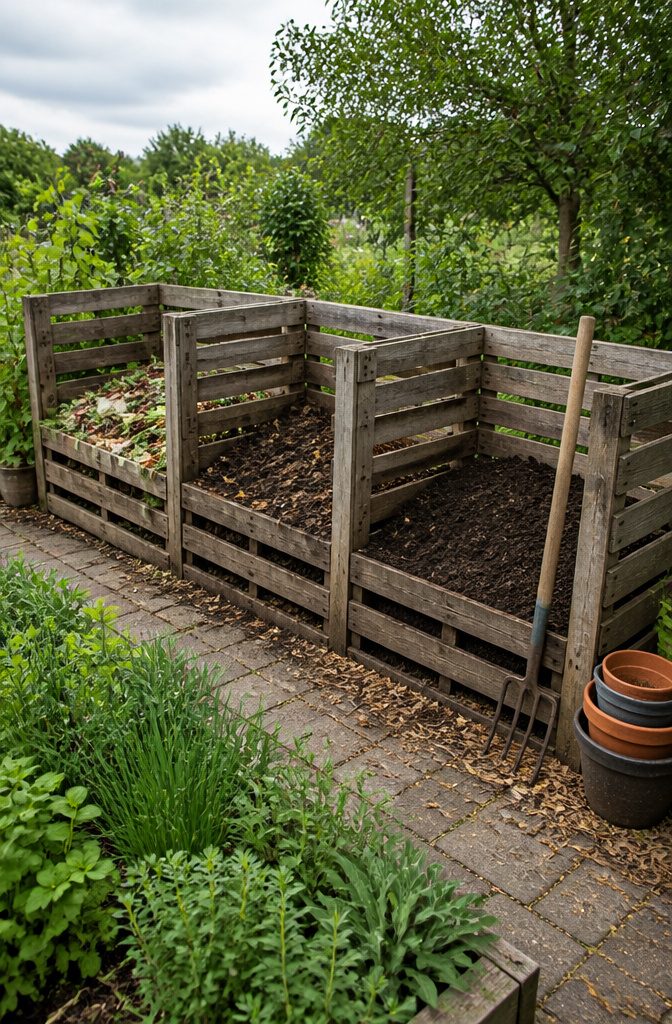
Compost is one of the easiest jobs for a pallet, because the gaps between the slats let air move through the pile while the walls hold it in place.
Joe Gardener’s 3-bin system shows the layout well. Build three bins side by side, so each one holds compost at a different stage.
Fresh scraps and yard waste go in the first, a pile that has started breaking down moves to the second, and the third holds finished compost ready for your beds.
The slatted walls also keep dogs and small children away from the pile. Pallets are about as cheap as bin material gets, which matters when your yard budget is a few hundred dollars a year.
Pallet Height Limits
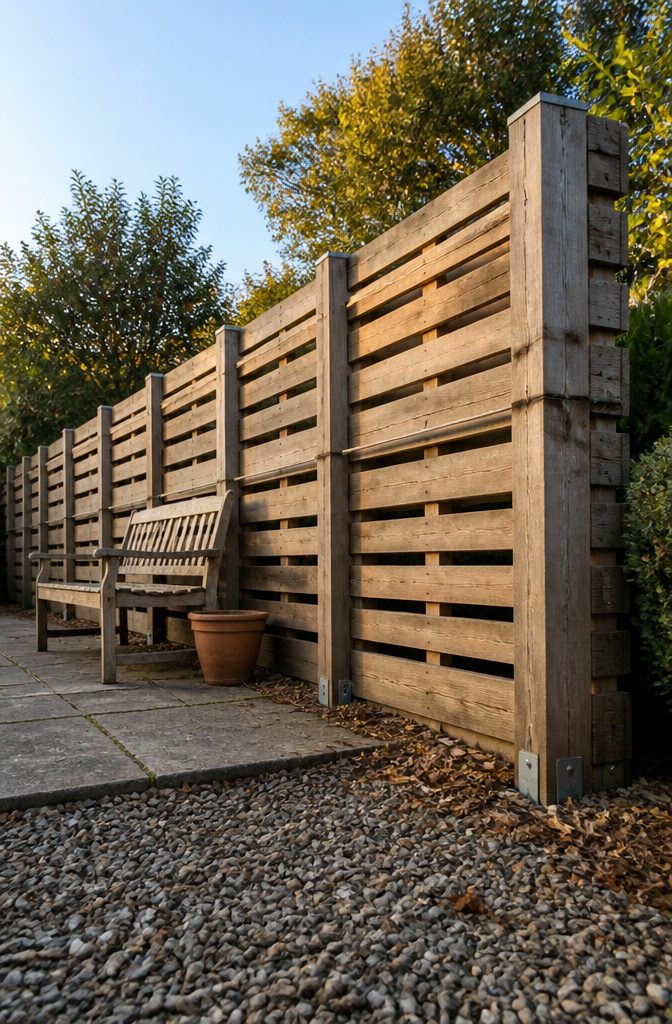
Most pallets are too short to block a neighbor’s view on their own, so a single row of upright pallets works as a screen for seating areas more than as true privacy.
Stacking one pallet on another adds height, and creative stacking with good support can make a taller fence possible.
The support is what matters. Stacked pallets need posts or a frame set firmly in the ground, because two pallets resting on each other will lean and shift in wind.
Fasten each layer to the posts and to the pallet below it, and start with a level bottom row, since any tilt grows with every layer you add. I would skip freestanding stacks entirely.
Choosing Safe, Cheap Pallets
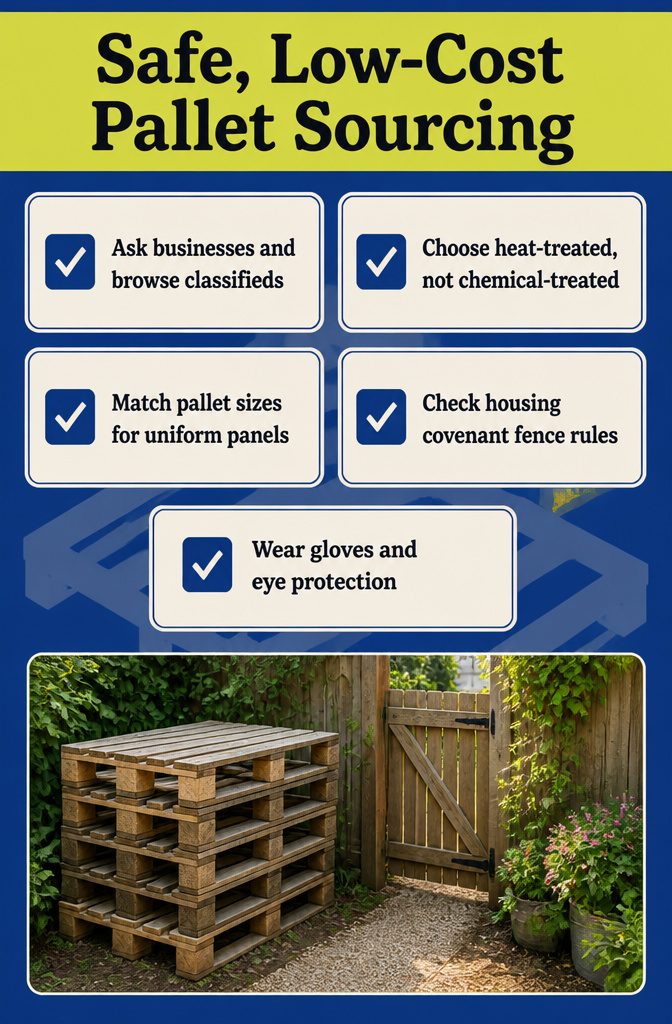
Pallets cost little or nothing, but a few checks belong before you load the truck:
- Ask nearby businesses and browse local classifieds or Facebook Marketplace. Owners are often glad to be rid of unused pallets, and reusing them keeps the wood out of a dump.
- Choose heat-treated pallets, not chemically treated ones. Some pallets are treated with harsh chemicals against pests, and you don’t want those near a garden.
- Collect pallets that are all the same size so the panels line up into a uniform fence.
- Read your housing covenant first. Some allow only specific fence types, and pallets may not qualify.
- Wear gloves and eye protection whenever you haul or take pallets apart.
Posts, Hardware and Upkeep
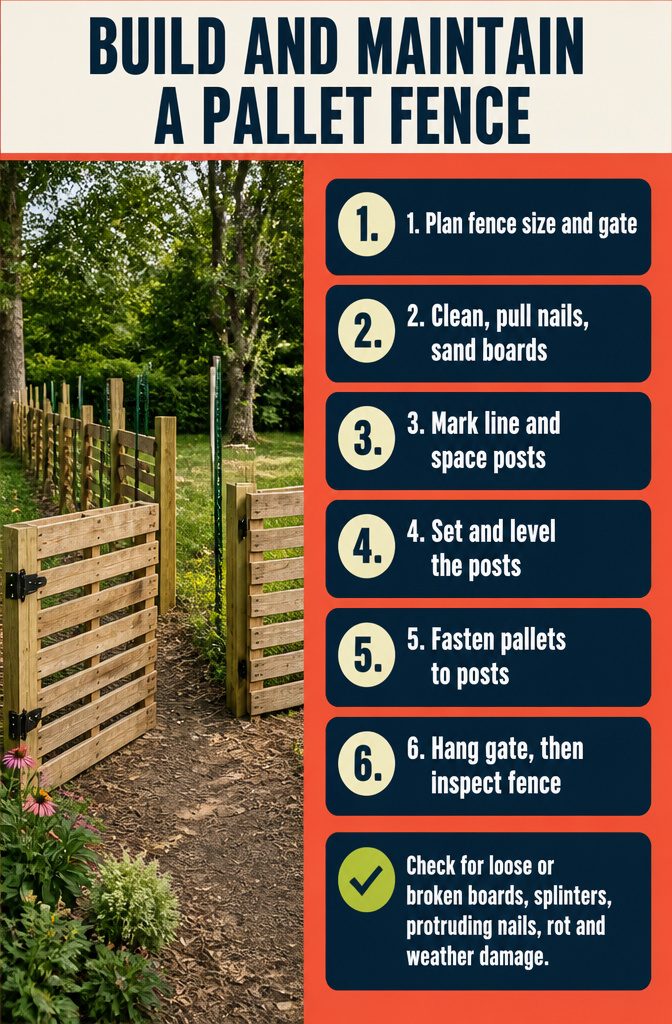
- Decide the fence’s height, length and gate location. Use pallets that are all the same size so the fence stays uniform and stable.
- Clean the pallets, pull any protruding nails, and sand rough boards to prevent splinters.
- Mark the line with a tape measure and string. Space posts one pallet width apart, with a post on each side of the gate.
- Set 4×4 wood posts in concrete mixed per the bag, burying one-third of each post (a 9-foot post gets a 3-foot hole). Check each with a level. Drive metal T-posts until only the T shows.
- Fasten pallets to wood posts with outdoor-grade screws or nails at least 2.5 inches long. On T-posts, use fence clips.
- Butt each pallet tightly against its neighbor and fasten it to the post.
- Hang the gate with hinges and a latch.
- Paint if you like.
- Check for loose or broken boards, splinters, protruding nails, rot and weather damage.
Frequently Asked Questions
Do pallet privacy fences give full privacy?
Usually not on their own. Most pallets are too short to block a neighbor’s view, so a single row works better for screening a seating area.
Planter openings also leave gaps until the plants grow in, so skip them along the sightline you most want covered.
How do you make a pallet privacy fence taller?
Stack one pallet on top of another, but only with posts or a frame set firmly in the ground.
Fasten each layer to the posts and to the pallet below it. Start with a level bottom row, because any tilt grows with every layer, and avoid freestanding stacks, which lean and shift in wind.
How deep should the posts be for a pallet fence?
Bury one-third of each 4×4 post, so a 9-foot post goes into a 3-foot hole.
Set it in concrete mixed per the bag directions and check it with a level. Metal T-posts are driven in until only the T shows.
What screws or nails should I use to attach pallets to posts?
Use outdoor-grade screws or nails at least 2.5 inches long for wood posts.
For T-posts, fence clips hold the pallets in place. Butt each pallet tightly against its neighbor before fastening it.
Which pallets are safe to use for a fence near a garden?
Pick heat-treated pallets over chemically treated ones.
Some pallets get harsh chemicals against pests, and you don’t want those near plants. Matching pallet sizes also keeps the panels lined up evenly.
Where can I get free pallets for a fence?
Ask nearby businesses and check local classifieds or Facebook Marketplace.
Owners are often glad to get rid of unused pallets. Wear gloves and eye protection when you haul or take them apart.
Do I need permission before building a pallet fence?
Read your housing covenant first if you live in a community with one. Some covenants allow only specific fence types, and pallets may not qualify.
Can a pallet fence keep chickens in?
Yes, with additions.
Staple chicken wire across the slats on the inside face so small animals can’t slip through. Many breeds can fly over a fence this tall, so cover the top of the run with chicken wire or netting.









